

Web Content Viewer
Actions
buscador
Actions
Web Content Viewer
Actions
Contextual and Physical Security Events
Sep 18, 2026
Ecopetrol operates in regions with complex social realities and public order challenges, including illegality, migration, homicides, kidnappings, extortion, and the presence of illegal armed groups. These conditions pose risks to people, the security of the oil infrastructure (a national strategic asset), and the continuity of operations. The Company continuously monitors the area and its broader context by identifying, assessing, and following up on relevant developments, thereby enabling it to anticipate potential issues and take preventive measures to support strategic decision-making. This analysis includes examining the causes, interactions, conditions, and dynamics present in the territory.
Alerts and incidents assessment
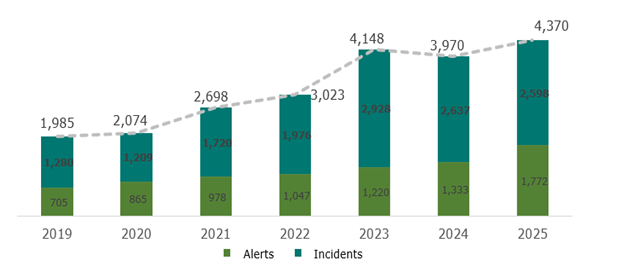
In 2025, the number of reported events increased by 9.8% compared with the previous year, with 4,370 context and physical security events reported, including 1,772 alerts and 2,598 incidents. Of the incidents, 1,750 (67.4%) were related to contextual conditions, while 848 (32.6%) involved physical security.
The number of context-related alerts increased by 44.6%, from 955 in 2024 to 1,381 in 2025. Notably, the non-materialization rate has remained stable at approximately 80% since 2023 (80.9% in 2023, 79.0% in 2024, and 80.8% in 2025), meaning that, on average, 80.8 out of every 100 detected alerts do not subsequently develop into context-related incidents. This suggests improvements both in timely detection and reporting and in the Company’s preventive and response capabilities. The average duration of incidents has decreased by 33.7% since 2023, from 1.78 days to 1.18 days, reflecting a more timely incident response.
Figure 1
Comparative Number of Environment and Physical Security Alerts and Incidents, 2019 –2025
Main types of incidents
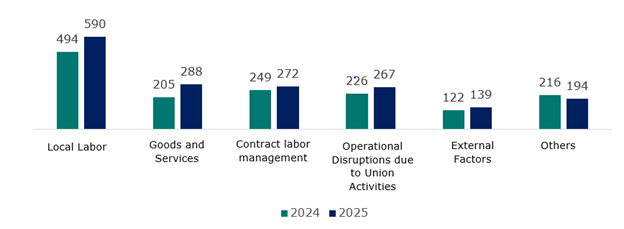
Regarding context-related incidents, in 2025, Local Labor remained the primary source of conflict in the territories, accounting for 33.7% of total incidents and representing a 19.4% increase compared with the previous year. These incidents were mainly driven by demands for hiring opportunities or the opening of vacancies not required for activities already underway. In addition, dissatisfaction with selection processes and pressure to hire specific individuals were identified as significant contributing factors.
The second most significant category was Goods and Services, which accounted for 16.5% of total incidents and increased by 40.5% compared with 2024. These incidents were primarily related to demands for the procurement of local goods and services by Ecopetrol or contractor companies, representing 97.6% of the cases. To a lesser extent, incidents were associated with dissatisfaction regarding Ecopetrol’s selection processes for the procurement of goods and services, as well as demands to participate as suppliers to Ecopetrol and/or its business partners, accounting for 2.1% and 0.4% of cases, respectively.
The third most significant category was Labor Contract Management, which represented 15.5% of total incidents and increased by 9.2% compared with 2024. These incidents included disagreements related to the termination or suspension of contracts, accounting for 34.5% of cases, followed by alleged non-compliance with payment obligations (30.5%) and demands for salary adjustments or job reclassification (9.6%).
Figure 2
Number of Context-Related Incidents, 2024 vs 2025
Main efforts undertaken
The Corporate Vice Presidency of Territorial Transformation and HSE emphasizes a proactive approach to conflict resolution within territories. It has implemented activities to build stronger community relationships through honest, transparent dialogue and to enhance local conflict transformation skills. These initiatives are structured around three primary areas:
- Strengthening social dialogue: Opening spaces for dialogue with communities and key actors to anticipate conflicts and build agreements that reduce the risk of interruptions to operations.
- Training in conflict management: Developing training programs aimed at improving skills in mediation, negotiation, and peaceful resolution of conflict, encouraging the participation of social leaders and local authorities.
- Territorial relationship initiatives: Encouraging actions that promote trust and collaboration between the Company and the communities, through mechanisms of participation and joint construction of development agendas.
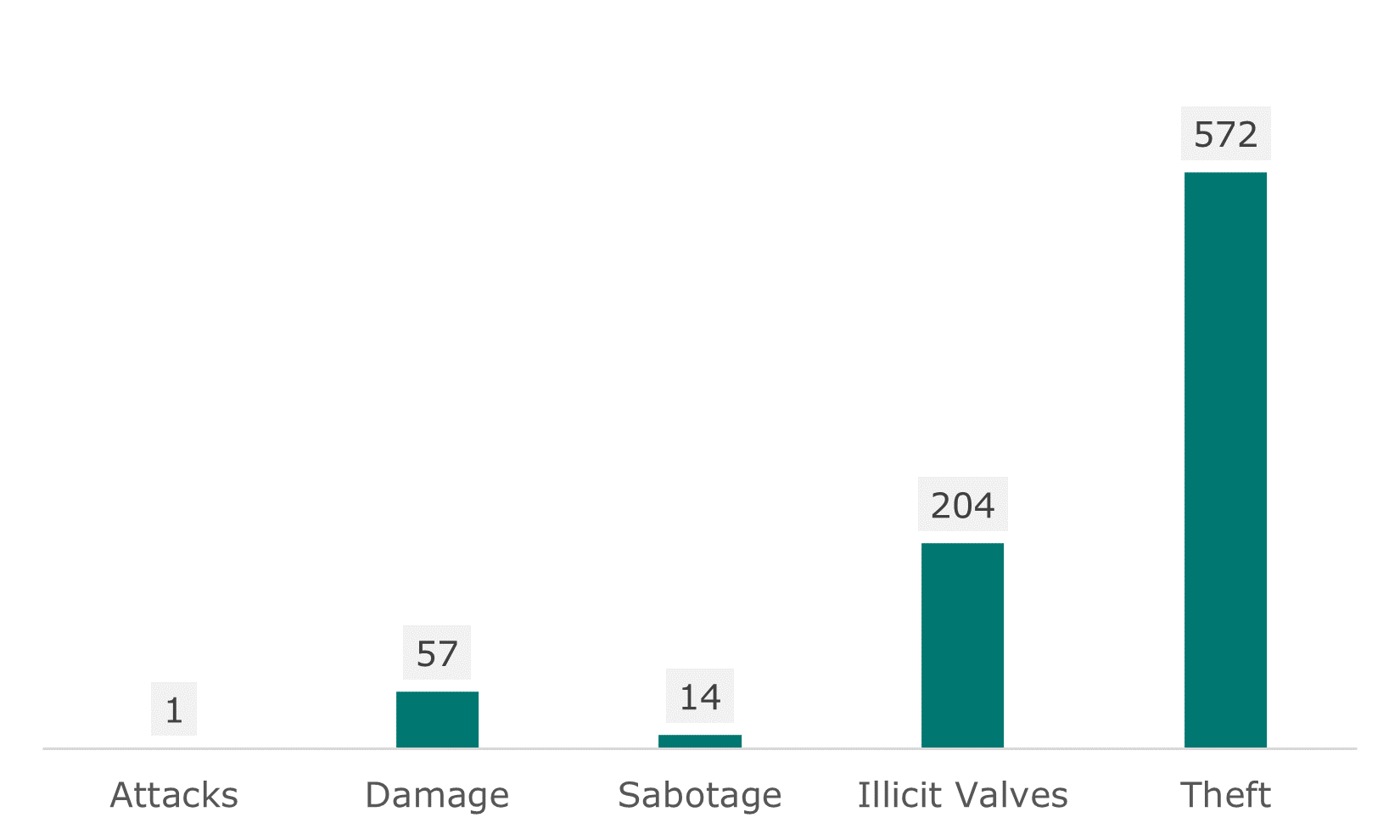
It is important to note that physical security incidents involving theft, sabotage, damage, attacks, and illegal valves occurred.
Figure 3
Number of Physical Security Incidents, 2025
Regarding events associated with physical security that also result in deferred production, the Company activates plans in coordination with State entities to ensure timely action in response to such events and thus minimize impacts.
Attacks on infrastructure
In 2025, there was one (1) attack on Ecopetrol’s infrastructure in the municipality of El Centro, Department of Santander, targeting the Lufkin Mark II mechanical pumping unit of the Cira 1775 well, allegedly perpetrated by unlawful armed groups.
In response, Ecopetrol immediately implemented contingency plans to prevent potential impacts on people and reduce the spill's effects on ecosystems. Additionally, there is ongoing coordination with law enforcement to provide oversight of hydrocarbon transport lines and prevent such events, in tandem with the Attorney General’s Office, to prosecute criminal organizations involved in these criminal actions.
Web Content Viewer
Actions

