Web Content Viewer
Actions
buscador
Actions
Value Chain
Actions
Value Chain
Apr 21, 2026
Suppliers and contractors are the intended recipients of the Human Rights and Business Guide. They are required to observe and implement this commitment in order to foster a human rights-respecting management approach and comply with the provisions of the Code of Ethics and Conduct for suppliers, contractors, subcontractors, and partners.
Human Rights and Diversity, Equity and Inclusion Contractual Annex update
In 2023, the Company approved the contractual annex of Human Rights and Diversity, Equity and Inclusion (DEI),that seeks to ensure that suppliers and contractors:
- Formulate their public commitments to action and management in human rights and DEI.
- Strengthen mechanisms for the prevention and care of the effects of these issues.
- Perform due diligence exercises.
- Reject and have zero tolerance for situations of violence, harassment or discrimination.
- Respect the work of human rights defenders and environmental and social leaders.
Our commitment to the supply chain
Performance evaluation
Ecopetrol has established a methodology and criteria to evaluate its suppliers performance, in order to ensure contractual relationships with the best contractors of goods and services, and to meet the objectives of the hiring. Likewise, the performance evaluation of contractors includes the integral management of sustainability in the execution of the contracts, for which reason, it has evaluation criteria for the management of Environmental, Social and Governance (ASG).
We evaluate the performance of our contractors based on the following three steps and five criteria:
1. Environmental Management: Measure compliance with the criterion “HSE Aspects” in order to monitor and reduce the potential negative impact on people, the environment and facilities during the execution of contracts.
2. Social management: Measuring compliance with:
-
Criterion Labor and Commercial Aspects: To monitor and measure compliance with legal and contractual obligations of a commercial, labor or social security nature, and to monitor compliance with inclusive employment or binding of local skilled labor in excess of the percentage established by law.
-
Environmental Management Criterion: Monitor and measure incidents, complaints and claims that affect the environment and that are attributable to the contractor. It also measures the level of fulfillment of the commitment made by the contractor to promote the local offer in terms of chain management and activities for the creation of value.
3. Management Governance: Measuring compliance with:
-
Criterion Operational efficiency: Monitor and measure the efficiency of the contracted service and the fulfillment of the promise of value in economic, technical, subject matter and scope of the contract and/or the sourcing strategy.
-
Criterion Contract Terms: Evaluate compliance with the agreed work plan and follow-up and control of the delivery of administrative documents, which includes the authorization of the contractor in the Supplier Information System, complying with legal, financial, commercial, HSE and ethical and compliance requirements
In order to evaluate the performance of our contractors in matters relevant to human rights, from the Procurement Function, we identify 3 evaluation criteria with a potential impact on this aspect: 1) Labour and Commercial Aspects, 2) HSE Aspects and 3) Environmental Management, however, each criterion evaluated includes different additional variables to the management of human rights. Based on this, we have:
-
Labour and commercial aspects, applies when the contract includes:
-
Linking of full-time labour (Labour, social security), and/or
-
Commitment to inclusive employment or to local skilled labour in excess of the percentage established by law; and/or
-
Subcontracting and Supply of Goods and Services (Commercial)
a. Compliance with legal and contractual obligations relating to employment or social security are: If there is evidence of labour or social security breaches that are assessed as having a very high impact or having a high impact (see Annex 1 of this document: “Labour breaches considered to have a high impact and a very high impact”).
b. Fulfillment of contractual obligations of employment in accordance with the commitment presented by the supplier: If there is evidence of non-compliance with the commitment presented by the supplier in the commercial offer of: inclusive employment (when applicable) or the commitment of qualified local labour in excess of the percentage established by law (when applicable), these must be taken into account for the evaluation of this criterion.
c. Performance of commercial obligations: In assessing performance of contractors ' civil or commercial obligations to third parties (suppliers and subcontractors), account should be taken of the number of breaches versus the number of months of performance of the contract.
- HSE Aspects criterion, this criterion applies to service contracts executed:
- • Within Ecopetrol facilities and under its operational control.
- • Outside Ecopetrol facilities but under its operational control.
- • Through the scheme of letters of assignment with health professionals who carry out work within the facilities of Ecopetrol
d. Total Rate of Recordable Cases (TRIF) (*).
|
TRIF: Total Frequency Index of Recordable Cases |
|
If TRIF <= Defined limit, you will get 100% of the points
If TRIF > Defined limit, you will get 0 points
|
e.HIPO: High potential event affecting people or the environment defined according to the ECP standard
|
HIPO: High-potential event affecting people or the environment defined according to the ECP standard |
The limit in all cases where this aspect is applied shall be 0
|
HIPO = 0 will get 100% of the points HIPO > 0 will get 0 points |
Environmental Management Criterion: Applies when the contract includes the development of operational activities with the potential to generate conflict with interest groups in the territory, within this criterion the following aspects are considered: i) Environmental incidents attributable to contractors and/or ii) Complaints and claims affecting the environment.
-
Environmental incidents attributable to contractors: The assessment of this component will take into account the number of environmental incidents attributable to the contractor.
-
Environmental Complaints and Claims: Complaints and Claims classified as valid and attributable to the contractor, related to environmental issues by suppliers in the report will be taken into account
Partners
Within the framework of Ecopetrol’s relationship with its partners, commitment with the highest human rights and corporate standards is promoted, such as the establishment of due diligence processes, the continuous monitoring of these matters, timely reporting to interest groups, respect for the work of human rights defenders, the establishment of complaint and redress mechanisms, among others. Likewise, companies undertake to identify adverse impacts that may occur during the development of operations.
The activities carried out with our partners are respectful of human rights, which makes it possible to ensure due diligence in operations that are carried out in society.
Supply Chain based on Human Rights Program
In 2025, the Corporate Responsibility Department continued the Supply Chain based on Human Rights Program, with the aim of progressively and systematically strengthening human rights due diligence within the Company’s procurement process. This initiative helped promote and consolidate internal capabilities to identify, prevent, and mitigate risks associated with potential human rights violations, fostering responsible practices aligned with corporate commitments to responsible business conduct.
As part of this initiative, a comprehensive training and support process was implemented for small and medium-sized enterprises (SMEs) to assist them in integrating human rights into their management systems, in accordance with international standards, including the Guiding Principles on Business and Human Rights (UNGPs) and the OECD Guidelines for Multinational Enterprises on responsible business conduct.
As part of the process, the SMEs developed six (6) modules covering the following topics:
- Introduction to Human Rights.
- Human Rights Policy
- Human Rights Impact Assessment
- Integration of Findings and Action Plans
- Remedial Mechanisms
- Sustainability Reports.
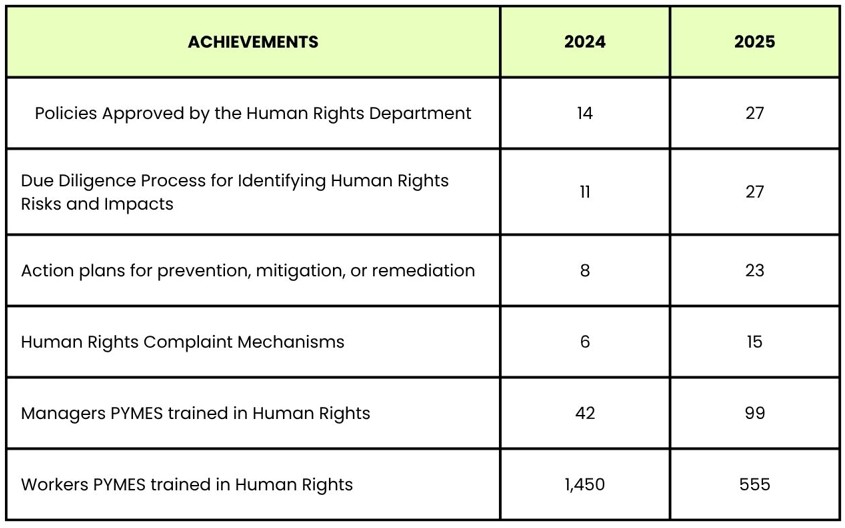
Between 2024 and 2025, more than 45 SMEs participated in this process, resulting in:
- 40 of them having human rights policies developed and approved at the highest organizational level
- 37 having due diligence processes in place to identify human rights risks and impacts.
- 22 of the participating companies have action plans for the prevention, mitigation, and remediation of identified risks and impacts
- 13 have complaint and remediation mechanisms that are sensitive to human rights
- 141 SME managers trained and made aware
- 2,005 workers from participating SMEs trained in human rights
Similarly, it is important to highlight that this process enabled the identification of human rights risks and impacts in the supply chain associated with decent work, a healthy environment, safety, and participation. These findings strengthen Ecopetrol’s human rights due diligence, as they facilitate the early detection of situations that could affect the effective enjoyment of rights as a result of the business activities of commercial partners. With this information, the necessary preventive or corrective measures are strengthened to reinforce responsible management.