

Web Content Viewer
Actions
buscador
Actions
Web Content Viewer
Actions
Risk Management in Biodiversity and Ecosystem Services
Apr 23, 2026

For the Biodiversity and Ecosystem Services area, the risk "Lags in commitments to mitigate climate change, water, neutrality and biodiversity in the face of market expectations and stakeholders" has been identified, which is directly related to the company's Management Strategy and Objectives (TBG).
This risk refers to the Company's "exposure to negative impacts due to its limited capacity to respond in a timely, efficient, and effective manner to its commitments, obligations, and expectations related to climate change, water, and biodiversity."
The focus of this risk is connected to the failure to meet the biodiversity-related targets (Natural Capital Management) included in the 2040 Strategy under the Generating Value with Sustainability pillar. The causes are: (i) Limited capacity to adopt increasingly rigorous management and reporting frameworks related to nature/natural capital, and (ii) A dynamic environment, insufficient guidelines, or lack of implementation of these, that mitigate current and emerging risks associated with the generation of natural climate solutions.
To minimize and manage this risk, Ecopetrol has implemented its main action: "Updating and implementing the biodiversity and ecosystem services roadmap, with activities aimed at strengthening the company's natural capital management, innovation through technologies and tools, and training at all organizational levels, to advance toward a positive impact on biodiversity."
In detail, the management of this risk has been developed through the following actions:
-
The approval of the updated biodiversity and ecosystem services roadmap.
-
Guidelines for natural capital risk management and Zero Net Deforestation (ZND) designed and implemented for project planning and evaluation, as well as in the supply chain (HDR CC and Water Alignment).
-
Impacts and dependencies on biodiversity identified in the supply chain.
-
Economic assessment of the management of risks associated with the implemented natural capital (HdR CC and Water Alignment).
Detailed Treatment Actions (TA) associated with the Risk "Lags in commitments to mitigate climate change, water, neutrality and biodiversity in the face of market expectations and stakeholders":
-
Updating the biodiversity and ecosystem services roadmap.
-
Updating the strategic pillar of biodiversity and ecosystem services.
-
Natural capital management guidelines for the Ecopetrol group.
-
Generate guidelines for suppliers in the management of natural capital.
-
Definition of prioritization criteria for impacts and dependence on Ecopetrol assets.
-
Definition of impact prioritization criteria and dependencies on assets with partners, subsidiaries, and the supply chain.
Opportunities and risks associated with Natural Capital
Articulation between Ecopetrol and the TNFD
To systematically manage and report their interactions with nature, Ecopetrol has adopted the TNFD (Taskforce on Nature related Financial Disclosures) framework, a global initiative that seeks to help companies identify, manage and report nature-related dependencies, impacts, risks and opportunities (DIRs).
Through this framework, organizations can integrate natural factors into their financial, strategic, and operational processes, strengthening risk-based decision-making and promoting greater transparency and commitment to sustainability and business resilience. This is in line with Target 15 of the Kunming-Montreal Global Biodiversity Framework (GBF), which calls for "Taking legal, administrative or regulatory measures to encourage and encourage business activity, and in particular to ensure that transnational corporations and financial institutions control, analyse and disseminate their risks in a transparent and regular manner, dependencies and impacts on biodiversity, including requirements for all large companies and financial institutions, along with their operations, their supply and value chains and their portfolios"
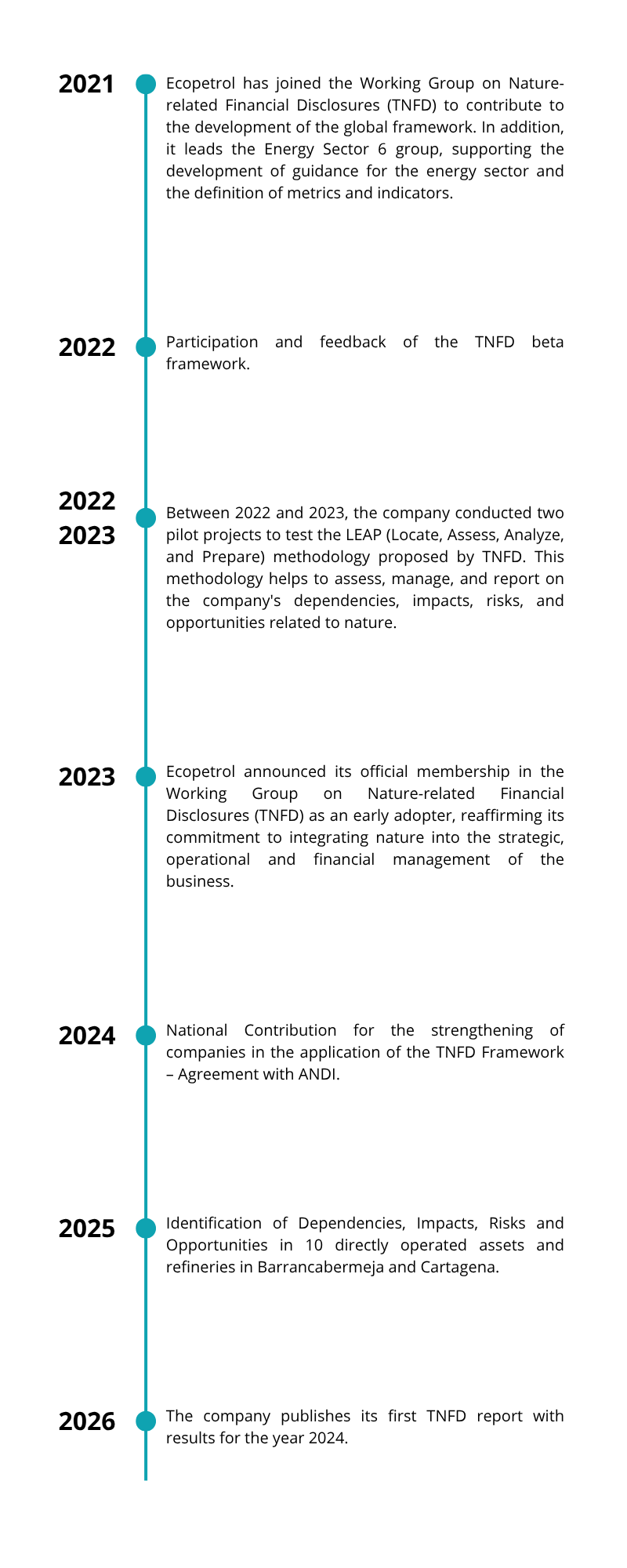
Ecopetrol's participation in TNFD.
For more information about the TNFD, the following link: https://tnfd.global/
Ecopetrol's First TNFD Report
During 2025, Ecopetrol made significant progress in the identification, evaluation, and analysis of nature-related dependencies, impacts, risks, and opportunities (DIRs), within the framework of the development of its first exercise aligned with the TNFD management framework, through the rigorous application of the LEAP (Locate, Assess, Analyze, and Prepare) methodology.
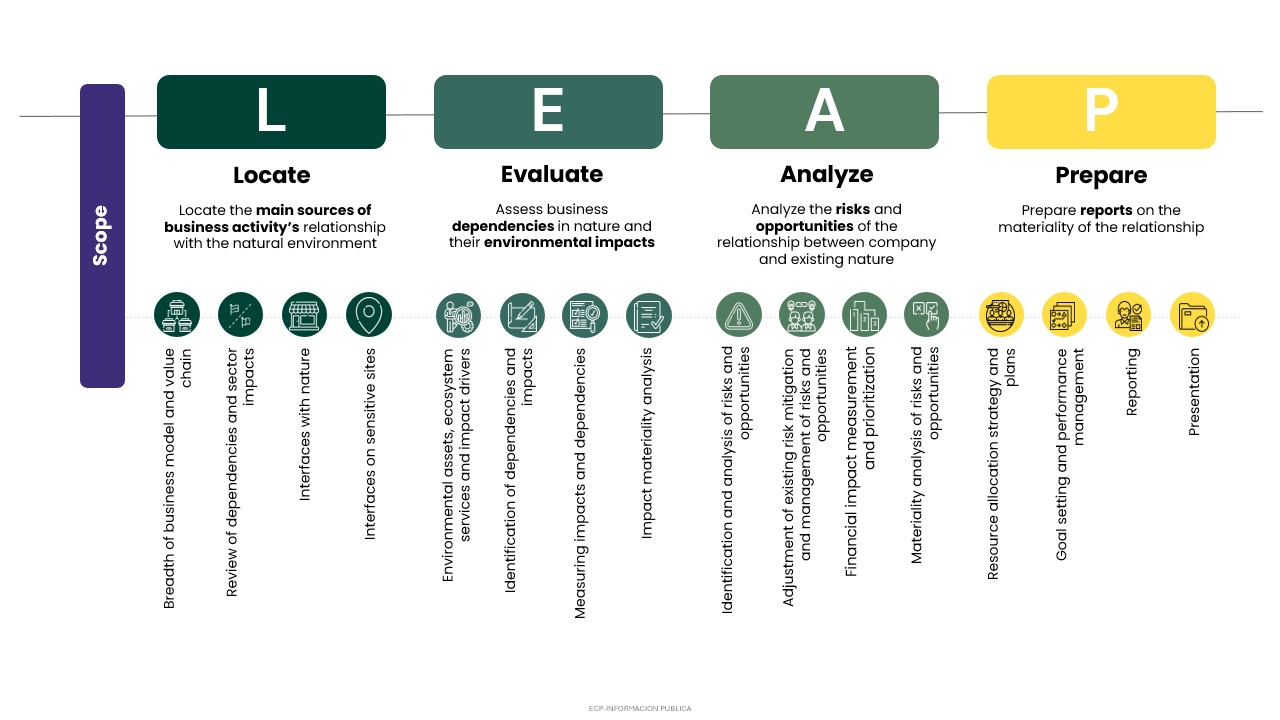
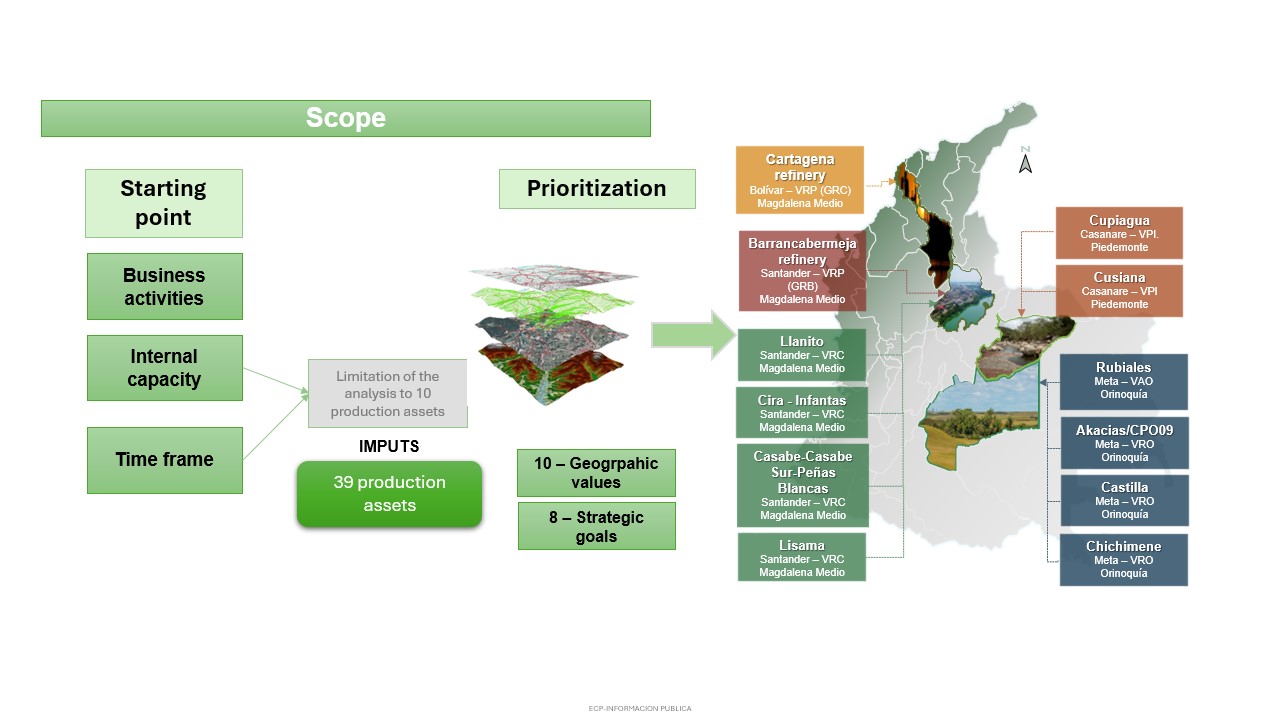
This approach allowed the analysis to be structured in a progressive, spatially explicit and risk-based way, integrating ecological, operational, territorial and strategic variables of the business. As a result, ten (10) production assets and the Barrancabermeja Refinery, corresponding to direct operation, as well as the Cartagena Refinery, were prioritized, systematically characterizing their interaction with strategic ecosystems of the Orinoquía, the Middle Magdalena and the Caribbean, as well as with the areas adjacent to these assets, laying a solid foundation for informed decision-making and the integration of nature in corporate management.
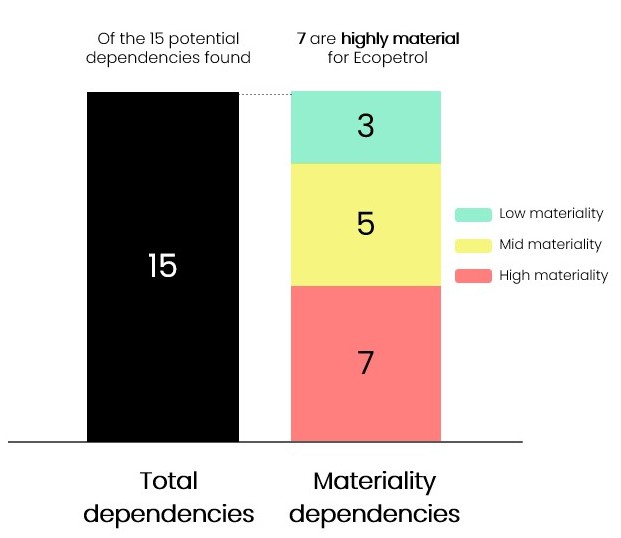
As a result of the analysis, 15 potentially material dependencies were identified, including the supply and regulation of water resources, global climate regulation and other key ecosystem services for operational continuity.
Similarly, 9 potentially material impacts were identified, mainly associated with greenhouse gas (GHG) emissions, water use and transformation of the territory. Based on this assessment, 15 nature-related risks were analyzed, classified into physical, transitional, and systemic risks, including events such as floods, fires, water scarcity, and changes in energy demand, with potential operational, financial, and reputational implications.
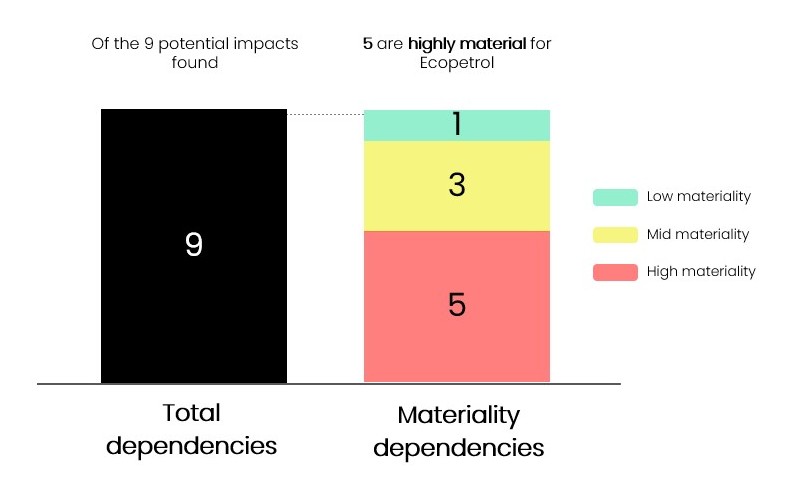
On the other hand, the analysis of the interrelationship between dependencies and impacts allowed the identification of 15 potential risks that could affect the Company's operational continuity, financial performance and reputation. Of these, the following risks exceed the financial materiality threshold: water scarcity, floods, fires, erosion and mass movements, tightening environmental regulations, and changes in energy demand. As a strategic response, the Company prioritized a set of opportunities that strengthen its resilience and generate sustainable value:
- Portfolio: promotion of lower impact energies (hydrogen, SAF, biogas), circular economy, carbon and biodiversity credits, and blue carbon and mangrove restoration projects.
- Operation: reduction of the use of fresh water, greater recirculation, strengthening of infrastructure in the face of extreme events, advanced environmental monitoring, reduction of emissions and recovery of waste.
- Cross-cutting: Nature-Based Solutions, community projects, network of Eco-reserves, Biodiversity Information System, incorporation of the value of ecosystem services and commitment to Zero Net Deforestation.
TNFD in the Supply Chain
Ecopetrol's management of nature-related risks is not limited to the scope of its direct operations, but extends to the supply chain. The organization recognizes that its suppliers, contractors, partners and strategic allies also play a decisive role in the generation and mitigation of impacts on nature.
The process of identifying risks in the supply chain starts with the perimeter of inputs to be analyzed. Among the inputs prioritized in this first report are calcium carbonate, clarifiers, humectants, breakers, catalysts, reinforced steel pipes, cement, bentonite and wood, all of which are essential for extractive activity, drilling and refining of crude oil.
Ecopetrol carried out the identification of the ISIC economic sectors associated with each prioritized input, linking each material with its official productive sector according to the International Standard Industrial Classification.
This exercise made it possible to translate the inputs into economic activities that could be analyzed with standardized risk tools. For example, catalysts and clarifiers were associated with the manufacture of basic chemicals and other chemicals; reinforced steel pipes with the iron and steel industry; cements and bentonites with the manufacture of non-metallic mineral products; and wood with the extraction of forest products. This sectoral classification was the starting point for linking each input to the relevant ecosystem services.
In addition, a mapping of impacts and dependencies of each sector was carried out, analyzing the key interactions between the identified economic activities and nature using the ENCORE tool. This tool makes it possible to determine the extent to which each sector depends on services such as water supply, climate regulation, pollination or flood protection, and how their processes generate pressures on biodiversity, soils or water bodies.
Through this approach, Ecopetrol established matrices that relate each sector to the most critical ecosystem services, identifying both the essential dependencies for business continuity and the impacts that could affect the integrity of the territories.
In addition, a list of potential risks was defined. Physical risks derive from the loss or degradation of ecosystem services, transition risks are linked to regulatory, technological, or market changes that could modify operating conditions, and systemic risks are related to the reputational, social, and financial implications derived from environmental impact.
Finally, a measurement and prioritization exercise was carried out, in which the risks were assessed according to their magnitude, probability and vulnerability, using a prioritization scale that combined the intensity of dependence or impact with the geographical exposure and criticality of the input in the operation.
Processes used by the organization to manage nature-related DIROs
Ecopetrol manages its nature-related dependencies, impacts, risks, and opportunities (DIROs) through an integrated approach structured around four strategic pillars: the mitigation hierarchy and conservation, Nature-based Solutions, knowledge generation, and a biodiversity culture. The first pillar guides decision-making through the application of measures to avoid, minimize, restore, and offset impacts, prioritizing prevention from the early stages of projects. This approach is complemented by integrating conservation as a core component of the business, promoting a balance between operational activities and ecosystem protection. In parallel, the implementation of Nature-based Solutions addresses environmental and social challenges through the restoration, conservation, and sustainable use of ecosystems, contributing to water management, climate change mitigation, and the recovery of degraded areas.
The strengthening of environmental management is supported by the generation of scientific and technical knowledge through monitoring programs, research, and partnerships with academic and territorial stakeholders, enabling informed and adaptive decision-making. Additionally, the organization fosters a biodiversity culture that promotes the adoption of sustainable practices among employees, contractors, and communities. This approach is operationalized through initiatives that encourage sustainable production models, innovation, environmental education, and local capacity building, contributing to ecosystem conservation, climate resilience, and the sustainable development of the territories where Ecopetrol operates.
Articulation between areas
Water is a vital resource for Ecopetrol, as well as for the environment in which it operates. For this reason, in 2021 the Roadmap for Integrated Water Management was established, seeking for the company to be water neutral or even water positive by 2045. For more information, see the Climate Action and Towards Water Neutrality sections in detail.
Ecopetrol advances in actions to conserve natural capital and biodiversity, through voluntary efforts and compliance with environmental compensation and investment obligations of 1%, which contribute to the conservation and monitoring of water resources. For more information, see the section Environmental compensation and forced investment of the 1% in detail.
The circular economy is an enabler of goals in energy transition, zero net carbon emissions, reduction of the water footprint, closure of material and waste cycles, and natural capital management. Contributing with opportunities for growth, innovation, job creation and conservation of biodiversity and ecosystem services. For more information, see the Circular Economy section in detail.
Research support
Within the framework of the development of Ecopetrol's first TNFD report, two doctoral research projects led by the University of Manchester and the London School of Economics and Political Science have been supported.
These academic works have made it possible to share and analyze Ecopetrol's experience in the implementation of the LEAP approach and the recommendations of the TNFD framework, contributing to the generation of knowledge on the management of risks and opportunities related to nature and biodiversity in the business sector.

