

Web Content Viewer
Actions
buscador
Actions
Web Content Viewer
Actions
Ethnic group relationship strategy
Sep 18, 2026
During 2025, the relationship with ethnic groups in the areas of influence of Ecopetrol's operations was based on intercultural dialogue and support for regional relationship initiatives, with the aim of maintaining trust.
Click here for the Guide to Engagement with Ethnic Communities (GDE-G-006)
Click here for guidelines for coexistence with ethnic communities (GDE-G-006 Annex 3)
Identification of Communities of Ethnic Groups in Projects
Prior to the development of any project that may result in new impacts, and in order to ensure the exercise of the right to participation of ethnic communities, Ecopetrol requests that the Directorate of the National Authority for Prior Consultation (DANCP) resolve on the admissibility of prior consultation for an area of influence, which, for each project, is defined based on the activities to be carried out. The information delivered to the DANCP includes: (i) a description of the project activities, (ii) a definition of the area of influence, or the area in which the impacts may materialize, (iii) an analysis of the possible impacts and the management measures to be applied, (iv) specific areas of intervention, (v) a description of the biotic, abiotic, socio-cultural, and economic environments of the area where the project would be carried out, and (vi) a description of ethnic communities present in the project area (when they have been previously identified in the area).
By 2025, requests to determine the admissibility of prior consultation had been submitted for five projects, and responses were received for all five. Additionally, three resolutions were received in response to requests made in 2024 (two of these resolutions address appeals), for a total of six projects with resolutions of origin obtained. The DANCP determined the need to conduct prior consultation for the Reto 31 Pilot project: Low-speed wind energy, which involves one ethnic community.
For the Yátaro Development Area in the municipality of San Martin (Meta), the prior consultation verification visit was conducted from October 14 to 17, 2025, with the Directorate of the National Authority for Prior Consultation (DANCP). This was done in light of DANCP's prior identification of an indigenous council in the municipality. DANCP will continue work on the resolution of origin in 2026.
As part of Human Rights due diligence, when Ecopetrol identifies ethnic communities that may be directly affected by a project's activities, the presence of the community in the area is reported to the DANCP, and the Authority's pronouncement on the admissibility of prior consultation is requested. In 2025, there was no evidence of unidentified communities in project areas.
In addition, to update information on ethnic communities in the municipalities of influence, the municipal mayors' offices are requested annually to report on the recognition or registration of any new ethnic communities.
Understanding the Context for Building Good Relations with Indigenous and Afro-Colombian Communities
For the relationship with ethnic groups living in areas where Ecopetrol operates, the Company takes intercultural dialogue as the principle and articulating axis of the process. That is why, in addition to diagnoses of the territories that can provide relevant information on the characteristics of the ethnic groups, approaches are made to the ethnic communities, and during the prior consultation processes, baselines are built using intercultural and participatory methodologies for collecting information from the community, covering social, cultural, environmental, and cartographic aspects that allow us to understand the community's context and subsequently establish management measures for the project's impacts.
Within the framework of processes for understanding and building relationships with communities belonging to ethnic peoples, Cooperation Agreement Two was signed in 2025 with the Asounuma Indigenous Association, which seeks to promote the strengthening of self-government, education, cultural identity, and trust between indigenous communities and industry in Puerto Gaitán.
Likewise, within the framework of good relations and the building of trust, the first space for dialogue and relationship with Afro communities in Puerto Gaitán was held in September.
Prevention and Management of Intercultural Conflicts
To avoid intercultural conflicts, the main actions adopted by Ecopetrol are: i) compliance with environmental legal regulations in the areas where we operate, ii) identification of the presence of ethnic groups in the areas to be intervened, their authorities and expectations, in order to create spaces for dialogue, and iii) carrying out prior consultation processes when required.
The main cause of the conflict with ethnic groups is the lack of clear regulations governing the application of the prior consultation process, especially in operational areas that existed before the issuance of Law 21 of 1991, which incorporates Convention 169 of the International Labor Organization (ILO). Ethnic communities have requested the inclusion of labor and the procurement of goods and services. Although Ecopetrol focuses on diversity and inclusion in contracting processes, we create spaces with the communities to clarify the mechanisms established in current regulations for participation in processes for both labor and goods and services.
Other types of conflicts have arisen, associated with requests that ethnic communities make to third parties. However, because the Company is present in the area, these conflicts involve us as actors in the territory. In all cases, Ecopetrol is willing to participate in these spaces to the extent of its responsibility and scope.
Table 1
Significant Conflicts with Ethnic Communities (2025)
|
DATE CONFLICT BEGAN |
COMMUNITY |
PROJECT |
FACTS ARGUED BY THE COMMUNITY |
ECOPETROL’S POSITION |
STATE OF THE CONFLICT 2025 |
|---|---|---|---|---|---|
|
December 11, 2024 |
Florida Kawinanae Indian Reservation |
CPO Block 08 |
They request the annulment of Administrative Act No. 2275 of December 13, 2012; Resolution No. 57 of August 28, 2013; and any other acts issued to amend or supplement them, including Official Letter No. 442866 dated November 12, 2024. They further request that the plaintiff be ordered, within a peremptory term established by the judge, to restart the administrative process for certifying the presence of ethnic communities and determining the origin of the consultation for the CPO-08 South Exploratory Drilling Area project, as well as for the seismic prospecting project carried out in 2009 and 2010. The foregoing is subject to the process for restitution of collective territories initiated in 2023. |
The projects mentioned in the writ of protection (“acción de tutela”) were duly reviewed at the time and are currently closed. The CPO-08 2D seismic acquisition project was carried out between 2010 and 2011. The CPO-08 South Exploratory Drilling Area (APE) project involved the drilling of an exploratory well called Provenza 1 in 2019, which is located outside the reservation and is currently undergoing abandonment. The reservation was established in 2023, by which time these projects had already been completed. |
On December 11, 2024, the Second Civil Oral Court of the Circuit of Bogotá issued an order admitting the writ of protection filed by the Florida Kawinanae Reservation of the Sikuani people against the DANCP. In the proceeding, the Ministry of the Interior, Ecopetrol, the Office of the Comptroller General of the Republic, and the Office of the Attorney General were mentioned as defendants. On December 12, 2024, a writ of defense filed. On April 3, 2025, the Second Civil Court of the Bogotá Circuit issued a first-instance ruling declaring inadmissible the writ of protection filed by the Florida Kawinanae Reservation. On May 5, 2025, the Superior Court of the Judicial District of Bogotá issued a second-instance ruling fully confirming the April 3, 2025 decision by which the writ of protection was declared inadmissible. |
|
August 28, 2024 |
Taganga Indigenous Community |
Tayrona exploratory drilling área (APE) |
The Fourth Labor Court of the Santa Marta Circuit issued an order of August 28, 2024, whereby it resolved to admit the writ of protection against Petrobras, among other defendants, for not guaranteeing the right to prior consultation within the framework of the Tayrona Exploratory drilling area project. |
Ecopetrol is a partner, and Petrobras is the operator. The response to the writ of protection explains that there has been no violation of the fundamental right to prior consultation of the Indigenous community of Taganga. It sets out, based on the jurisprudence of the Constitutional Court, why the requirements for establishing a direct impact—and therefore the need for prior consultation—have not been met. |
On September 12, 2024, the Fourth Labor Court of the Santa Marta Circuit issued a first-instance ruling protecting the fundamental rights to prior consultation, due process, and intellectual, cultural, and environmental property of Mr. Ariel Daniels de Andreis, acting in his capacity as Governor of the Taganga Indigenous Community. The ruling also issued orders to several institutions, including the need to conduct a verification visit. The verification visit took place from October 7 to 11, 2024, led by DANCP and Petrobras. Ecopetrol provided technical support during the visit. Through Resolution ST-1686 of December 6, 2024, DANCP stated that prior consultation applies to the CABILDO INDÍGENA DE TAGANGA for the project: "TAYRONA EXPLOITATION AND DEVELOPMENT AREA." Because the direct impact described in Resolution ST-1686 of 2024 was unclear, Petrobras filed an appeal for reconsideration on December 20, 2024. To date, Petrobras is advancing actions to establish a meeting space in order to agree on a methodological route. |
|
December 20, 2024 |
U'wa People |
Gibraltar Field Magallanes exploratory drilling área (APE) |
In December 2024, the Inter-American Court of Human Rights issued a ruling in the case of the U'wa Indigenous People v. Colombia. The State was found responsible for human rights violations and was ordered, among other measures, to carry out a participatory process regarding ongoing extractive activities and to ensure that projects within or adjacent to the reservation do not cause harmful impacts. |
Ecopetrol acts as a compliance partner with Order No. 13 of the Inter-American Court’s ruling. |
Although the ruling is against the Colombian State, Ecopetrol serves in a supporting role. Throughout 2025, Ecopetrol S.A. has participated in 24 planning and coordination meetings with central government and community entities, led by the Ministry of Foreign Affairs. Progress is being made in dialogue with institutions and the community to ensure a participatory process with the U'wa Reservation. |
|
March 18, 2025 |
Woumain Wajira Foundation Proyectando Futuro Foundation Jóvenes para el Progreso y Desarrollo Social Foundaiton |
Sirius |
They argue that these actions affect subsistence fishing and culture and are requesting prior consultation. The response was prepared by the different areas involved, under the leadership of the legal department. Follow-up is ongoing. |
Information is provided on the current status of the execution of the Gua OFF-0 project. It is reported that the company does not directly carry out the activities involved in the project, as these are the responsibility of another operator. It is also reported that the facts referred to in the complaint are generic statements without sufficient supporting evidence. The absence of direct impact from the project’s activities, and therefore the inadmissibility of prior consultation, are also noted. |
On March 18, 2025, a writ of protection was received, presented by Pablo Segundo Ojeda Gutiérrez on behalf of the Woumain Wajira, Proyectando Futuro, and Jóvenes para el Progreso y Desarrollo Social foundations, indicating that they represent the coastal communities of the Department in general. On March 17, 2025, the Second Mixed Administrative Court of the Riohacha Circuit admitted the writ of protection and requested a report from each of the parties regarding the facts that gave rise to the writ. On March 18, 2025, the preparation of a response to the writ of protection was agreed. On March 20, 2025, Ecopetrol filed a response to the claim. On March 31, 2025, the Second Mixed Administrative Court of the Judicial Circuit of Riohacha issued a second-instance ruling denying the claims. On May 14, 2025, the Court issued a second-instance ruling ordering procedures to determine whether there are communities affected by the project. DANCP carried out verification visits in November 2025 and scheduled subsequent visits for January 2026. A decision is pending. |
Identified Cases of Violations of the Human Rights of Indigenous peoples
In 2025, there were no violations of the human rights of indigenous peoples, black, Afro-Colombian, Raizal, and Palenquera communities, or Roma (Gypsy) communities. In the writs of protection (“acción de tutela”) related to Ecopetrol's operations, the judges did not identify any violations of the human rights claimed by the communities.
The Company's Position on the Local Hiring of Ethnic Community Members
The hiring of members of ethnic groups as laborers is based on respect for the right to non-discrimination on the basis of ethnic status in employment and is regulated by the provisions of the Political Constitution of Colombia and, in particular, by Convention 169 of the International Labor Organization (ILO), which, in Article 20, establishes the following:
"Governments shall adopt, within the framework of their national legislation and in cooperation with the peoples concerned, special measures to ensure that employees belonging to such peoples have effective protection in recruitment and conditions of employment, to the extent that they are not effectively protected by the legislation applicable to employees in general."
Although the Government is responsible for defining an employment policy for ethnic groups, the Company must avoid any negative discrimination against employees belonging to ethnic groups and ensure that the principle of bilingualism is applied at a minimum and that the cultural differences of each community and its representative authorities are taken into account.
As explained above, mechanisms are sought for listening to and disseminating information about legal processes, in order to facilitate access to contracting processes.
Request, Complaint, and Claim Mechanisms for Indigenous Communities
For each project, communication and information channels are established and made available for the community to submit requests, complaints, and claims. These channels may include the collection of verbal complaints, telephone calls, and letters. This applies equally to ethnic communities; however, when it is identified that communities require translation, the process for collecting such requests is facilitated.
Ongoing, Follow-up, and Closure of Prior Consultation Procedures
Click here to learn about Prior Consultation Procedures (GDE-P-008)
Prior consultation is conducted to comply with legal and environmental regulations and to reach agreements with indigenous and Afro-Colombian communities, managing project impacts in ways that respect their cultural heritage. In Colombia, the Constitutional Court, through Judgment SU-123 of 2018, has established that prior, free, and informed consent is necessary for the development of projects that involve any of the situations established by the Court in these three exceptional cases: i) transfer or relocation of indigenous or tribal people from their place of settlement; ii) storage of hazardous or toxic materials in their territories; or iii) measures that imply a high social, cultural, and environmental impact that puts their livelihood at risk.
From the planning of the operations to be carried out, the possible impact on ethnic groups in the work areas is verified. If a possible direct impact on ethnic groups is identified before the authority, Ecopetrol accompanies and promotes the guarantee of the right to prior consultation. For the development of prior consultations, Ecopetrol has an internal procedure based on current regulations and the analysis of the possible impacts of the projects. This guideline is updated periodically as new guidelines are generated.
During 2025, the following preliminary consultations are presented by stage:
Table 2
Prior Consultation Processes (2025)
|
STAGE |
PROJECT |
COMMUNITIES |
|---|---|---|
|
In planning |
ANLA Environmental imposition. Bioremediation, abandonment and environmental recovery activities of the Airú Well 1 (RAM PETROLEUM) |
1 |
|
Reto 31 Pilot: Low-Speed Wind Energy |
1 |
|
|
Gibraltar Field |
1 |
|
|
APE Magallanes |
1 |
|
|
Follow-up |
Rubiales Field Repair consultation |
1 |
|
Modification of the Rubiales Global License |
1 |
|
|
Modification of the PMA North West Cluster |
2 |
|
|
In the process of closing |
APE Naphtha |
1 |
|
TOTAL |
8 |
9 |
The following are the communities with which the prior consultations are being carried out:
Table 3
Prior Consultation Processes in Process, Follow-up and Closings (2025)
|
Communities consulted / Location |
Ecopetrol Project |
Progress |
Phase reached in 2025 |
|---|---|---|---|
|
Inga Villa Catalina Reservation in Puerto Rosario |
Environmental imposition ANLA.1 Bioremediation, abandonment and environmental recovery activities Airú 1 Well |
Progress is being made in relations with the Villa Catalina Reservation of Puerto Rosario, DANCP, and ANLA within the framework of the prior consultation for bioremediation, abandonment, and environmental recovery activities at the Airú 1 Well. A technical group meeting between ANLA, DANCP2, and Ecopetrol was held on September 18, 2025. |
Community Engagement |
|
Wayacasirra Indigenous Community |
Reto 21 Pilot project: Low-Speed Wind Energy |
On December 5, 2025, the coordination and preparation meeting was held. |
Coordination and preparation |
|
U'wa United Reservation |
Gibraltar Field |
In the process of dialogue with the community to build a methodological route for the participatory process. |
Planning |
|
U'wa United Reservation |
Magallanes APE |
In the process of dialogue with the community to build a methodological route for the participatory process. |
Planning |
|
Sikuani Alto Unuma Meta Reservation / Puerto Gaitán (Meta) |
Cluster within Rubiales Field: Consultation carried out in response to the order issued by the Council of State. |
Consultation was formalized in 2019 and currently is in the follow-up stage. Consultation agreements are ongoing. A follow-up meeting was held in 2022. Compliance with the agreements of the consultation process continues. Once completed, a closing meeting will be arranged with DANCP. |
Follow-up |
|
Buenos Aires Community – part of the Alto Unuma Indigenous Reservation |
Modification of the Global Environmental License for Rubiales Field |
Prior consultation with agreements protocolized in 2023. By 2025, progress has been made in the adjustments of the Environmental Impact Study and in the adjustment of the management sheets. The relationship with the Reservation is maintained. |
Follow-up |
|
Camentsá Biya and Pasto Orito Siberia Councils (Orito, Putumayo) |
Modification of the North West PMA Cluster located in the west |
Prior consultation with agreements were formalized in 2022. A follow-up meeting was held on November 25th with the Pastos Orito Siberia Council and on November 26th with the Camentsa Biya de Orito Council. |
Follow-up |
|
Embera Chami Council from Dachidrua / Puerto Parra (Santander) |
Naphtha Exploratory Drilling Area |
Consultation was formalized in 2014 and consultation agreements were completed. The DANCP was asked to administratively close the consultation process due to difficulties with representativeness within the community. In 2025, a request for closure was reiterated before the DANCP. |
Request for administrative closure |
- WIND Autogeneración S.A.S. Agency Agreement: Windpeshi Project
Within the framework of the WIND Autogeneración S.A.S. agency agreement and the Non-Conventional Sources of Renewable Energy – FNCER projects, the acquisition of the Windpeshi Wind Farm project and its transmission line, which will carry energy to the national interconnected system, moved ahead. Prior to the reactivation of construction activities, a strategy is being implemented to engage the 30 Wayuu communities in the project area, located in the Alta and Media Guajira reservation, in the municipalities of Maicao and Uribia, in La Guajira. This strategy is based on direct dialogue with the Wayuu authorities, with whom prior consultation was carried out during the project’s feasibility stage. With the support of the institutionality, it is expected to resume compliance with the protocolized agreements for the project's development, now under Ecopetrol's responsibility.
Likewise, a relationship is maintained with local authorities and other key actors in the territory, enabling progress and coordination for the project to enter the area.
Participatory Construction of the Baseline and Impact Analysis
In such a case, if the authority determines the admissibility of prior consultation for a project, the corporate procedure is activated. It involves the direct collection, with the participation of the consulted communities, of social, environmental, cultural, and cartographic information, and the consolidation of a document known as a baseline. The participatory process of building the baseline involves field trips that allow us to understand the general characteristics of the communities, identify places of cultural importance, and explain the project's operational scope in technical terms.
This primary source information, built together with the communities, allows to:
- Determine and understand the current characteristics of each community; consequently, conduct a specific analysis of the possible impacts and formulate proportional and coherent management measures.
- Expose the operational scope of the activity in the field. In this way, the communities have technical information about the activities to be developed and can formulate and manage their concerns.
In 2025, no baseline information collection processes were carried out because prior consultation processes were not initiated. For the Reto 31 Pilot Project: Low-Speed Wind Energy, within the framework of the prior consultation process, the approach with the Wayacasirra indigenous community began in September. In December, a coordination and preparation meeting was held with the Directorate of the National Authority for Prior Consultation (DANCP) of the Ministry of the Interior for the 2026 consultation process.
Formalized Prior Consultations
In 2025, no official formalization meetings were held with DANCP.
Fulfillment of Prior Consultation Agreements
Ecopetrol is bound by the prior consultation agreements, which become effective during the project’s operational phase. These agreements include management measures designed to ensure the project’s activities do not harm the ethnic community’s integrity. The Directorate of the National Authority for Prior Consultation (DANCP for its Spanish acronym) regularly verifies compliance on-site. Once all obligations are met, the DANCP validates the situation and issues a formal document verifying the resolution of the consultation process. If the project is canceled and is therefore not realized, the DANCP verifies and officially closes the prior consultation.
In light of the above, the following official follow-up meetings were held with the DANCP in 2025:
North West
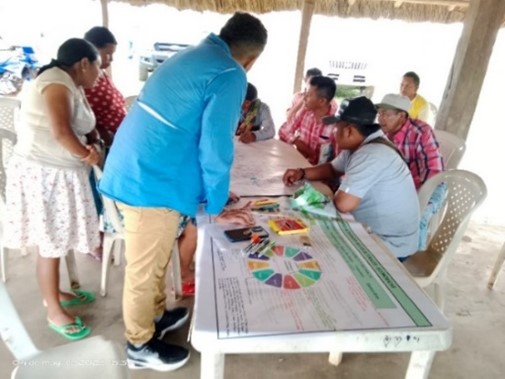
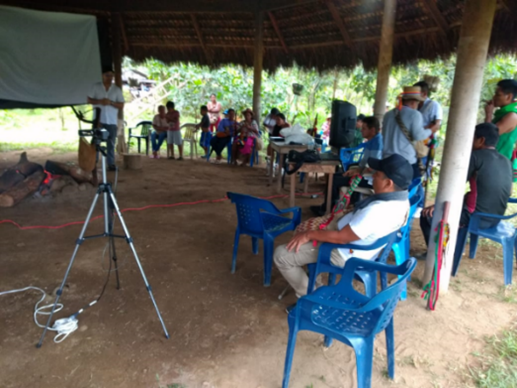
On November 25, 2025, within the framework of the North-West Polygon Environmental Management Plan Amendment project, a follow-up meeting was held with the Pastos Orito Siberia Indigenous Council. The meeting, organized and attended by the Directorate of the National Authority for Prior Consultation, reviewed the agreements established under the prior consultation formalized on August 28, 2022.
Figure 1
Harmonization Ritual to Restore Balance, Pastos Orito Siberia Indigenous Council, Follow-up Meeting November 25, 2025
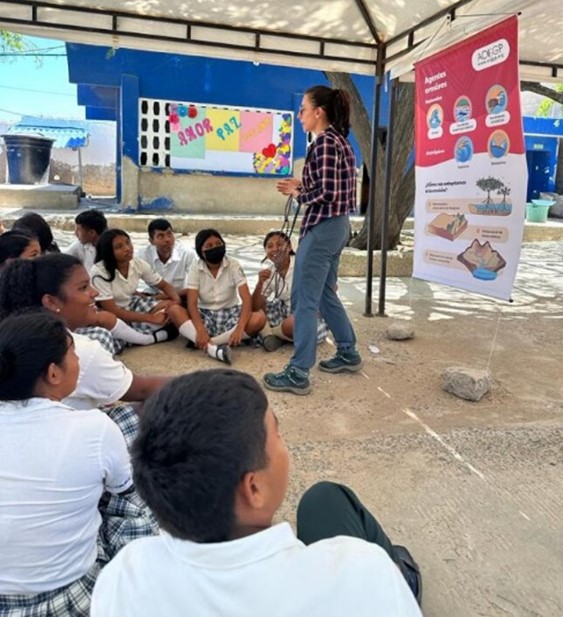
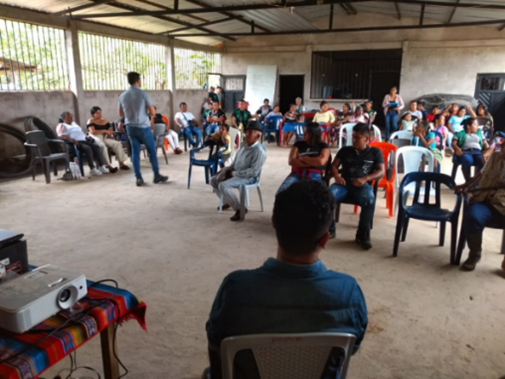
On November 26, 2025, within the framework of the North-West Polygon Environmental Management Plan Amendment project, a follow-up meeting was held with the Orito Kamentsa Biya Indigenous Council to ensure compliance with the agreements formalized on October 22, 2022. The meeting was organized by the Directorate of the National Authority for Prior Consultation.
Figure 2
Harmonization Ritual to Restore Balance, Orito Kamentsa Biya Indigenous Council, Follow-Up Meeting, November 26, 2025
WIND Autogeneración S.A.S. Mandate Agreement: Windpeshi Project
As part of the WIND Autogeneración S.A.S. Mandate Agreement for Non-Conventional Renewable Energy Sources projects, prior consultation agreements were received from ENEL Energy. Their implementation will begin during the project’s operational phase.
The map below illustrates Ecopetrol's operations, infrastructure, and exploratory blocks, highlighting Indigenous Reservations and lands under Community Council titles. It is important to note that there is no existing database that pinpoints the locations of communities without legally recognized lands, as territorial boundaries must be officially recognized by the Colombian State. Therefore, whenever activities are planned in a new area, a request must be made to the Ministry of the Interior for a resolution on the necessity of prior consultation. The Ministry will then determine whether a certification visit is needed or issue an administrative decision based on its existing databases.
Figure 3
Operations in Locations with an Ethnic Community Presence On-Site or in Adjacent Areas
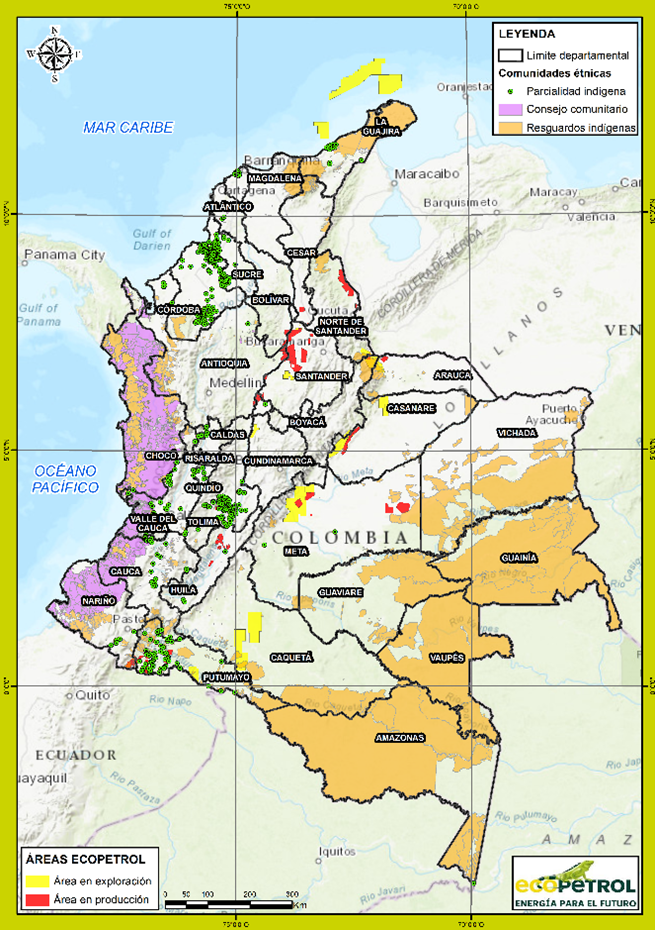
Department of La Guajira: Includes the Chuchupa and Ballenas Fields, operated by Hocol, a subsidiary of Ecopetrol, as well as offshore blocks under appraisal for operational feasibility.
Department of Bolívar: The Cartagena Refinery and the Néstor Pineda Maritime Terminal are located in the Mamonal Industrial District of Cartagena. Although no ethnic groups reside in the Industrial District, Community Councils and Zenú Councils have been established in the adjacent areas.
Department of Norte de Santander: Production fields operate near the Motilón Barí communities.
Departments of Santander, Boyacá, and Arauca: The U'wa People reside in these departments, near the Gibraltar field operations and facilities. Recently, multiple Community Councils of Black Communities have been organized.
In Santander, Embera councils have been established, claiming settlements in Puerto Parra, Cimitarra, Puerto Berrio, and Puerto Boyacá for over 40 years.
Department of Meta: Next to the Rubiales and Mago fields, operated by Ecopetrol, are the El Tigre and Alto Unuma Reservations. Additionally, the Sikuani communities have established settlements and are engaging in dialogue with the national government to clarify their registration and territorial rights.
Department of Putumayo: The region has historically hosted various incoming ethnic groups, arriving through colonization or displacement due to violence. Recently, these communities have requested enrollment in the Ministry of the Interior’s registry to gain official recognition. In Putumayo, councils representing the Embera, Nasa, Awá, Pasto, Kichwa, Pijao, and Muruy peoples exist. Additionally, community councils have been established. The Kamentsá and Inga communities originate from the upper Putumayo, while the Siona and Cofán communities are from the lower Putumayo.
Department of Nariño: In the municipality of Ipiales, the Sucumbíos field is home to the Pasto, Awá, Nasa, and Cofán Indigenous People, as well as Community Councils. The Trans-Andean pipeline also runs through the area, and Awá, Pasto communities , and the Community Councils are located along it.
Dialogue with the U’wa People
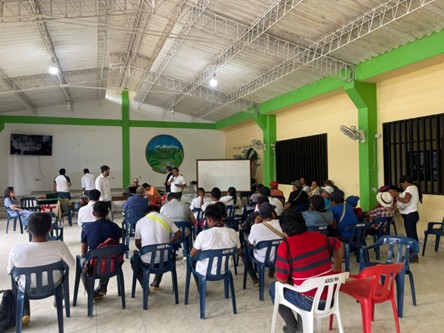
During 2025, Ecopetrol continued its relationship with the new Board of Directors of Asou’wa for the 2022–2025 term to ensure continuity in its intercultural dialogue. While Ecopetrol aims to maintain communication with the U’wa community, this year the dialogue mainly involved the National Government and the community to advance government compliance efforts, with Ecopetrol providing logistical support.
Construction of the Thinking Center in the Unido U’wa Reservation is ongoing. This project, developed in agreement with the community, seeks to create a space that enhances governance and cultural activities, while also offering services to those traveling to the municipal capital.
In December 2024, the Inter-American Court of Human Rights issued a ruling in the case of the U’wa Indigenous People v Colombia. The Court found the State responsible for human rights violations and mandated, among other measures, a participation process for ongoing extractive projects and assurance that projects within or near the reservation do not cause negative impacts. The ruling includes Order 13, directing participation processes related to extractive projects affecting Ecopetrol, specifically referencing the Gibraltar field and APE Magallanes. The Intersectoral Commission on Human Rights and International Humanitarian Law tasked the Company with supporting compliance, under the leadership of the Ministry of Mines and the DANCP. Throughout 2025, all 24 inter-institutional and community meetings focused on implementing this order.
Furthermore, relationships and trust with the U’wa Indigenous People were enhanced through support for the Leadership School, promoted by local authorities and communities, as well as logistical assistance to the workgroup that monitors fulfillment of the Court’s ruling, coordinated by the Ministry of Foreign Affairs, particularly regarding point 13 of the order.
Figure 4
Gathering of Knowledge Meeting (“Encuentros de Saberes”) U’wa people, November 18, 2025, Cubara – Boyacá
Intercultural dialogue with the Alto Unuma Meta Reservation
Dialogue and consensus with the Alto Unuma Reservation (Meta) of the Sikuani ethnic group, located adjacent to the Rubiales field, have laid the foundation for respecting cultural differences and promoting indigenous self-governance.
In 2025, the Cooperation Agreement 2 was signed with the ally ASOUNUMA, focusing on strengthening self-governance, education, cultural identity, and building trust between indigenous communities and industry in Puerto Gaitán. Additionally, the First Cultural gathering of Indigenous Peoples of Puerto Gaitán took place, where Ecopetrol’s support and commitment were publicly acknowledged.
Training on Special Indigenous Jurisdiction and alternative conflict resolution mechanisms, conducted with the Alto Unuma Reservation, also took place in cooperation with the Ministry of Justice. This initiative aimed to enhance capacities in self-governance and indigenous guard, in collaboration with Ecopetrol and institutional partners. In September 2025, the first dialogue space with Afro-Colombian communities in Puerto Gaitán was held to understand their expectations, needs, and demands, particularly regarding reinforcing the Afro perspective in social management and territorial transformation in the region.
Relationship-building activities with ethnic communities in the departments of Putumayo and Nariño
Ecopetrol maintains dialogue with nearby ethnic communities to stay informed about operations. This communication has facilitated the formalization of investment projects in areas where ethnic and farmer populations coexist.
Strengthening of traditional practices through cultural, social, and environmental innovations among ethnic communities in Putumayo and Nariño.
Throughout 2025, the project titled “Spaces for Commemoration and Preservation of Intercultural Expressions, Arts, and Knowledge of Ethnic and Non-Ethnic Communities in Putumayo and Nariño, operational areas Ecopetrol S.A – Phase I and II 2025” was approved. This initiative reinforces territorial and cultural traditions through various meetings and cultural activities with different ethnic groups in these departments:
- Cultural event for Afro-Colombianity in the municipality of Orito, Putumayo
- Cultural encounter of the Inti Raimi of the Pastos Siberia Indigenous Council, in the municipality of Orito, Putumayo
- Cultural Uakjnayté “Carnival of Forgiveness” event with the Inga Suma Iuiai council in the municipality of Orito, Putumayo
- Cultural event celebrating the day of the Indigenous Peoples in the municipality of Orito, Putumayo
- Cultural encounter of the Inty Raymi with the Yanacona Mirador Pepino council in the municipality of Orito, Putumayo
- Celebration of the Afro-Colombianity of the Community Councils of the Jardines de Sucumbíos jurisdiction in the municipality of Ipiales, Nariño
- Reinforcing the cultural recovery process as a result of the Cofán meeting in the Santa Rosa del Guamuez Reservation, Valle del Guamuez, Putumayo
- Cultural gathering of the Banner with the Alnamawami community in the municipality of Orito, Putumayo
- Cultural Gratitude celebration with the Cabildo Chicalá Pijao, in the municipality of Orito, Putumayo.
- Cultural Uakjnayté “Day of the Offering” celebration with the Kamentsá Biyá de Orito council in the municipality of Orito, Putumayo
- Cultural gathering for Afro-Colombianity in the municipality of Valle del Guamuez, Putumayo
- Intercultural dialogue to enhance fraternal bonds with the Organization of the Permanent Working Group of the Cofán people around the recognition, safeguarding, and promotion of living memory, in the departments of Putumayo and Nariño (including cultural literature meetings, traditional medicine, and traditional games).
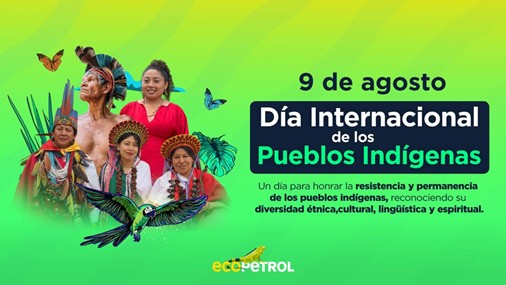
Commemoration of the International Day of the World’s Indigenous Peoples
In August 2025, to honor Indigenous Peoples, activities were held to emphasize the significance of ethnic and cultural diversity to the Company’s growth.
Figure 5
Publicity for Indigenous Peoples’ Day Activities
Sponsorship of artisans from ethnic communities at Expoartesano and Expoartesanias
In 2025, we continued to support craft fairs featuring artisans from diverse ethnic groups across the country. These fairs serve as a significant platform for artisan communities to sell their products and explore new business opportunities while concurrently preserving their traditions and knowledge. They offer unique opportunities for artisans to showcase their work and establish new commercial contacts. This year, we organized three such events.
Expoartesano Miami 2025 crafts fair
The third edition of this international fair took place over three days - from October 23 to 26, 2025 - showcasing works from artisans representing all 32 departments. The event was attended by four artisans.
Figure 6
Expoartesano Miami
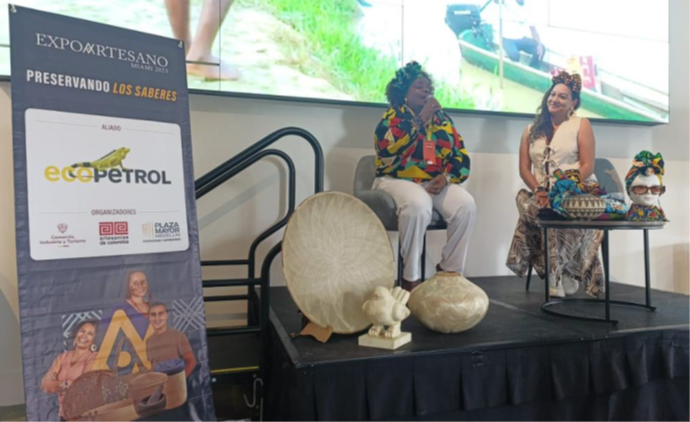
The fair enabled artisans to reach new markets, showcasing and honoring the traditions and customs of the country’s ethnic communities. Consequently, artisans were able to promote their products internationally and generate resources from sales.
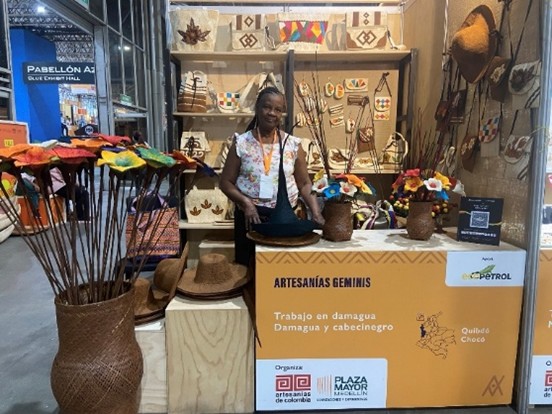
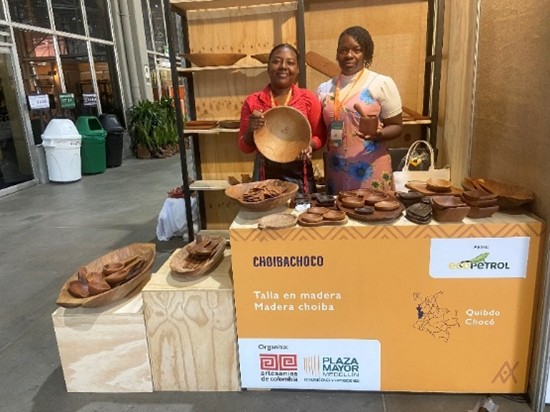
Expoartesano Medellín crafts fair
Since 2022, Ecopetrol has sponsored five artisans from ethnic groups to participate in this fair. These artisans are selected based on priorities established by Artesanías de Colombia, the government organization that supports artisans nationwide. In 2025, the logistics and continuous presence of five artisans were again funded at this event, held from July 11 to 20, 2025.
Figure 7
Sponsored artisans, Expoartesanos Medellín
Expoartesanías Bogotá crafts fair
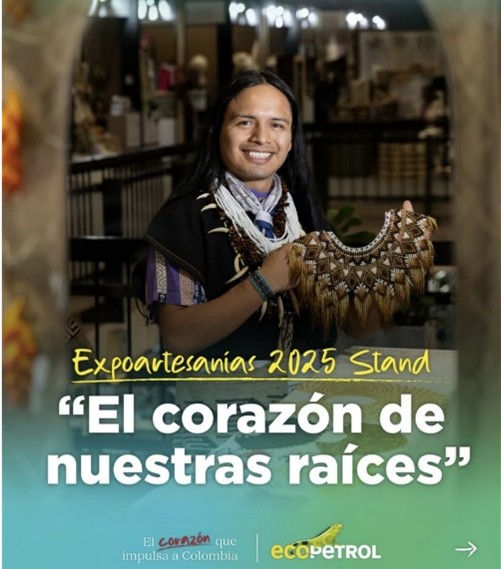
Since 2014, Ecopetrol has sponsored this fair’s ethnic pavilion, covering 50% of the ethnic artisans’ costs for stand rental, assembly, and daily lunch. Each year, between 120 and 135 artisans from ethnic communities across the country have benefited from this sponsorship. In 2025, Expoartesanías Bogotá was held from December 5 to 18, with 124 beneficiary artisans in attendance.
Figure 8
Sponsored Artisans, Expoartesanías Bogotá
Archaeology
Under Colombia’s Political Constitution, archaeological heritage is considered non-seizable, imprescriptible, and inalienable. The Colombian Institute of Anthropology and History (ICANH, for its Spanish acronym) is the authority responsible for protecting these assets nationwide (General Law of Culture 397 of 1997). According to regulations in force (Law 397 of 1997, Law 1185 of 2008, and Decree 138 of 2019), all projects requiring environmental licenses or similar permits must include Preventive Archaeology Programs. Ecopetrol S.A. is committed to adhering to these norms by implementing various Preventive Archaeology Programs (PAP) and submitting periodic reports and requests to ICANH across the different regions. This ensures the protection of potential archaeological legacy during project activities and supports the project’s viability strategy.
During 2025, Ecopetrol had in place 39 ongoing Preventive Archaeology Programs. Preventive archaeology activities were conducted in 16 of these, primarily in the Andina Oriente (including PAP Campo Rubiales, PAP Campo Mago, PAP Campo Cumanday), Orinoquía (including PAP Bloque Cubarral, PAP Campo 50K, PAP Bloque Apiay), and Central regions (comprising PAP Casabe-Peñas-Blancas, PAP Mares). These areas saw the highest number of archaeological interventions. Notably, in 2025, three Preventive Archaeology Programs—namely the Aqueduct of Cúcuta, Nueva Zodme Floreña, and Gran Vía Yuma—were formally concluded in accordance with ICANH decree 138 of 2019.
Throughout the archaeological activities carried out during the prospecting and approval stage of the Archaeological Management Plan (PMArq), 17 resolutions were issued, approving the plan for 68 specific polygons. These approvals mainly targeted Ecopetrol’s Preventive Archaeology Programs, including Campo 50K field (Resolution 1050), Cubarral Block (Resolution 631), Rubiales Field (Resolution 258), Huila Norte, Tello, Rio Ceibas Fields (Resolution 868), and Casablanca – Membrillal NCRE Ecopark (Resolution 0136), with one approved PMArq.
During the implementation of archaeological management plans, 97 specific polygons were finalized through 17 administrative acts. These mainly targeted the following Preventive Archaeology Programs: Campo Rubiales, Campo 50K (Resolution 1050); Bloque Cubarral (Resolution 631); Campo Casabe and Peñas Blancas (Resolution 112); and MARES (Resolution 667).
Furthermore, the authorizations for archaeological interventions for the Llanito DLP (AIA 8247) and Castilla 3 (AIA 6490) projects were finalized.
Archaeological findings have been reported in the Orinoquía region, particularly in the municipalities of Acacias, Castilla, and Guamal. These discoveries are associated with several projects, including the Troncal Norte and Cluster 60 project of the Chichimene field, electrical networks, Cluster 8b of the Akacias A2.2 development project, and Cluster 69 of the Frontera project in the 50k field. Additionally, artifacts were found along the mechanical lines of the Integral Module of Secondary Development by the GDT, and in Cluster 111, related to the basic water-use project in the Castilla field. Notably, in Cluster 8b of the 50k field, over five complete vessels in good condition and approximately 3,000 archaeological items, including zoomorphic ceramic pieces, were uncovered. In Cluster 60 of Chichimene, around 14 vessels and various archaeological settings have been identified. Ongoing analysis of these settings promises valuable insights into settlement patterns and characteristics of pre-Hispanic occupations in this plains region.
In the Andina Oriente region, within the municipality of Puerto Gaitán, archaeological monitoring was conducted for the module 4 and module 5 projects at the Campo Mago and Campo Rubiales fields, Integrated Development sites. For Campo Rubiales, analyses were conducted to date earlier discoveries in the area.
In the Central region, archaeological activities were carried out for the relocation of the Casabe projects and the SARD project across three fields.
Another activity within Ecopetrol’s Preventive Archaeology Programs involves managing the nation’s cultural assets discovered during regional projects. Regional institutions have been contacted to transfer possession of reported archaeological materials. For example, efforts have included reaching out to the cultural institutions of the Mayor’s Office of Acacías, Morrocota Corporation in Yopal, Castilla’s Ecolibrary, Guamal’s Ecocenter, the Norte de Santander History Academy, Barrancabermeja’s Mayor’s Office, and Acacías’ Escuela Normal Superior, among others. These actions aim to ensure the proper conservation and preservation of archaeological items reported in various Ecopetrol projects across Colombia.
Finally, it is important to highlight that during the prospection, approval, and implementation phases of the archaeological management plan, public archaeology activities, such as talks and workshops, took place. These sought to raise awareness among project staff, the local community, and municipal authorities about the importance of protecting their archaeological legacy and the existing regulations for its safeguarding.
Investments Under the Integrated Territory Management Strategy
Investment under the Integrated Territory Management Strategy
The Sustainable Territorial Development Portfolio enables the implementation of the Integrated Territory Management Strategy through investments in its three mission components. The investment made in 2025 in the Social Investment and Relationship-Building components is detailed below:
Table 4
2025 Investments Under the Social and Relationship-Building Investments Mission Components, Ecopetrol Group (in millions of pesos)
|
Mission Component |
Strategic Investments (Voluntary) |
Mandatory Investment |
Total |
|---|---|---|---|
|
Relationship-building |
$13,090 |
$12,823 |
$25,913 |
|
Social Value generating |
$287,473 |
$21,767 |
$309,239 |
|
Total |
$300,563 |
$34,589 |
$335,153 |
Note: Does not include Works for Taxes or sponsorships
Implementation of social investment and relationship-building efforts
In 2025, social investment and relationship-building projects and initiatives (strategic/voluntary and mandatory) were executed, valued at $335,153 million pesos (see Figure).
Figure 9
Ecopetrol’s Execution of Social and Relationship-Building Investments from 2017 to 2025 (in millions of pesos)
Note: Figures reported from 2019 to 2024 pertain to Ecopetrol S.A. Starting in 2025, they feature Grupo Ecopetrol, which comprises Ecopetrol S.A., ISA, Refinería de Cartagena, Esenttia, Hocol, Cenit, Ocensa, ODC, and ODL.
The strategic (voluntary) and mandatory investments executed during 2025 are classified under the following social investment lines and other investments (See figure), generating impact across different dimensions of local development in the territories (See table).
Figure 10
Social and Relationship-Building Investments, Ecopetrol Group 2025 (in millions of pesos)
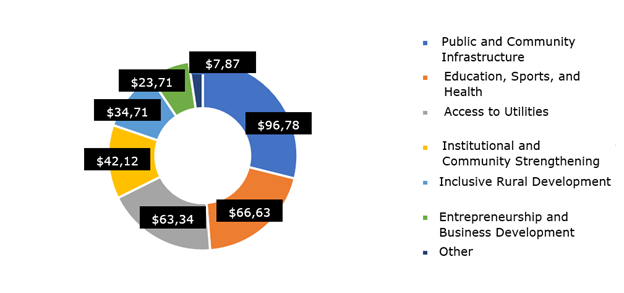
Table 5
Ecopetrol Group 2025 Results by Social and Relationship-Building Investment Lines
|
Investment Lines |
Results |
|---|---|
|
1. Education, Sports, and Health (Ecopetrol Educa) |
Student beneficiaries: 256,496 Health beneficiaries: 55,210 |
|
2. Inclusive Rural Development (Ecopetrol al Campo) |
Small and medium-sized producers: 2,663 |
|
3. Entrepreneurship and Business Development (Ecopetrol Emprende) |
No. of beneficiaries: 19,982 |
|
4. Public and Community Infrastructure (Ecopetrol Construye) |
Km. of the road intervened: 147.91 No. of structures built: 14 No. of infrastructures intervened: 53 |
|
5. Access to public utilities (Ecopetrol Agua y Vida and Ecopetrol Conecta) |
Water No. of beneficiaries: 6,494 Energy No. of beneficiaries: 5,862 Gas No. of connected users: 51,795 |
|
Relationship- Building: Institutional and Community Strengthening |
No. of beneficiaries: 81,422 |
Figure 11
Regional Breakdown of Social and Relationship-Building Investments, Ecopetrol Group 2025 (in millions of pesos)
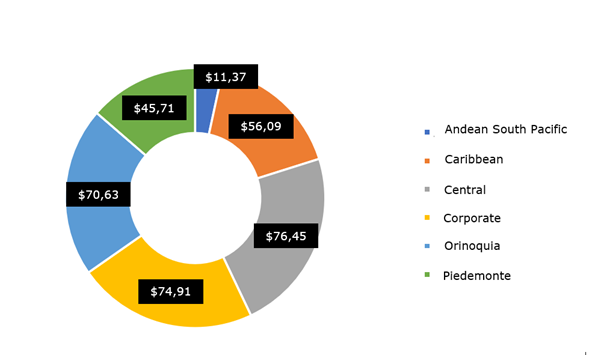
Note: Investments categorized as “Corporate” have a national scope, spanning multiple departments and municipalities. This category also covers investments made outside Colombia, such as those by ISA.
Table 6
Voluntary and Mandatory Social and Relationship-Building Investment by Region, Ecopetrol Group 2025 (in millions of pesos)
|
Region |
Social and voluntary relationship-building investment |
Mandatory social and relationship-building investment |
Total social and relationship investment |
|---|---|---|---|
|
Andean South Pacific |
$10,883 |
$0.483 |
$11,366 |
|
Caribbean |
$52,067 |
$4,026 |
$56,093 |
|
Central |
$67,025 |
$9,421 |
$76,447 |
|
Corporate |
$73,065 |
$1,842 |
$74,908 |
|
Orinoquía |
$65,365 |
$5,269 |
$70,634 |
|
Piedmont |
$32,157 |
$13,548 |
$45,705 |
|
Total |
$300,563 |
$34,589 |
$335,153 |
The resources executed by the Ecopetrol Group in 2025 under the works-for-taxes mechanism amount to $93,400 million pesos, mainly in the Public and Community Infrastructure, Education, Sports and Health, and Access to Public Services investment lines. Worth highlighting are projects for the improvement of the Yotoco - Buenos Aires - El Dorado road (Valle del Cauca), at an expense of $24,859 million pesos, and the improvement of the tertiary road in the municipality of San Onofre (Sucre), with an execution of $16,408 million pesos. Together, these projects represent 44% of total executed resources under this mechanism in 2025.
Figure 12
Execution of Works-For-Taxes by Investment Line, Ecopetrol Group 2025 (in millions of pesos)
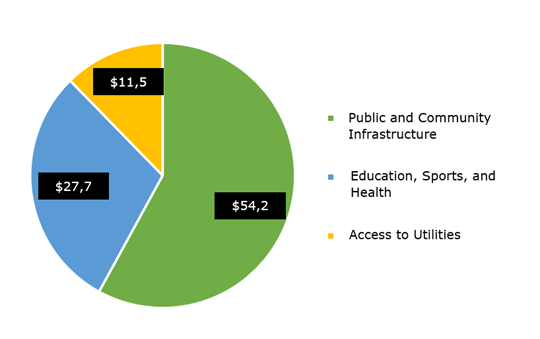
Table 7
Ecopetrol Group 2025 Works-For-Taxes Investments Results
|
Investment Line |
2025 Results |
|---|---|
|
Access to Public Services |
No. of beneficiaries (power): 2,830 |
|
Education, Sports, and Health |
No. of students benefited: 63,607 |
|
Public and Community Infrastructure |
Km. of intervened roads: 12.05 |
Programs for the Benefit of the Communities (PBC)
The investments made through the Programs for the Benefit of the Communities (PBCs) represent a direct contribution by companies in the hydrocarbons sector, funded by sustainable social investments stemming from contracts and agreements for exploration, production, and technical evaluation signed with the National Hydrocarbons Agency (ANH).
To fulfill the PBCs' contractual obligations, Ecopetrol has carried out social investment projects in partnership with the communities. These projects align with the country’s social policies and are based on the Sustainable Development Goals (SDGs), which the national government adopted through CONPES 3918 on March 15, 2018, as well as the Multidimensional Poverty Index (MPI).
Currently, 31 PBCs with contracts that include D and F and single annexes are being overseen by the Corporate Vice Presidency of Territorial Transformation and HSE. The following is a breakdown of the status of these PBCs:
Table 8
PBC Status
|
Status of PBCs with ANH-approved annexes |
Number of PBCs approved |
Number of projects |
PBC value approved by the ANH (in millions of pesos) |
|---|---|---|---|
|
In execution, analysis, and assignment |
23 |
76 |
$86,273 |
|
Finalized before the ANH |
2 |
2 |
$977 |
|
Drafted and awaiting approval from ANH * |
6 |
26 |
$20,360 |
|
Total |
31 |
104 |
$107,610 |
Note: *PBC drafted and filed with the ANH, pending approval
Mandatory social investment is underway in 12 municipalities, and the approved projects primarily affect the following SDGs:
Table 9
Distribution of Investment in Approved Projects Classified by the SDG Addressed
|
MAIN SDGS IMPACTED |
PROJECTS |
|---|---|
|
No poverty
|
19% in projects aimed at enhancing production. |
|
Sustainable cities and communities
|
14% in road construction projects, and improvements of educational institutions and infrastructure |
|
Decent work and economic growth
|
13% in projects on livestock production solutions and supply of elements and tools for community work |
|
Industry, innovation, and infrastructure
|
12% in the construction of community facilities, enclosures, and sports areas |


To define these projects, citizen participation and consultation processes were conducted between the communities and the Company. This process enabled the identification of needs and the prioritization of social investment to benefit 42,702 people in the departments of Casanare, Meta, Guajira, Santander, Cesar, Putumayo, Antioquia, and Huila.
In addition to the PBC with an annex, two other types of PBC are contemplated (Terms and Conditions and Agreement 5 of 2011). Although this social investment is contractually mandatory, the corresponding amount is defined by the operator.
During 2025, the Territorial Headquarters conducted a diagnosis for this type of PBC, identifying 36 PBCs under Terms and Conditions and Agreement 5 of 2011, with 64 projects currently in planning and execution.
In accordance with the above, the amount executed as of November 2025 is presented below:
Table 10
Value of PBCs Executed in 2025 by Regional
|
Regional |
No. of projects |
Value executed by 2025 (in millions of pesos) |
|---|---|---|
|
Central |
4 |
$668 |
|
Orinoquía |
3 |
$1,099 |
|
Piedemonte |
1 |
$69 |
|
Total |
8 |
$1,837* |
Note: The value of $1,837 includes the amount executed by November 2025, according to the information provided by Territorial Planning and Monitoring and HSE Management.
1 National Environmental Licensing Authority - ANLA
2 Directorate of the National Authority for Prior Consultation - DANCP
Web Content Viewer
Actions

