

PautaInternas
Actions
buscador_1
Actions
GHG emissions reduction
Actions
GHG emissions reduction
Mar 18, 2026

Greenhouse gases emissions reduction
Ecopetrol establishes a voluntary annual goal for reducing GHG emissions, based on the identification of initiatives planned to come into operation in the respective year. In 2025, the reduction achieved by new initiatives implemented was 561.454 tCO₂e. The cumulative annual reduction in GHG emissions in the period 2020 - 2025 is 2.831.363 tCO₂e.
 Reduction levers
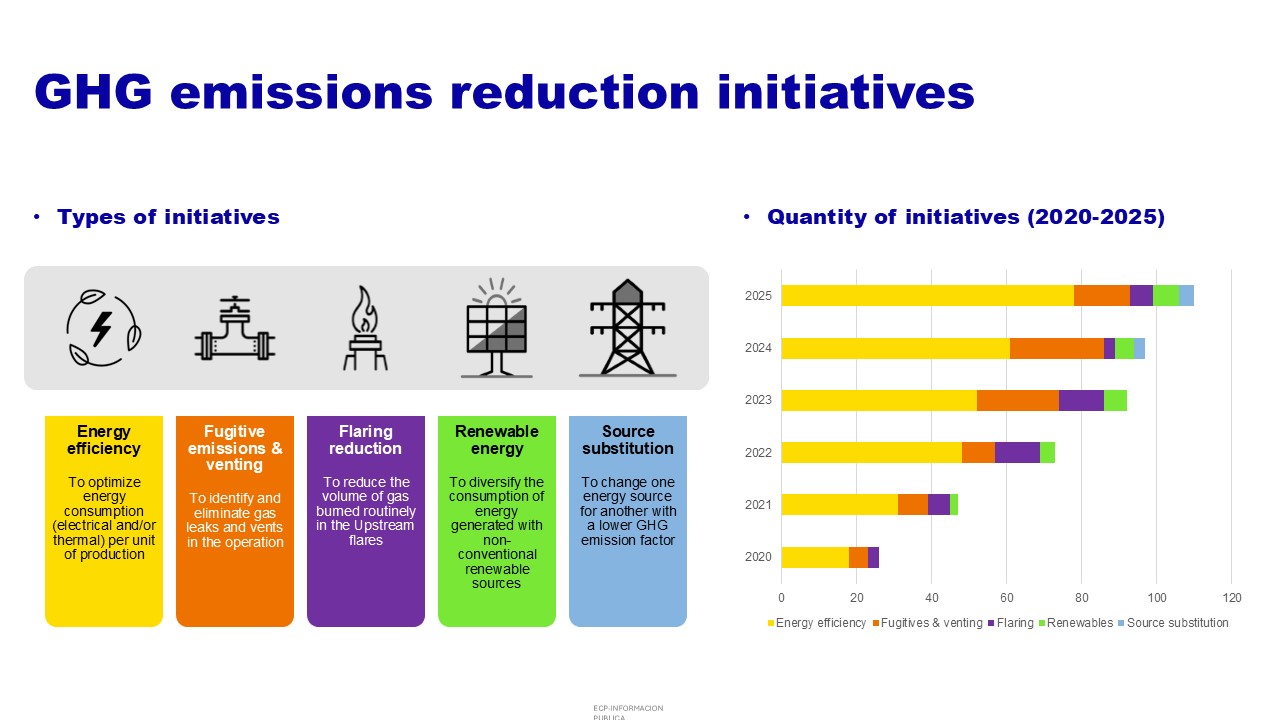
Operational GHG emissions reduction initiatives are classified into five groups: Energy Efficiency, Flaring Reduction, Fugitive and Venting Emissions, Renewable Energy, and Source Substitution. In 2025, 110 initiatives contributed with GHG emission reductions, of which energy efficiency initiatives accounted for ~72% of the total. In the 2020 - 2025 period, 445 GHG emissions reduction initiatives have reported performance towards meeting our targets.
GHG emission reduction initiatives
Types of initiatives:
-
Energy Efficiency
-
To reduce energy consumption per unit of production
-
Fugitive Emissions & Venting
-
To identify and eliminate gas leaks and ventings in production
-
Flaring reduction
-
To reduce the volume of gas routinely burned in flares by using it
-
Renewable energy
-
Diversify energy consumption with non-conventional renewable sources
-
Source substitution
-
To change one energy source for another with a lower GHG emission factor
 Economic instruments for emission management
The increase in the average global temperature of the planet has grown at an accelerated rate in recent decades, due to economy growth, and its dependence on production and use of fossil fuels (oil, natural gas, coal), among others, which have substantially increased the concentration of greenhouse gases (GHG) in the atmosphere.
With the signing of the Paris Agreement, the parties’ commitments aimed at limiting the temperature increase to well below 2°C. However, in 2018, the Intergovernmental Panel on Climate Change (IPCC) published a special report warning about the risks of temperature increases above 1.5°C, which means that the efforts to meet this target must increase.
Among the options available to reduce Ecopetrol Group’s emissions is the portfolio strategic review, which includes the use of an internal CO₂e price (value established by the Group as a price for the emission of a tonne of CO₂e) as a capital discipline criterion for the financial analysis of future investment opportunities.
An internal price consists of associating a cost to the CO₂e emissions to optimize the decision-making process when selecting projects with capital investment, to manage risks and/or to plan the business strategy. The adoption of this instrument for decision-making seeks to mitigate the emissions from future projects from the outset and in the most cost-effective manner possible. This internalization allows investment alternatives to be evaluated under a consistent framework, strengthening decision‑making with environmental criteria aligned with the energy transition and emission reductions throughout asset design and operation.
The mechanism facilitates the identification and feasibility of low‑carbon opportunities by enhancing the competitiveness of projects focused on energy efficiency, electrification, renewable energy, clean technologies, process changes, hydrogen, carbon capture, and innovation for emission reduction. This incentivizes the mobilization of capital toward initiatives that contribute to portfolio diversification and decarbonization, supporting the creation of long‑term sustainable value.
For this reason, the internal price applies to all the company's investment opportunities considering in its evaluation scope 1 and 2 emissions. In case the projects achieve reductions in scope 3, specifically in the categories related to acquisition of goods and services and use of products sold, they can discount 50% of the reductions to scope 1 and 2 emissions. Accordingly, the internal price is part of the base scenario for the economic evaluation of investment opportunities in all segments of the hydrocarbon business line: exploration and production, refining and transportation.
To leverage compliance with emission reduction targets, and to manage some of the climate change risks to which the industry is exposed, the Ecopetrol Group defined an internal price on carbon of:
|
Internal Carbon Princing |
|||
|---|---|---|---|
|
Period |
2024 |
2025 - 2029 |
+ 2030 |
|
Price |
25 USD/tCO₂e |
40 USD/tCO₂e |
50 USD/tCO₂e |
.

