Web Content Viewer
Actions
buscador
Actions
Web Content Viewer
Actions
Risk and dependency management
Apr 24, 2026

Mitigation hierarchy
Colombia is a country recognized as a megadiverse territory where complexity, fragility and biological diversity are interwoven with a dynamic and complex social, economic and political history and present, which influence ecosystems to face at least 5 major drivers of biodiversity loss, which are described below (Sustainable Development Goals Center for Latin America, 2019):
- Land-use change: This involves the transformation of natural ecosystems due to agriculture, deforestation, and urbanization. Forty percent of the country's land area has undergone severe transformation.
- Direct overexploitation of species: This is the depletion of wild fauna and flora that is used as a natural resource, in fisheries, forestry, or the collection of wildlife products.
- Biological invasions: These are caused by the introduction of wild or domesticated species into areas outside their original range. They produce devastating effects on islands and fragile ecosystems and threaten to homogenize the world's flora and fauna.
- Water and soil pollution: This occurs through the dumping of polluting substances or substances that alter the natural conditions of ecosystems. These substances can have local and regional impacts on biodiversity, and if not addressed, would contribute to the global collapse of populations and species.
- Climate change: Climate stresses on ecological systems are already being observed, with changes in the distribution or integrity of fauna and flora populations. If climate change continues, it could become the primary driver of biodiversity loss, as it affects other direct drivers.
To avoid, minimize, recover, restore, and offset these impacts, the company implements biodiversity and ecosystem services management processes aimed at generating the lowest amount and magnitude of residual impacts, based on the implementation of the mitigation hierarchy. To this end, the Mitigation Hierarchy is incorporated into project and operations planning.
Following the mitigation hierarchy, the Company harmonizes its activities around land use planning and environmental determinants by implementing environmental zoning as a measure to prevent negative impacts on biodiversity, complemented by mitigation, correction, and compensation measures. Residual impacts are offset by biodiversity preservation, restoration, and sustainable use actions implemented through conservation agreements with local communities, the purchase of land for conservation and restoration, and other measures. This is aligned with the company's principles of prevention and no net loss of biodiversity.
The mitigation hierarchy also prevents large-scale impacts and potential human rights impacts. In cases where direct impacts are identified, the Company activates the corporate prior consultation protocol, as established by the National Prior Consultation Authority of the Ministry of the Interior.
The Company manages these impacts and dependencies through four (4) axes:
-
Mitigation hierarchy and conceptualization of the conservation hierarchy.
-
Nature-based solutions, including Natural Climate Solutions strategies.
-
Knowledge generation through research and education on biodiversity.
-
Biodiversity Culture.
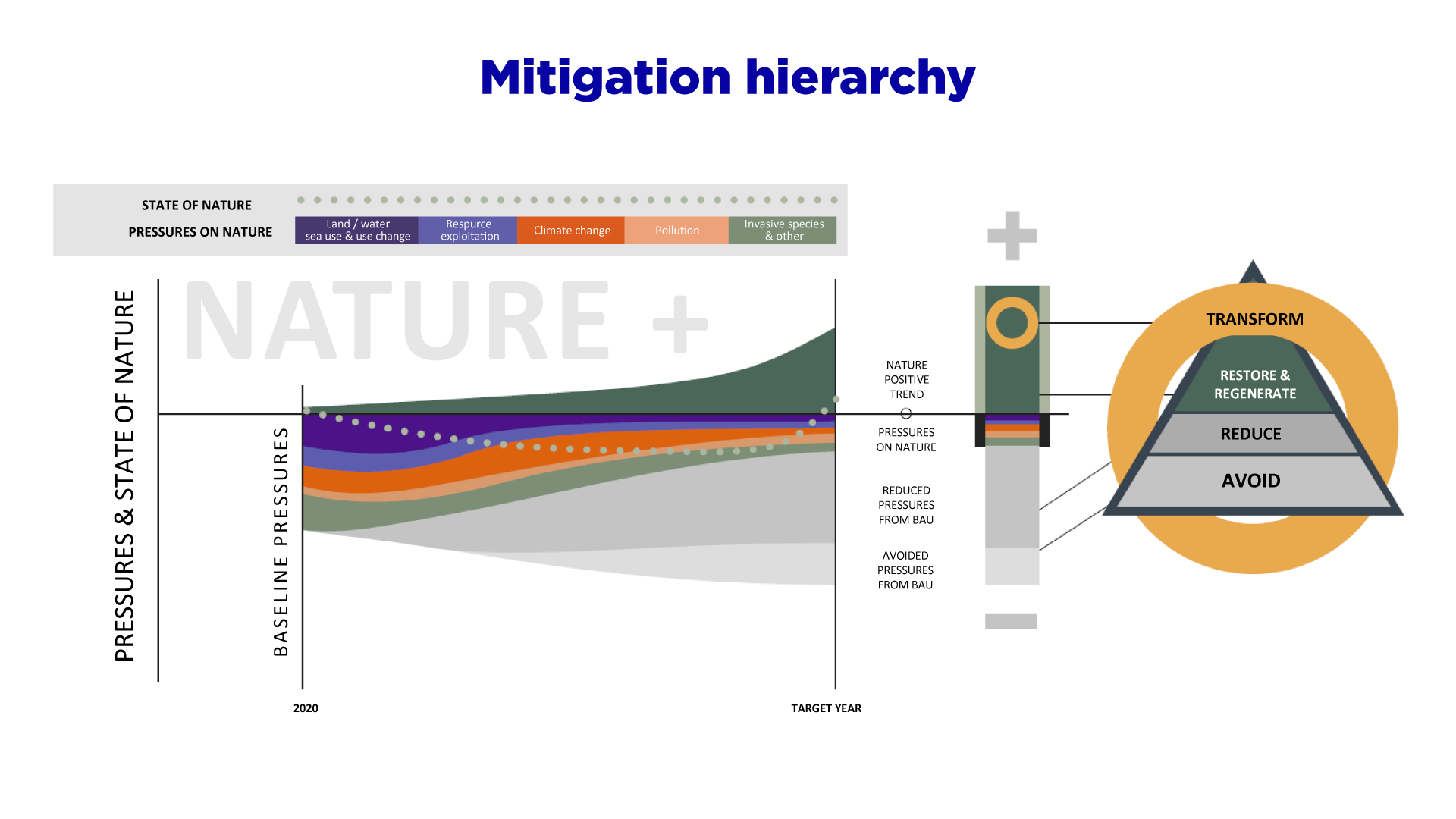
This hierarchy refers to the sequence of measures designed to manage the negative impacts of a project, work, or activity, in pursuit of no net loss of biodiversity, and should be applied to decision-making in the planning and design of this project.
In a complementary manner, progress is being made in the conceptualization of the Conservation Hierarchy, which goes beyond the mitigation of direct negative impacts to encompass any activity that affects nature. Conservation actions to address the loss of historical biodiversity from a voluntary perspective imply the same four-step framework for conservation actions: avoid/minimize/remediate/compensate in relation to the four R's: Restrain/Reduce/Restore/Renew:
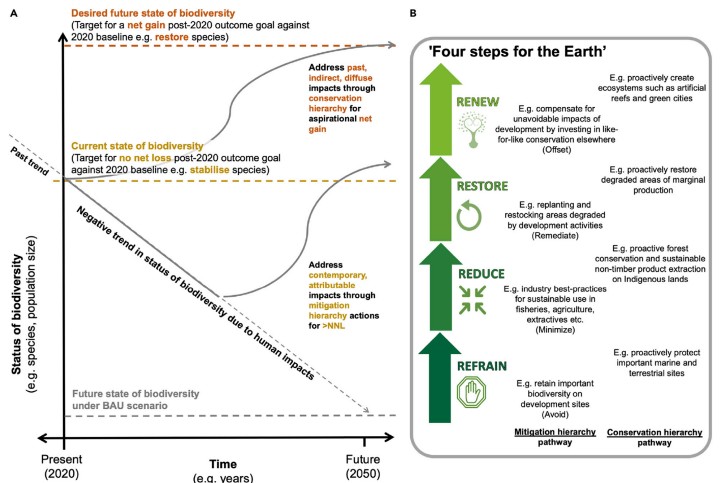
Adapted from: One Earth
Four Steps for the Earth: mainstreaming the post-2020 global biodiversity framework.
Significant impacts on biodiversity
Hydrocarbon activity in Colombia is held under an environmental zoning process that applies the mitigation hierarchy, avoiding, minimizing, and correcting impacts on biodiversity, and compensating only for residual impacts.
The main activities carried out in Ecopetrol's operations that may generate impacts on biodiversity are:
- The construction of platforms, operation fields and transportation infrastructure
- Use of substances that do not occur naturally
- Planned forest harvesting as part of maintenance, adaptation or construction of facilities
The main impacts that the Company's operations may have on biodiversity are:
- Land use change
- Habitat transformation
- Contamination
Area of influence
According to the Single Regulatory Decree of the Environment and Sustainable Development Sector (Decree 1076 of 2015): The area of influence is the area in which the significant environmental impacts caused by the execution of a project, work, or activity on the abiotic, biotic, and socioeconomic environments, in each of their components, are objectively manifested and, as far as possible, quantifiable. Its identification and delimitation are closely linked to environmental characterization. It should be noted that this area is larger than the areas of potential intervention of projects, works, or activities, given that its delimitation depends on the expansion of the impact and not on the operational area.
For more information, consult the Environmental Impact Studies (EIA) in the section: Legal Compliance and Relations .
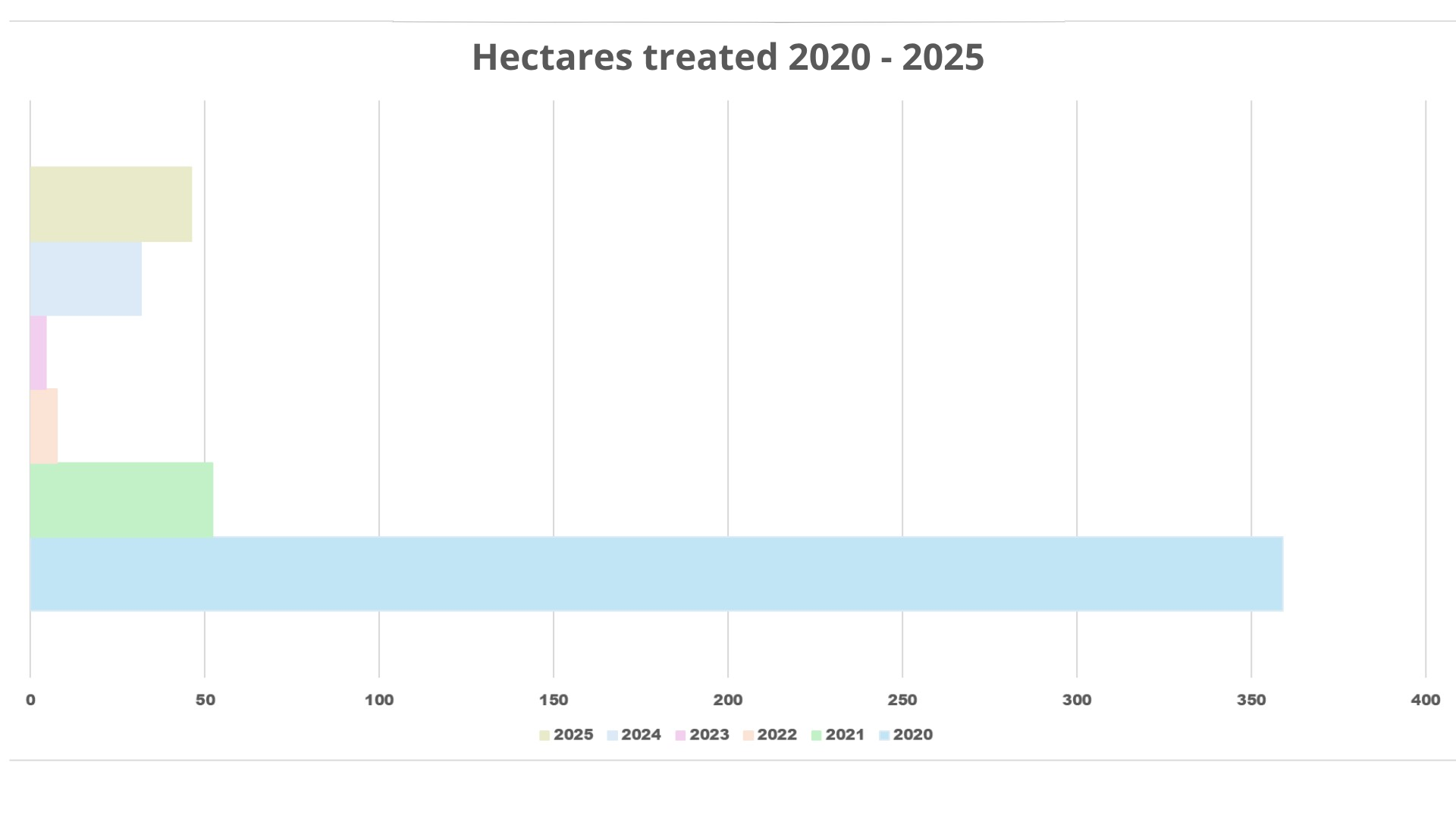
All impacts on biodiversity are reversible and the Company's guideline is to intervene in transformed areas. In 2025, the Company intervened 46.13 ha in total, of which 5.67 ha corresponded to natural ecosystems, mainly open shrub and semi-natural cover of secondary vegetation, with no interventions recorded in primary vegetation cover. The coverage with the highest intervention was secondary vegetation with 3.78 hectares, followed by open shrub with 1.89 hectares. The coverage with the highest intervention was secondary vegetation with 3.78 hectares, followed by open shrub with 1.89 hectares.
In addition, it converted 11.21 hectares of ecosystems of intensive use or modified. These interventions were carried out for the expansion and adaptation of locations. Likewise, the Company implemented environmental recovery actions in 29.25 hectares under the processes of dismantling and abandonment of wells.
The residual impacts of interventions carried out by Ecopetrol are subject to environmental compensation through the implementation of conservation or restoration projects using the actions, methods, mechanisms, quantities, and methods enabled in each environmental management instrument.
No impacts were generated related to the introduction of invasive species, pests and pathogens, species reduction, habitat transformation, or changes in ecological processes outside the natural range of variation (such as salinity or changes in water table).
Forest Utilization
Forest harvesting of 945.46 m3 of wood was carried out, corresponding to isolated trees in anthropogenic cover. The main activities where there was forest harvesting were maintenance of flow lines and power lines and maintenance of infrastructure, which indicates that there was no impact on new areas with respect to this activity. Each of the forest harvests is authorized and is subject to compensation measures that are monitored by the competent environmental authority.
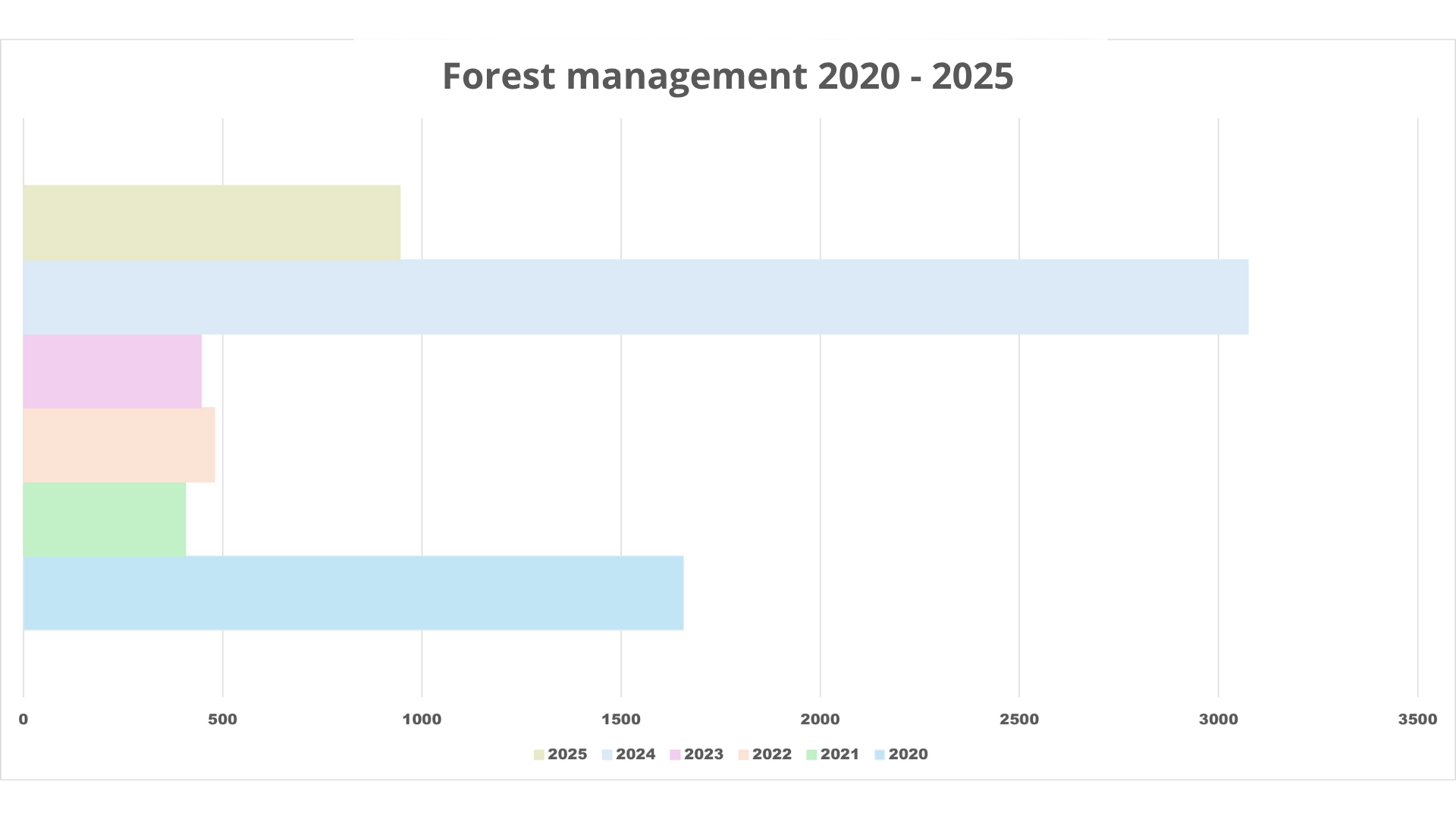
Intervened Hectares
Environmental Recovery Progress Report - Lisama Event 158
With regards to the 2018 event known as Lisama 158, the environmental recovery plan presents an implementation rate of 99%.
Biotic component
 Fauna
Fauna
- 2,400 recolonized individuals belonging to 13 species
- 135 Habitats and 34 Microhabitats built
- 18 wildlife monitoring campaigns
 Flora
Flora
- Achieved 43 voluntary conservation agreements with private property owners.
- 139.91 hectares at the beginning of the rehabilitation process.
- 112,704 seedlings of 86 native species of the region established on the 131.48 hectares.
- 9,083 seedlings planted on the Santo Tomás II property (La Tayra Lizama Ecoreserve).
- Planting of 30 trees on the Santo Tomás II property, as forestry compensation
 Monitoring
18 wildlife monitoring campaigns:
6 monitoring of fish and semi-aquatic fauna (2019):
- Number of Fish Records: 8,939 individuals
- Number of Amphibian-Reptile records: 22 individuals
- Number of records Mammals: 2 individuals
6 terrestrial and arboreal fauna monitoring (2019):
- Number of Amphibian records: 12 individuals
- Number of Reptile records: 258 individuals
- Number of bird records: 755 individuals
- Number of Mammal records: 59 individuals
6 monitoring of 13 reintroduced species and other species (2020):
- Number of reinstated records: 681 individuals
- Registration No. of other species:
- Number of Amphibian records: 1,186 individuals
- Number of Reptile records: 4,078 individuals
- Number of bird records: 10,038 individuals
- Number of Mammal records: 850 individuals
Overall, the goal of significantly increasing abundance and richness was met as wildlife monitoring was conducted, demonstrating the success of habitat and microhabitat construction and maintenance, as well as reintroductions.
Flora Monitoring - Permanent Plots:
- Establishment of 14 permanent monitoring plots along the 22.4 kilometers of the hydrographic unit of the Lisama stream and Caño Muerto, where the development of vegetation under natural conditions was verified after the contingency, where the balance and normal growth trend behavior of riparian vegetation was evident.
Flora Monitoring – Impregnated stems:
- Execution of 9 monitoring campaigns on impregnated stems
- Monitoring of the 3,721 individuals affected by the emergency, from July 2018 to June 2019, showed no evidence of any impact on their growth or development due to the initial exposure to hydrocarbons.
5 monitoring campaigns for the process of rehabilitation of vegetation on properties with Voluntary Conservation Agreements versus reference ecosystems
- Areas in the process of rehabilitation: 1,322 individuals of 97 species in 33 plots.
- Reference Ecosystems: 1,125 individuals of 92 species in 33 plots.
- After calculating the indicators density, diversity, similarity, natural regeneration index, vertical occupation, horizontal occupation, survival index, richness and abundance and making comparisons between both treatments (rehabilitation – reference), it can be indicated that in the fourth monitoring there is more closeness between the treatments in terms of structure and composition, expecting that in the sixth and last monitoring, particularly the values in similarity will be equal to or greater than 50% in all cases, since for the other indicators this goal has already been met.
- Additional activity Photo trapping: 1,433 individuals of 42 species including reptiles, birds and mammals have been recorded, which demonstrates the success and benefits of the vegetation rehabilitation process.
6 monitoring studies carried out on vegetative development on properties with Voluntary Conservation Agreements (2025).
- Six monitoring campaigns were conducted for established individuals, demonstrating optimal growth and development typical of the species planted in areas with voluntary conservation agreements, demonstrating the success of the forestry efforts implemented.
1 Ecological Condition Assessment (System Comparison 2018 versus 2020)
Fish: No significant variation was observed between the 2018 and 2020 data.
- Number of records 2020: 2,922 individuals
- No. of species 2020: 55
- No. of species 2018: 51
Birds: There were no significant variations between bird species records from 2018 and 2020.
- Number of records 2020: 1,460 individuals
- No. of species 2020: 122
- No. of species 2018: 127
Soundscape: The results showed an increase in acoustic activity in 2020 compared to 2018.
- Number of registrations 2020: 4405
Vegetation: It was determined that there was no impact from hydrocarbon exposure.
- Number of records 2020: 676 individuals
- Number of records 2018: 602 individuals
- No. of species 2020: 107
- No. of species 2018: 81
Microorganisms: Decrease in rapid response organisms to HC degradation, compared to 2018.
4 biodiversity and ecosystem services monitoring campaigns (vegetation, fish, microorganisms):
Vegetation: 1,090 individuals recorded from 257 species.
Fish: 4,921 individuals recorded from 52 species.
Microorganisms:
- Bacteria: 7,025 OTUs in soil, 5,843 in sediment and 2,527 in water,
- Fungi: 1,842 OTUs in soil, 710 in sediment and 711 in water.
At a general level, the results obtained showed signs of stability for the fish group and recovery for the vegetation and microorganism groups (fungi and bacteria in soil, water and sediment), which demonstrates the benefits and effectiveness of the actions established in the Lisama 158 Environmental Recovery Plan.
La Tayra Lizama Ecoreserve (Santo Tomás II Property)
In the La Tayra Lizama Ecoreserve, 9,083 individuals of 58 native species have been planted, and 1,370 individuals of 39 species of reptiles, birds, and mammals have been recorded through camera trapping. It is worth noting that, thanks to birdwatching initiatives such as Global Big Day and Bird Day-VRC, 1,033 individuals of 150 bird species have been recorded.
Based on the above, the presence of fauna recorded in this area demonstrates the success, benefits and effectiveness of the vegetation rehabilitation process in the La Tayra Lizama Ecoreserve, where a supply of resources necessary for its subsistence is currently being provided, with these areas being used by fauna as refuge, foraging, feeding, and breeding areas, among others.
Abiotic Component
 Water
Water
- Cleaning of 27,226 meters above the La Muerte canal and La Lisama stream
 Soil
Soil
- 18 defense works dismantled and refurbished
- Reconformed outcrop zone
 Monitoring:
- Development of 16 water monitoring campaigns, 7 of nutrients in water and sediments and 9 campaigns to verify fine cleaning.
- 5,745 Samples analyzed (water, soil, air, sediments, hydrobiological).
- 4 Monitoring of water and sediment nutrients and their impact on hydrobiological communities.
 Monitoring
- Development of 16 water monitoring campaigns, 7 of nutrients in water and sediments and 9 campaigns to verify fine cleaning.
- 5,745 Samples analyzed (water, soil, air, sediments, hydrobiological).
- 4 Monitoring of water and sediment nutrients and their impact on hydrobiological communities.
Socio-economic Component
 Social
- 11 voluntary investment projects prioritized through tripartite dialogue spaces.
- Participation of 17 tripartite spaces with the community and environmental authorities of the region.
- 5 follow-up tours in the field with the community and Institutionality.
- More than 50 environmental trainings with the participation of the community in the area of influence and artisanal fishermen
- 8 prioritized projects between the CDPMM, Institutionality, Community and Ecopetrol.
- 1 diploma in ecological rehabilitation, more than 50 environmental trainings, 19 training programs with SENA.
- 32 spaces for relations with territorial entities, institutions and local authorities, 10 tree planting days with the community, 1 meeting of opportunities for the sustainability of the fishing sector, support for 11 campaigns on the ban on striped catfish (Pseudoplatystoma magdaleniatum), development of 5 home and school garden programs in educational institutions and communities of influence.
- 7 courses to strengthen the institutional management capacity of the JAC in strategic alliance with ESAP.
- 1 certification process in fisheries monitoring UNIMAGDALENA – SEPEC.
- 1 environmental awareness and education campaign with the community.
- Development of 98.9% progress in the spaces for tripartite dialogues, meetings with fishermen, follow-up tours with the community and institutions and spaces for relations with territorial entities, institutions and local authorities.
- Progress in the implementation of the Communications Strategy with the development of 2,968 gatherings, 174 sketches, 124 loudspeaker days, 17 schools of the water teacher, 5 magazines La Voz de Lizama, Facebook page of the water teacher (2,146 followers).
- 1 diploma in ecological rehabilitation, more than 50 environmental trainings, 19 training programs with SENA.
The species of fauna and flora affected in 2024 are reported below according to the IUCN:
Fauna:
|
IUCN status - Fauna |
Species | Individuals |
|
Deficent data (DD) |
Hidrochoerus isthmius |
1 |
|
Least concern (LC) |
Coragyps atratus |
5 |
|
Dasypus novemcinctus |
2 |
|
|
Iguana iguana |
1 |
|
|
Caiman crocodilus |
1 |
|
|
Scinax ruber |
1 |
|
|
All individuals |
10 |
|
|
Total species |
6 |
|
Flora
|
IUCN status - Flora |
Number of species |
Species |
|
Least concern (LC) |
158 |
Abarema jupunba, Acacia mangium, Acromia aculeata, Albizia guachapele, Albizia saman, Alchornea, discolor, Alchornea triplinervia, Andira surinamensis, Aniba sp, Annona montana, Annona muricata, Apuleia leiocarpa, Astrocaryum jauari, Astrocaryum murumuru, Astronium graveolens, Attalea maripa, Bactris gasipaes, Bauhinia tarapotensis, Bellucia grossularioides, Bellucia pentámera, Bronwenia cornifolia, Bunchosia argéntea, Byrsonima crassifolia, Calliandra sp., Casearia arborea, Casearia commersoniana, Casearia corymbosa, Cassia fistula, Cecropia engleriana, Cecropia ficifolia, Cecropia membranácea, Cecropia peltata, Ceiba pentandra, Cereus hexagonus, Cestrum racemosum, Chloroleucon mangense, Citrus x aurantium, Clarisia biflora, Coccoloba caracasana, Cochlospermum orinocense, Cordia alliodora, Cordia gerascanthus, Coutarea hexandra, Cupania americana, Cupania cinérea, Cupania latifolia, Curatella americana, Delonix regia, Enterolobium cyclocarpum, Erythrina fusca, Erythrina poeppigiana, Eschweilera paviflora, Euterpe precatoria, Ficus benjamina, Ficus crassiuscula, Ficus donnell, Ficus insípida, Ficus soatensis, Ficus sp., Fuchsia paniculata, Garcinia madruno, Genipa americana, Gliricidia sepium, Gmelina arborea, Guarea guidonia, Guarea sp., Guatteria cargadero, Guatteria schomburgkiana, Guatteria sp., Guazuma ulmifolia, Guettarda elliptica, Heliocarpus americanus, Hevea brasiliensis, Hieronyma alchorneoides, Hirtella elongata, Inga edulis, Inga ornata, Inga sp, Jacaranda caucana, Jacaranda copaia, Jacaratia digitata, Lacmellea edulis, Lecythis cf. minor Jacq, Licania tomentosa, Mabea trianae, Machaerium capote, Maclura tinctoria, Magnolia caricifragrans, Malpighia glabra, Matayba elegans, Matayba scrobiculata, Matisia cordata, Melicoccus bijugatus, Miconia dolichorrhyncha., Miconia splendens, Morus alba, Muntingia calabura, Myrcia sp., Myrsine guianensis, Nectandra acuminata, Nectandra sp., Neltuma juliflora, Ochroma pyramidale, Ocotea bofo, Ocotea longifolia, Oxandra espintana, Parkia panurensis, Parkia pendula, Pentagonia spathicalyx, Persea americana, Piptadenia opacifolia, Piptadenia pteroclada, Piptocoma discolor, Pithecellobium dulce, Platymiscium pinnatum, Pourouma cecropiifolia, Pouteria caimito, Protium heptaphyllum, Pseudosamanea guachapele, Psidium guajava, Randia aculeata, Rollinia mucosa, Sapium glandulosum, Sapium laurifolium, Schefflera morototoni, Schizolobium parahyba, Senna siamea, Simarouba amara, Siparuna aspera, Spathodea campanulata, Spondias mombin, Sterculia apetala, Swartzia leptopetala, Syagrus orinocensis, Syzygium jambos, Syzygium malaccense, Tabebuia rosea, Tapirira guianensis, Tapirira obtusa, Tecoma stans, Terminalia catappa, Toxicodendron striatum, Trema micrantha, Trichanthera gigantea, Triplaris americana, Trophis caucana, Vachellia farnesiana, Vernonanthura patens, Virola elongata, Virola sebifera, Vismia baccifera, Vismia minutiflora, Xylopia aromatica, Xylopia emarginata, Zanthoxylum djalma, Zanthoxylum rigidum, Zanthoxylum rhoifolium, Zygia longifolia |
|
Deficent data (DD) |
2 |
Artocarpus altilis, Mangifera indica |
|
Not assessed (NA) |
22 |
Apeiba aspera, Bauhinia picta, Citharexylum sp., Citrus limon, Citrus sinensis, Cocos nucifera, Croton lechleri, Didymopanax morototoni, Elaeis guineensis, Guadua angustifolia, Leucaena leucocephala, Lindackeria paludosa, Luma apiculata, Miconia pilgeriana, Micropholis venulosa, Nectandra reticulata, Palicourea lariantha, Parkia balslevii, Solanum grandiflorum, Theobroma cacao, Vismia schultesii y Vochysia braceliniae. |
|
Vulnerable (VU) |
3 |
Cedrela odorata, Cedrella fissilis, Handroanthus chrysanthus |
|
Total species |
185 |
|
Operations in areas of high biodiversity value (Exposure and Assessment)
Total area of Ecopetrol's assets
Ecopetrol S.A. currently operates in 138 sites with an environmental license, covering a total area of 1,222,373.25 hectares. Of this total, 209,492 hectares represent the current spatial footprint of operational activities. For the 2025 report, only the number of sites and areas with actual intervention during the year are reported. Operational areas refer to those that were effectively intervened, usually representing a smaller portion of the total authorized area.
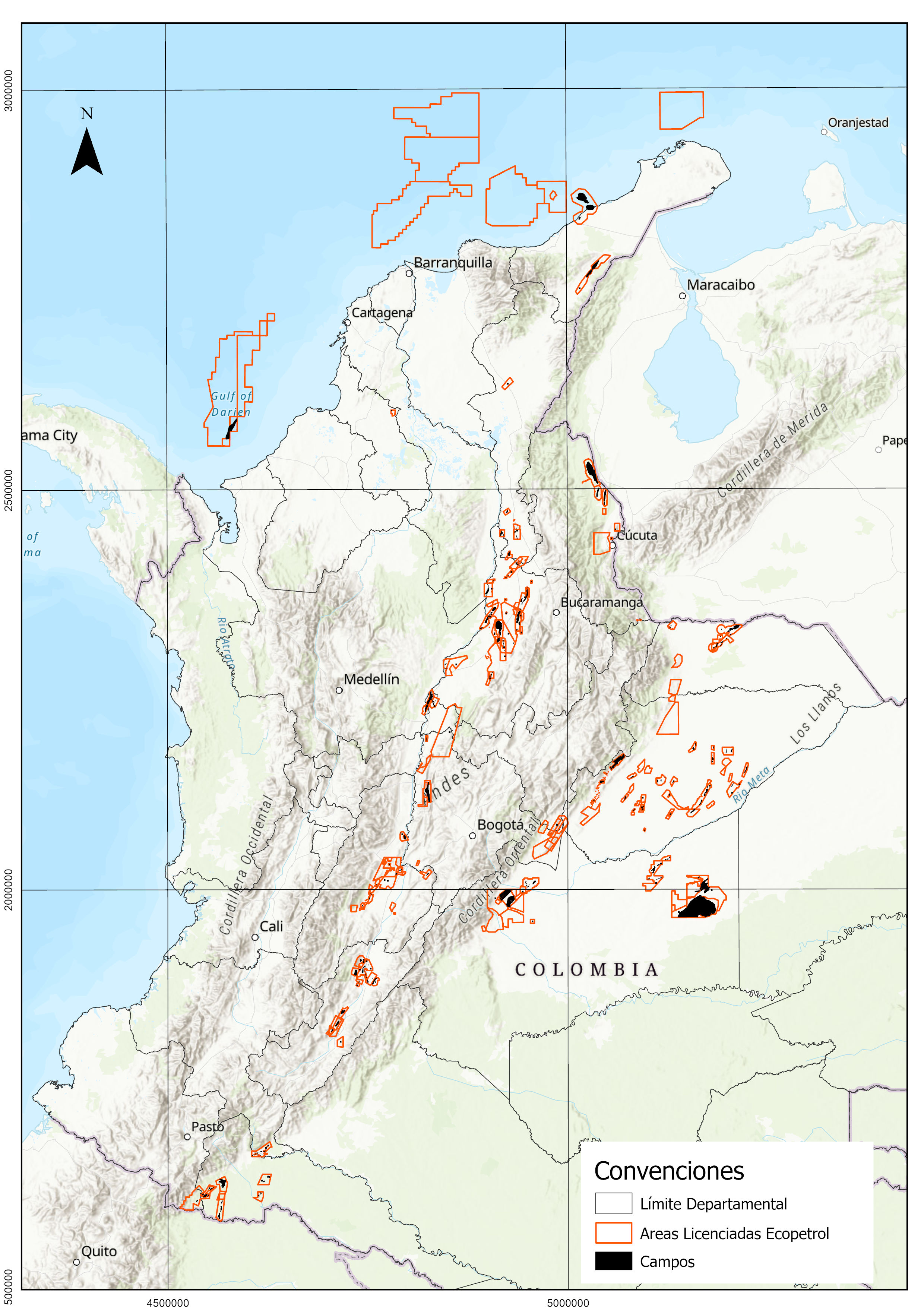
Map of licensed areas with operational fields.
Source: Ecopetrol S.A., Environmental Management Department
IUCN protected areas and Ecopetrol licensed areas
Ecopetrol SA declares that it does not have, nor does it plan to engage in, exploration, production, or refining activities in areas of high biodiversity value classified by the International Union for Conservation of Nature (IUCN) as categories I to IV. Likewise, Ecopetrol has no projects or operations in areas declared World Heritage Sites by UNESCO, nor does it plan to intervene in these areas.

Map of licensed areas with operational fields and IUCN category I to IV protection areas.
Source: Ecopetrol SA, Environmental Management Department
Areas of Ecopetrol's assets in DRMI in the Central Region
Ecopetrol operates four assets located near two Protected Areas, known as Integrated Management Regional Districts (IMRDs)—equivalent to IUCN Category VI—named La Ciénaga San Silvestre and La Serranía de los Yariguíes, in the department of Santander. The IMRDs contemplate the sustainable use of natural resources. Ecopetrol legally operates these four production assets, which were declared by regional authorities 50 years after the company began operations in the area.
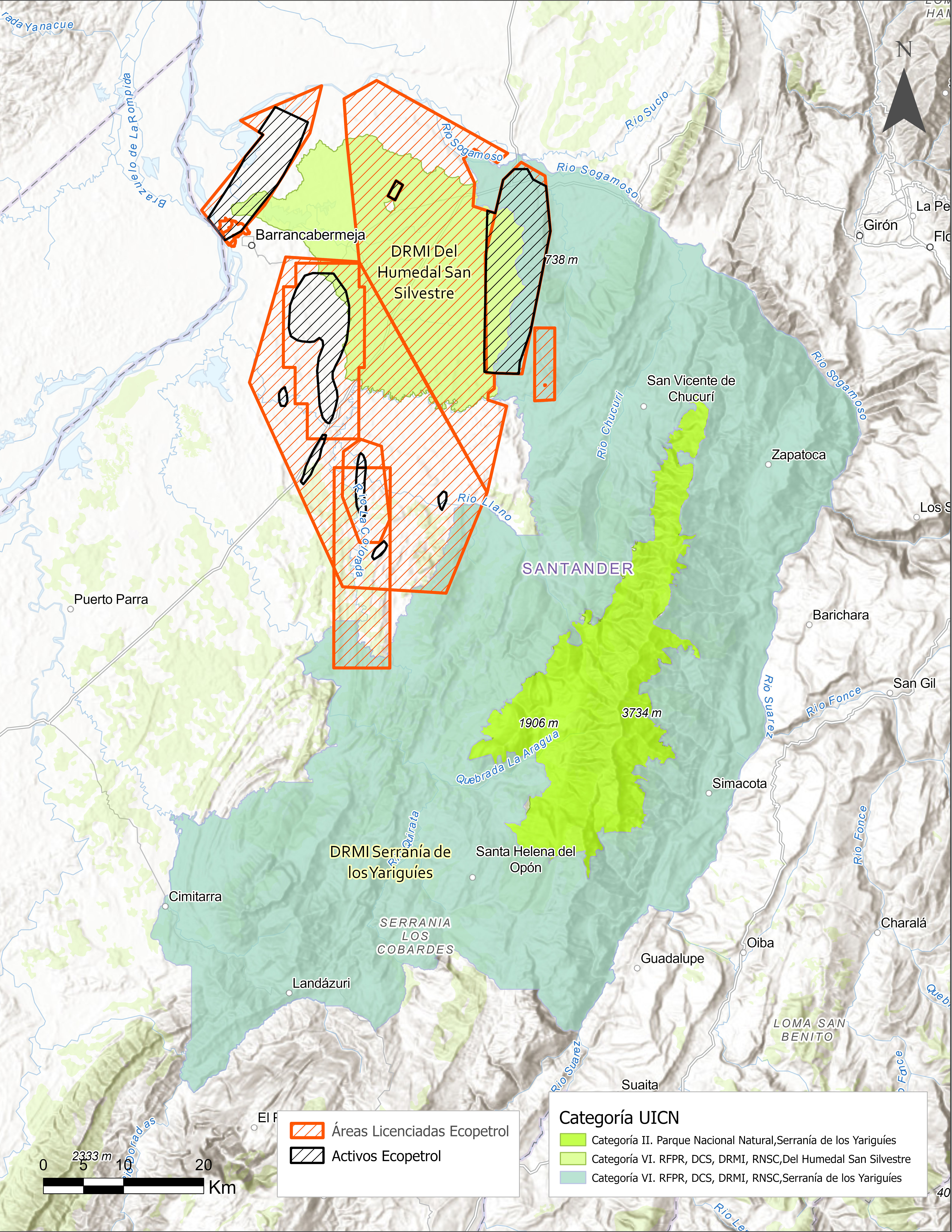
Source: Ecopetrol S.A. Environmental Management Department
Ecopetrol's operations center in protected areas or areas of great value for biodiversity
|
Operation Center/Fields |
Description/ Licensed Area |
Type |
Geographical location |
Respect position to the protected area |
Subsurface and underground soils |
Type of Operation |
Size in km2 |
Attributes of the protected area or area of high value |
Appears on protected lists |
|
Pauto Development Area |
PIEDEMONTE |
Direct operation |
Yopal, Casanare |
Protected area within the area of operation |
Yes |
Production |
0,18 |
Reserva Natural de la Sociedad Civil |
Yes, IUCN Category VI |
|
Peñas Blancas Casabe Field |
CASABE |
Direct operation |
Yondó, Antioquia |
Protected area within the area of operation |
Yes |
Production |
0,07 |
Reserva Natural de la Sociedad Civil |
Yes, IUCN Category VI |
|
Huila North Field |
HATO NUEVO |
Direct operation |
Tello, Huila |
Protected area within the area of operation |
Yes |
Production |
0 |
Reserva Natural de la Sociedad Civil |
Yes, IUCN Category VI |
|
Quebrada Roja Field |
QUEBRADA ROJA |
Direct operation |
Barrancabermeja, Santander |
Area of operation within the AP |
Yes |
Production |
2,18 |
Distritos Regionales de Manejo Integrado |
Yes, IUCN Category VI |
|
Tibú Field |
TIBU |
Direct operation |
Tibú, Norte de Santander |
Protected area within the area of operation |
Yes |
Production |
0,11 |
Reserva Natural de la Sociedad Civil |
Yes, IUCN Category VI |
|
Tibú Field |
TIBU |
Direct operation |
Tibú, Norte de Santander |
Protected area within the area of operation |
Yes |
Production |
0,4 |
Reserva Natural de la Sociedad Civil |
Yes, IUCN Category VI |
|
Center |
LA CIRA-INFANTAS |
Direct operation |
Simacota, Santander |
Area of operation within the AP |
Yes |
Production |
0 |
Distritos Regionales de Manejo Integrado |
Yes, IUCN Category VI |
|
The Cira Infantas |
LA CIRA-INFANTAS |
Direct operation |
Simacota, Santander |
Area of operation within the AP |
V |
Production |
4,81 |
Distritos Regionales de Manejo Integrado |
Yes, IUCN Category VI |
|
Lisama |
LISAMA-NUTRIA |
Direct operation |
San Vicente De Chucurí, Santander |
Area of operation within the AP |
Yes |
Production |
70,81 |
Distritos Regionales de Manejo Integrado |
Yes, IUCN Category VI |
|
Lisama |
LISAMA-NUTRIA |
Direct operation |
San Vicente De Chucurí, Santander |
Area of operation within the AP |
Yes |
Production |
85,64 |
Distritos Regionales de Manejo Integrado |
Yes, IUCN Category VI |
|
Lisama |
LISAMA-NUTRIA |
Direct operation |
San Vicente De Chucurí, Santander |
Protected area within the area of operation |
Yes |
Production |
0 |
Reserva Natural de la Sociedad Civil |
Yes, IUCN Category VI |
|
Llanito |
LLANITO |
Direct operation |
Barrancabermeja, Santander |
Area of operation within the AP |
Yes |
Production |
7,81 |
Distritos Regionales de Manejo Integrado |
Yes, IUCN Category VI |
|
Colorado field |
COLORADO |
Direct operation |
San Vicente De Chucurí, Santander |
Area of operation within the AP |
Yes |
Production |
6,16 |
AICAS |
International distinction to an 'Important Area for the Conservation of Birds and Biodiversity' |
|
Center |
COLORADO |
Direct operation |
Simacota, Santander |
Area of operation within the AP |
Yes |
Production |
0 |
AICAS |
International distinction to an 'Important Area for the Conservation of Birds and Biodiversity' |
|
Center |
SAN LUIS |
Direct operation |
Simacota, Santander |
Area of operation within the AP |
Yes |
Production |
1,53 |
AICAS |
International distinction to an 'Important Area for the Conservation of Birds and Biodiversity' |
|
Lloriquies |
COLORADO |
Direct operation |
El Carmen, Santander |
Area of operation within the AP |
Yes |
Exploration |
0 |
AICAS |
International distinction to an 'Important Area for the Conservation of Birds and Biodiversity' |
|
Moriche field |
MORICHE |
Direct operation |
Puerto Boyacá, Boyacá |
Area of operation within the AP |
Yes |
Production |
0,4 |
AICOMS |
Areas of Importance for Bat Conservation |
|
Lisama |
LISAMA-NUTRIA |
Direct operation |
San Vicente De Chucurí, Santander |
Area of operation near to the AP |
Yes |
Production |
0 |
AICOMS |
Areas of Importance for Bat Conservation |
Management of impacts from environmental compliance
With regard to management in the prevention, mitigation and correction of potential impacts that could affect biodiversity, the following actions are highlighted:
- 1 feasibility diagnoses in project and operations planning
- 9 environmental studies in exploratory and production projects, with biotic characterization.
- 106 fauna samples
- 18 flora samplings
- 83 hydrobiological sampling points
For more information, please consult the section: Legal Compliance and Relationships .
Among the most important results in biodiversity conservation with mandatory investments (including environmental offsets and Lisama 158) for the year 2025 are:
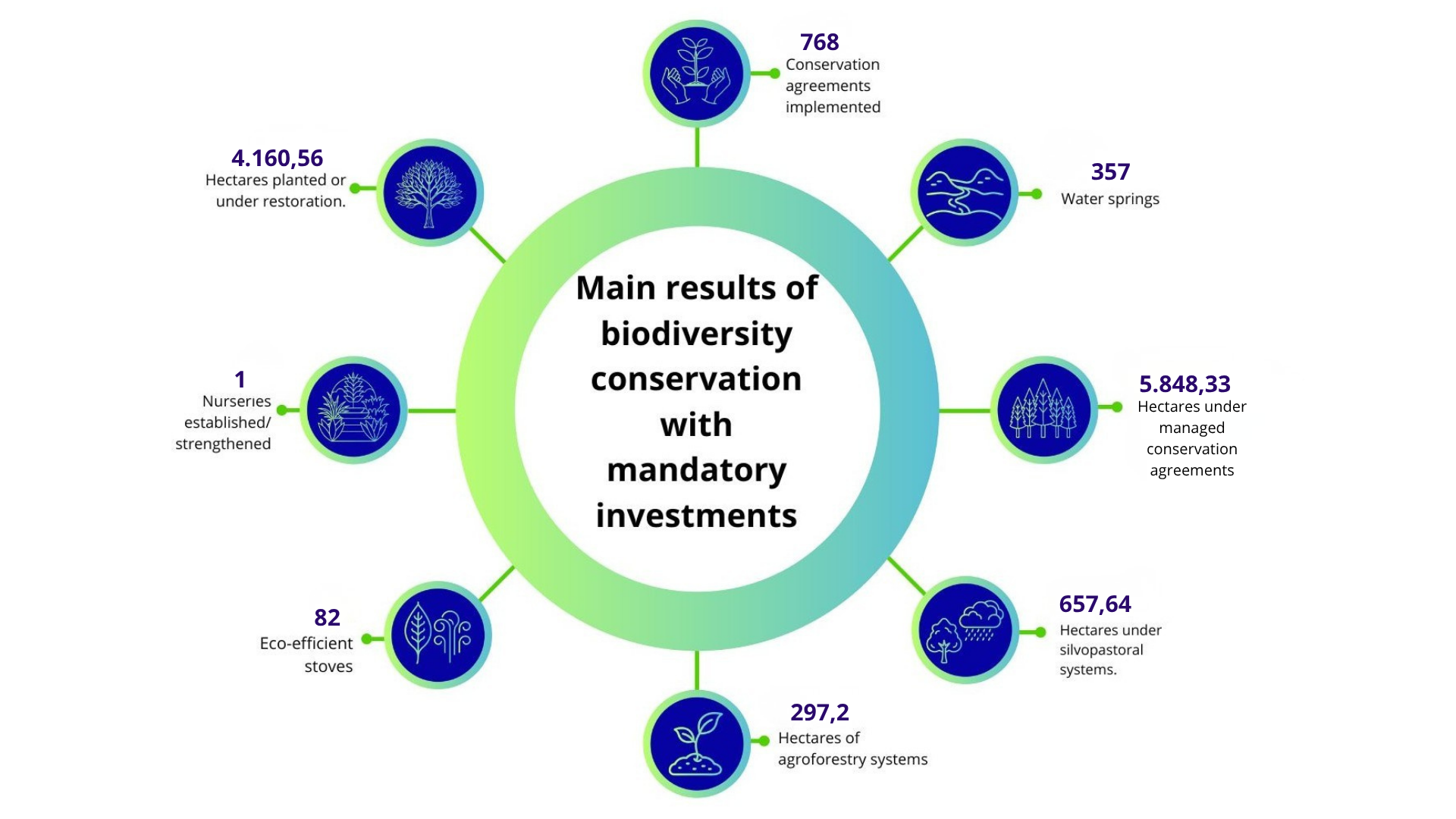
Strategy for environmental compensation and 1% investment
In compliance with the obligations of environmental compensation and investment of not less than 1% for the use of water from natural sources, Ecopetrol S.A seeks the conservation of biodiversity, its ecosystem services and natural capital in prioritized areas by the company through different actions that involve i) the signing of voluntary conservation agreements with local communities, ii) purchase of land in strategic conservation areas, iii) ecological restoration, among other actions.
Currently, the conservation agreements are the most widely implemented in the company and seeks, in addition to conserving, promoting the sustainable use of biodiversity and other natural resources through incentives such as agroforestry systems, silvopastorals, ecological gardens, eco-efficient stoves and wood energy orchards and more. These actions promote the reduction of tensioners in each of the properties where they are implemented.
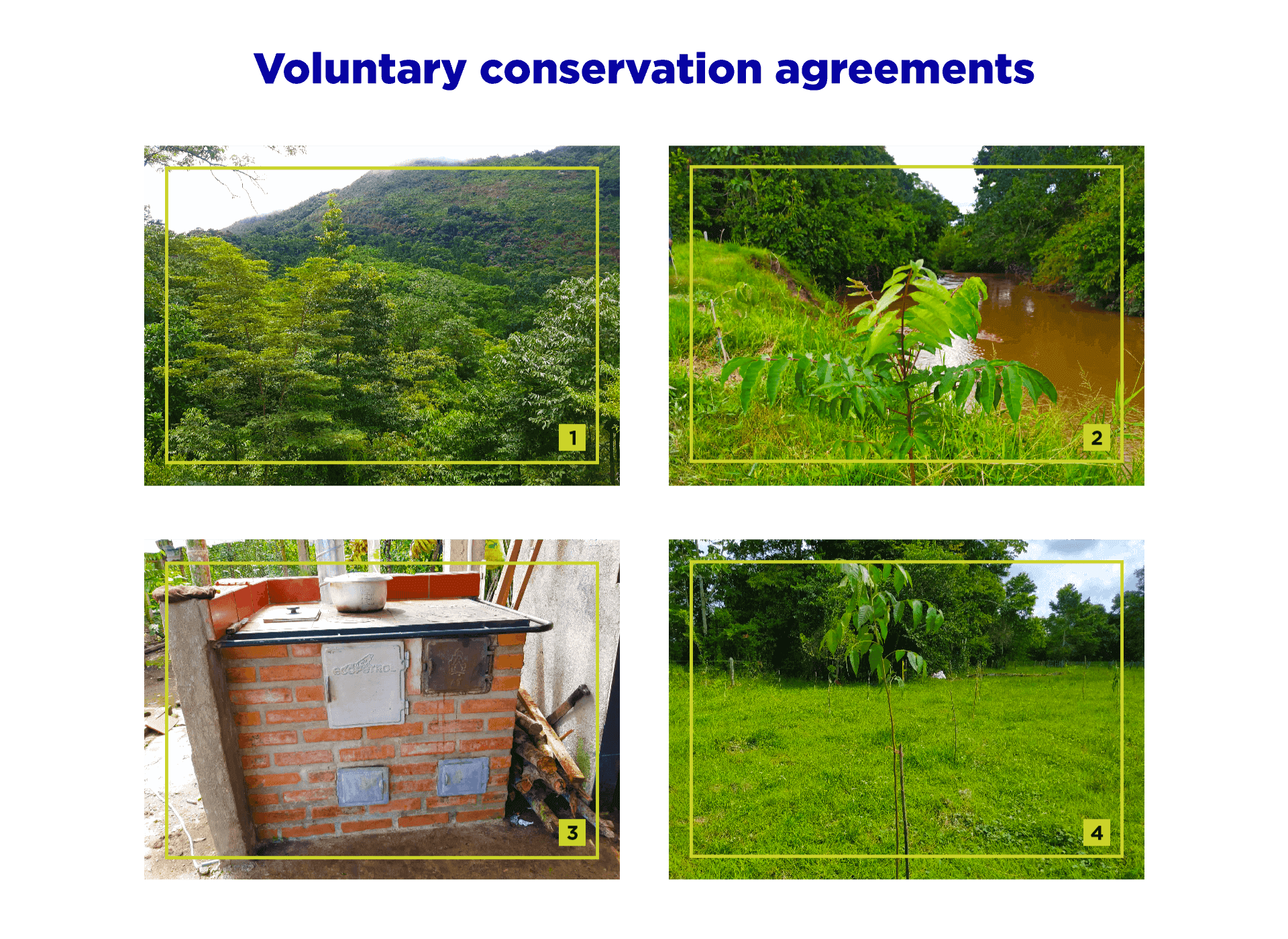 Actions implemented under voluntary conservation agreements.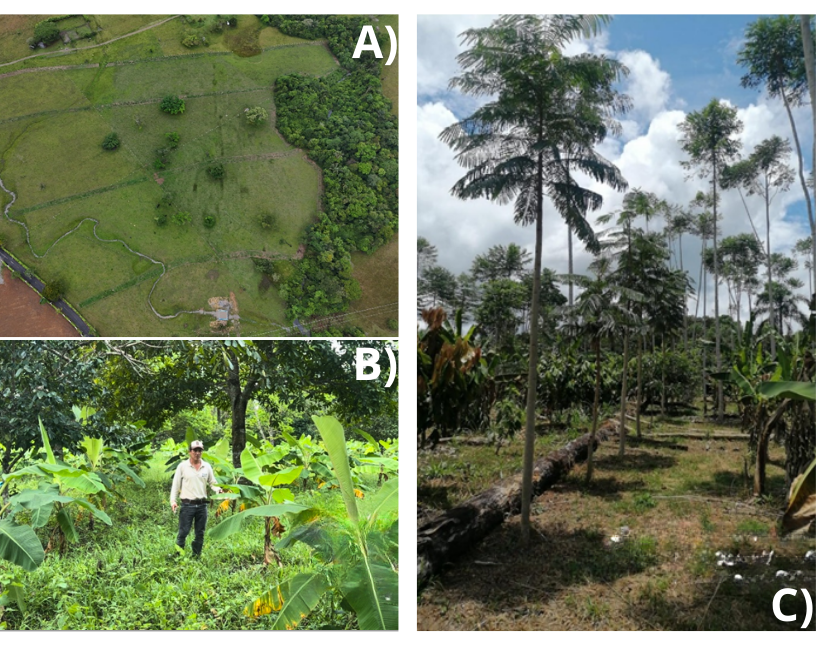
Actions implemented in voluntary conservation agreements
A. Conservation area and silvopastoral system of the Acacías municipality. Source: BQS SAS B. Agroforestry system of the Aguazul municipality. Source: Piedemonte Environmental Coordination. C. Agroforestry system of the Puerto Caicedo municipality. Source: Andean Environmental Coordination.
In turn, the conservation agreements seek to accompany the participant in the planning of their property through a participatory and concerted design, where an area is established for conservation.
Example of land design conservation agreement
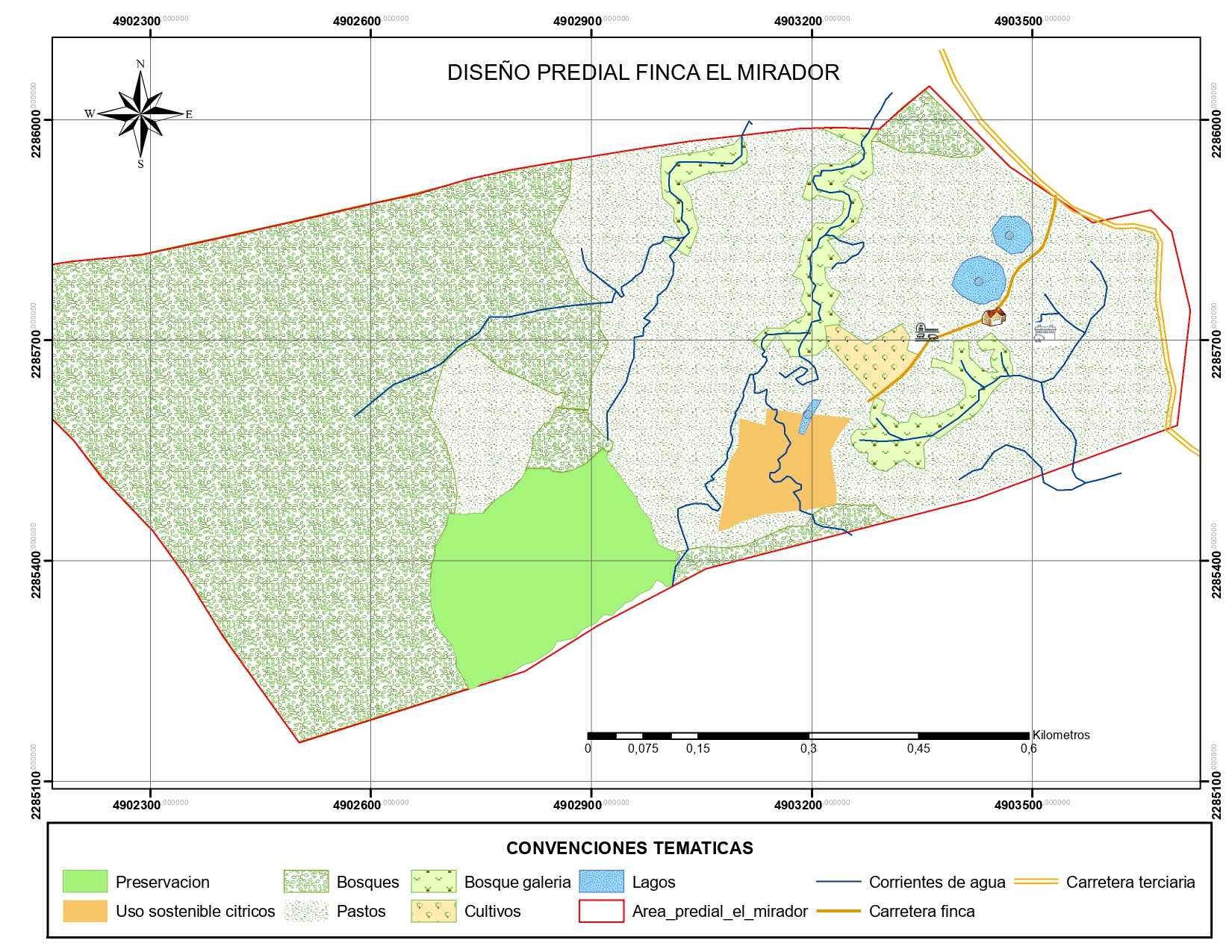
Source: Ecopetrol S.A. Environmental Management Department
This strategy seeks to generate positive impacts on biodiversity at the landscape scale through the implementation of Voluntary Conservation Agreements and other actions and to enhance the conservation of natural capital in the territories.
Properties with Central Regional Conservation Agreements
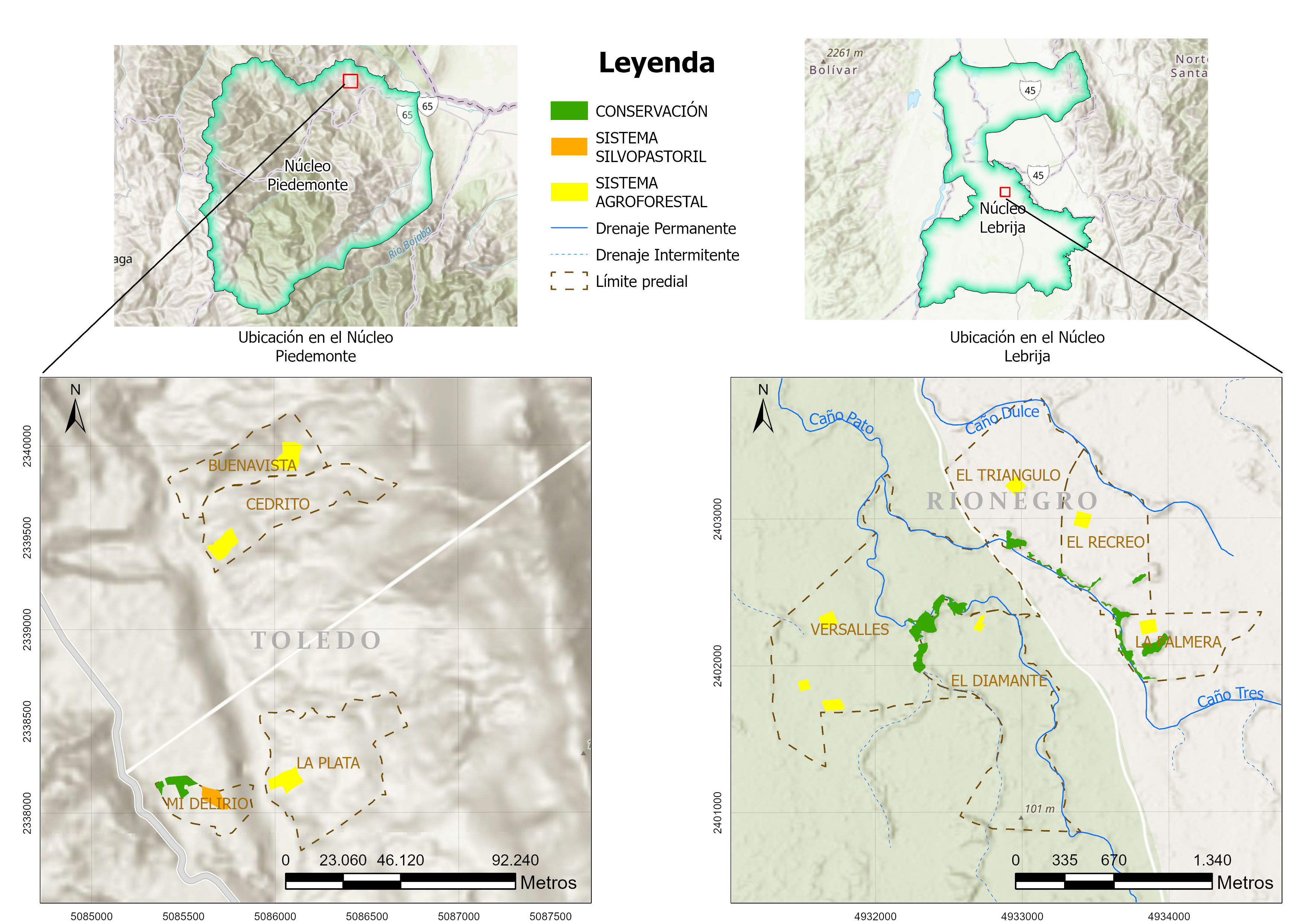
Source: Ecopetrol S.A. Environmental Management Department
To discover how we comply with the mandatory investments, see the Compliance to biodiversity offsets and 1% investment* requirements section.
Net Zero Deforestation - DN0
This approach is part of its sustainability and energy transition strategy, called SosTECnibilidad. For Ecopetrol, its commitment to Zero Net Deforestation means that its operations and those of its supply chain do not generate a net loss of forest cover. This means that any deforestation that cannot be mitigated must be offset through actions such as reforestation, ecological restoration, or conservation of existing forests.
Key concepts:
Forest: According to the Colombian Forest and Carbon Monitoring System, forest is defined as: Land occupied mainly by trees containing shrubs, palms, guaduas, grasses, and lianas, where tree cover predominates with a minimum canopy density of 30%, a minimum canopy height (in situ) of 5 meters at the time of identification, and a minimum area of 1.0 ha that is located in a territory. Tree cover from commercial forest plantations, palm crops, and trees planted for agricultural production are excluded (IDEAM et al. 2012).
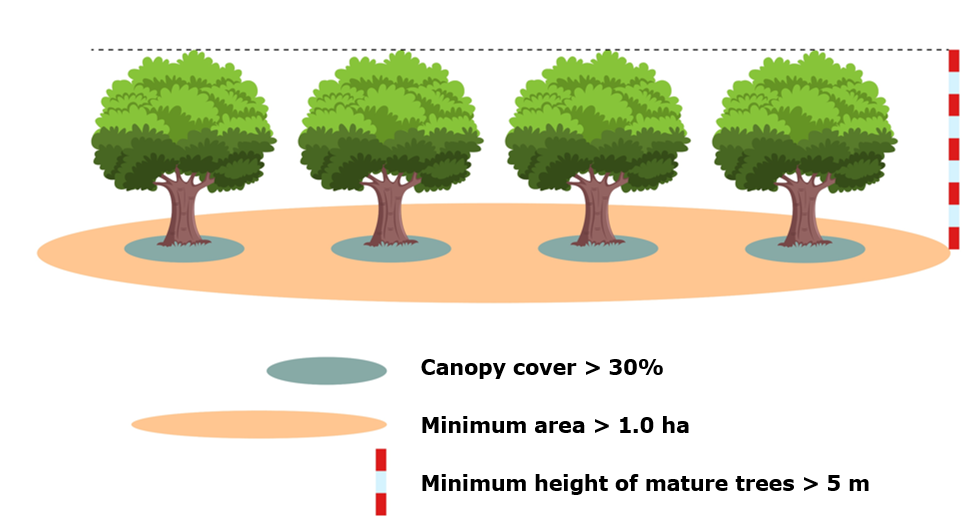
Adapted IDEAM. IDEAM Forest and Carbon Monitoring System.
Isolated trees outside the natural forest cover: Individual trees resulting from natural regeneration, planted or established trees that are not part of a natural forest cover or forest cultivation for commercial purposes (Decree 1532 of 2019).
Zero net deforestation: Balance between the loss of forests due to deforestation and the gain from reforestation/restoration processes or others, conceiving that the actions of forest cover gain must correspond to the criteria determined in the definition of natural forest adopted by Colombia (MADS, IDEAM, 2019).

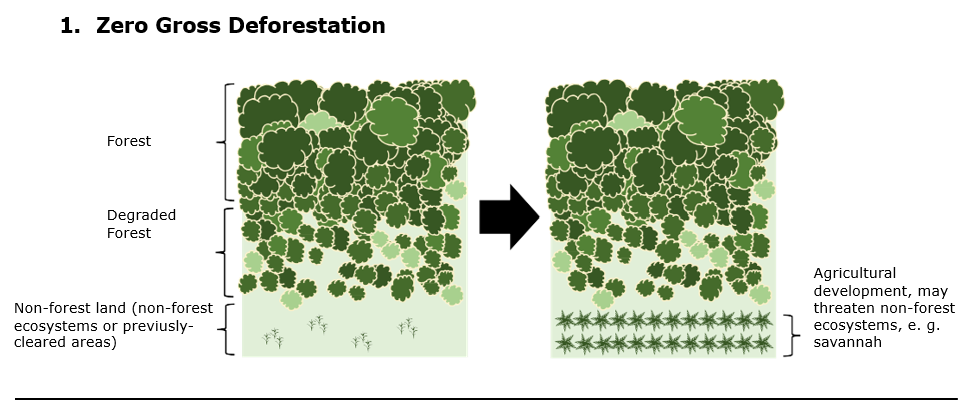
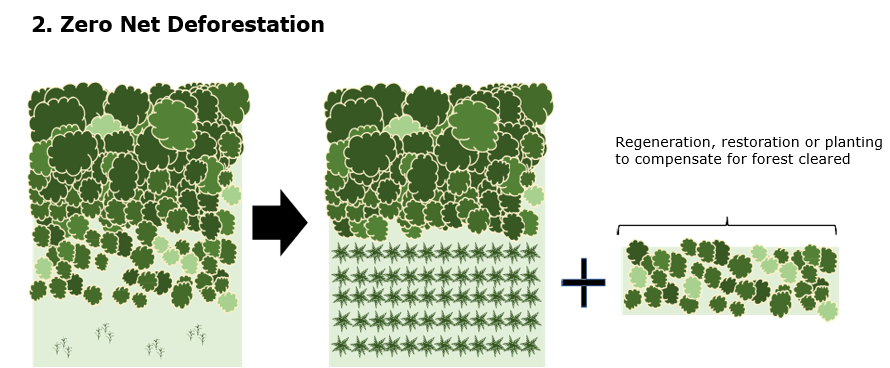
Lyons-White et al, 2020.
Natural forests are generally included in the exclusion areas* for ECP operations. Some linear projects are exempt from their exclusion.
*Areas that cannot be affected by project activities. Criterion related to the fragility, sensitivity, and socio-environmental functionality of the area; the self-healing capacity of the affected areas; and the status of the areas with a special status (ANLA, 2014).
We work in coordination with the Vice Presidency of Administration and Services in various training and awareness-raising activities aimed at the supply chain, with the goal of promoting practices aligned with the Zero Net Deforestation (ZND) commitment. These actions seek to raise awareness and strengthen capacity in our priority categories, encouraging their voluntary participation in the Intersectoral Pact for Legal Timber, as a concrete manifestation of their commitment to sustainability, traceability of forest products, and ecosystem conservation.
Currently, progress is being made jointly with ANDI in the development of an agreement aimed at strengthening the capacities of upstream and supply chain actors, as well as updating guidelines that allow the supply chain to be effectively integrated into the corporate strategy, under a zero net deforestation approach. This initiative will contribute to the strengthening of the Responsible Supply Chain, one of the 14 material elements defined in Ecopetrol's sustainability strategy, whose roadmap was approved on March 31, 2025. It will also align practices with international standards and promote more sustainable and traceable management in the value chain.
Biodiversity management and sustainability with Ecopetrol's partners
At Ecopetrol, we recognize the importance of biodiversity as a key component for sustainability in the territories where operations are carried out. In this context, the Partners incorporate, from their own management models, environmental considerations aimed at caring for ecosystems and the responsible use of natural resources, in accordance with their sustainability strategies, guidelines, and frameworks. These approaches reflect the Partners' commitment to responsible management aligned with good practices in environmental matters. For more information on the approaches and lines of work on biodiversity, links to the websites of some Partners are shared below, where additional information on their management in this area is available.
In addition, spaces for articulation with the Partners were developed aimed at socializing progress and results of environmental agreements, as well as strengthening technical and institutional capacities. These spaces facilitated the exchange of knowledge, the identification of good practices and the consolidation of joint actions for the sustainable management of biodiversity in the territories of intervention.
The following are the main advances of partners in the field of biodiversity: