

PautaInternas
Actions
buscador_1
Actions
GHG emissions information
Actions
GHG emissions information
Mar 4, 2026

The GHG emissions data management encompasses the GHG inventory continuous improvement, third party verification, and the development of technological tools that enhance data handling to ensure greater traceability, transparency, and analytical capacity for informed decision making.

GHG emissions inventory
Ecopetrol prepares its Greenhouse Gas (GHG) emissions inventory in accordance with ISO 14064‑1 and the international GHG Protocol standard. The inventory is developed under the operational control approach and is built using a bottom‑up methodology.
Aligned with its emission-reduction targets, Ecopetrol maintains 2019 as the baseline year for measuring progress toward its corporate goals. To support this, the company follows a biennial external verification plan under the NTC ISO 14064‑3 standard, ensuring 100% coverage of emissions generated in Colombia across all facilities under its operational control.
In 2024, Ecopetrol conducted an external verification of its GHG emissions inventory for Scopes 1 and 2 for the years 2021, 2022, and 2023, carried out by SGS Colombia S.A. under the GHG Protocol methodology. Additionally, and for the first time, Categories 1, 6, 8, 10, 11, 13, and 15 of Scope 3 for the year 2023 were also verified.
For 2025, total Scope 1 and Scope 2 emissions amount to 12.2 MtCO₂e. Likewise, the estimated Scope 3 emissions are approximately 146 MtCO₂e. This figure includes all categories established by the GHG Protocol, except Category 14 – Franchises, as Ecopetrol does not operate under this business model.
Ecopetrol is currently preparing for the third‑party verification process for the 2024–2025 period, which is scheduled for the third quarter of 2026.
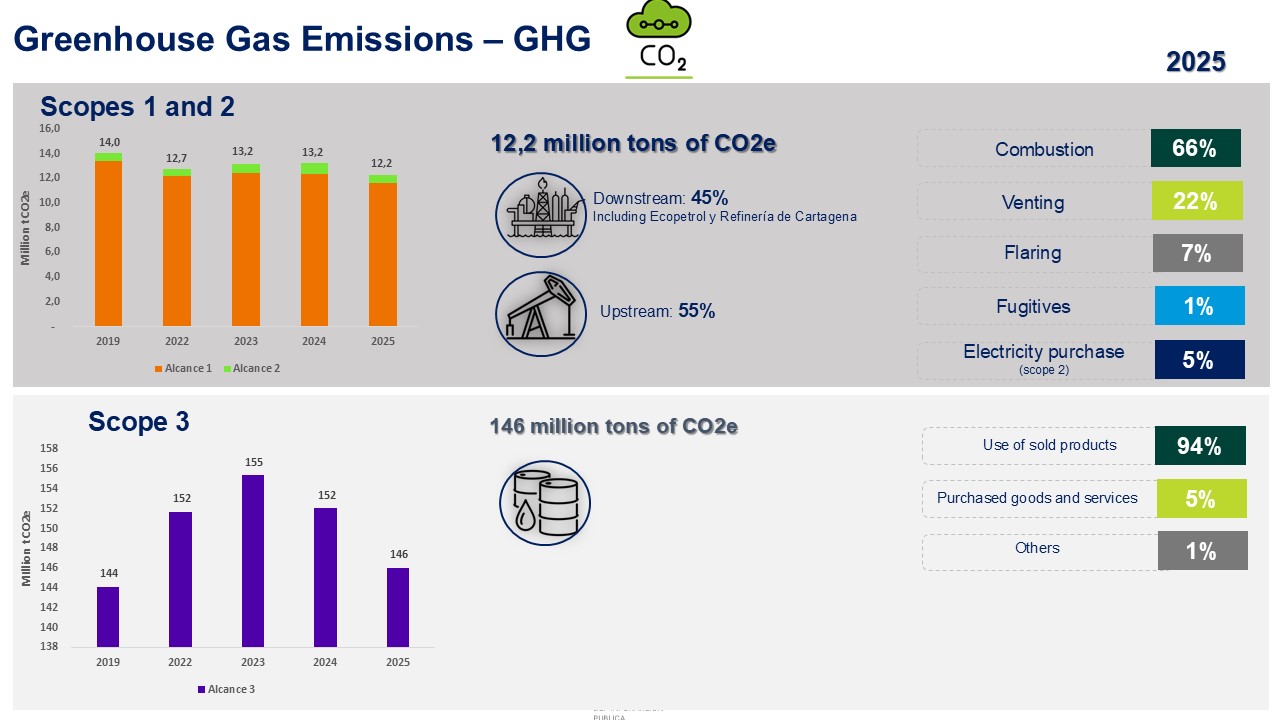
During the reporting period, Ecopetrol recalculated the baseline year (2019) and the 2020–2024 historical series for Scope 1 and Scope 2 emissions to reflect changes associated with: i) the inclusion of methane sources identified through measurement campaigns; ii) the incorporation of GHG emissions from Gigante and Abanico assets following their reversion to Ecopetrol's direct operation; and iii) adjustments derived from improvements in the quality of the information used for calculation purposes.
In line with the same principles, Scope 3 emissions were recalculated to reflect: i) the adoption of a criterion based on responsibility for transportation costs, aimed at improving transparency in the definition of the organizational boundary and ensuring consistent classification of emissions; ii) a methodological adjustment to remove the previous assumption that the fuel used for maritime transport of exports was of national origin and therefore already accounted for in Category 11; iii) reversion of assets previously operated by partners; and iv) adjustments associated with improvements in the quality of the information used for the calculation (activity data and emission factors).
The recalculated baseline year emissions amount to 13.365.945 tCO₂e for Scope 1 (a 3% increase), 658.908 tCO₂e for Scope 2 (a 0,4% increase), and 144.134.129 tCO₂e for Scope 3 (a 0,29% increase). All figures presented in this report correspond to the recalculated series, ensuring consistency and comparability of the information over time.


