

PautaInternas
Actions
Climate change adaptation
Actions
Climate change adaptation
May 23, 2025

Climate change adaptation
The increase in GHG concentration contributes to the rise in the planet’s average global temperature, which in turn leads to changes in temperature and precipitation patterns across regions over future time periods. This effect is known as climate change and will increasingly impact various systems (human, natural, and productive). As a result, it is essential to adapt to this new climatic dynamic.
 Climate Horizons
Ecopetrol has identified climate‑related risks and opportunities (both physical and transition), as well as their potential impacts and benefits across the following time horizons:
|
Short term (to 2030) |
The shortterm horizon is used to assess dependencies, impacts, risks, and opportunities in alignment with the company’s climatechange roadmap. This horizon includes: |
|
Medium term (to 2036) |
The medium‑term horizon is used to identify emerging risks that may affect the company over the next five or more years and to assess the portfolio of diversification opportunities. |
|
Long term (2037+) |
The long‑term horizon is used to analyze market trends, policy and regulatory changes, and emerging technological developments that could influence the company’s climate ambition and its long‑term business strategy. |
Physical risks and adaptation
 Physical risks
hysical risks associated with climate change can trigger acute events or lead to long‑term chronic shifts in climate patterns. These risks may result in financial impacts for the company, including direct damage to assets or indirect effects caused by disruptions in the production chain.
Ecopetrol developed a Climate Risk Index (IRC, for its Spanish acronym) tailored to both current conditions and projected futures under three climate scenarios, consistent with the Company’s planning horizons and risk‑management framework. The analysis covered 34 polygons (representing 100% of licensed areas) within the upstream segment in Colombia, with the objective of identifying critical zones using national‑level information such as water sensitivity, extreme weather events, protected environmental areas, Indigenous and ethnic communities, climate variability, and susceptibility to fires and floods, among other factors. The climate scenarios used are outlined below:
- SSP 5, which reflects an emissions pathway under a business-as-usual scenario.
- SSP 2, which reflects an emissions pathway that stabilizes temperature increase at 2°C, with emissions peaking around 2040.
- SSP 1, which reflects an emissions pathway that limits temperature increase to 1.5°C, aligned with the goal of the Paris Agreement.
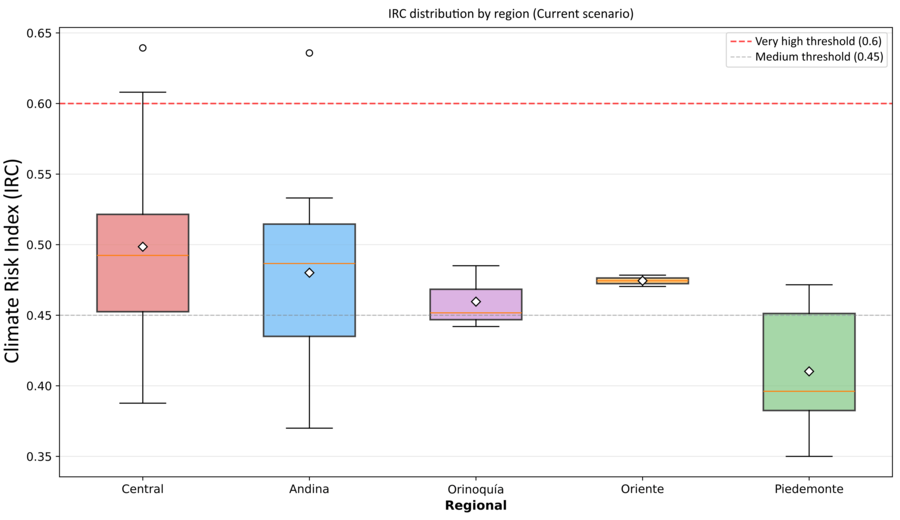
According to the methodological application of the IRC, the Central and Andina regions exhibit the highest levels of risk and variability, including specific cases of very high risk. The Orinoquía and Oriente regions display more homogeneous mediumlevel risks with lower internal dispersion, while Piedemonte stands out as the region with the lowest relative risk—though it already shows early signs of emerging vulnerability.
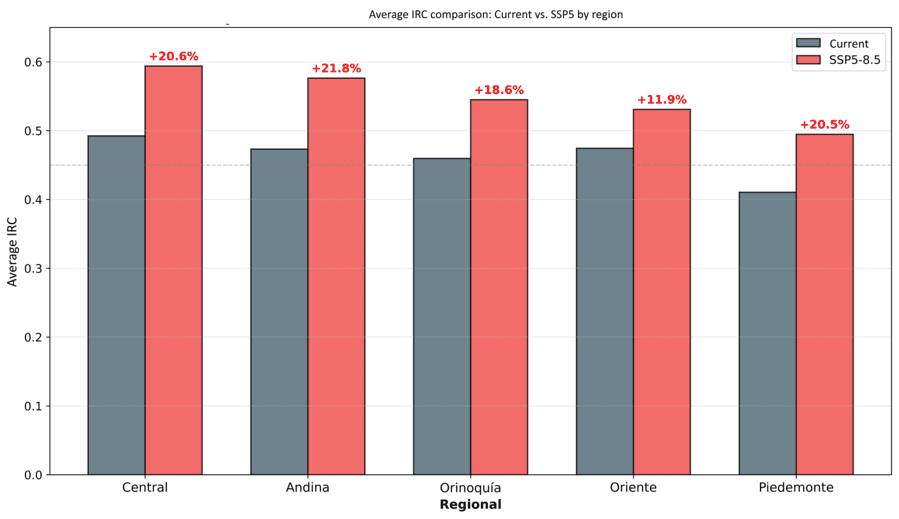
Under the highemissions scenario (SSP5), the average regional IRC increases by approximately ~12% to ~22% compared with current conditions, indicating a systemic amplification of risk across all regions. The largest percentage increases are observed in the Andina, Central, and Piedemonte regions, suggesting high sensitivity to rising hazards and/or shifts in exposure–vulnerability dynamics in these territories.
These results correspond to an aggregated and forwardlooking analytical exercise, developed using the available information and regionalscale analytical frameworks. Therefore, they should not be interpreted as deterministic or conclusive at a local scale, but rather as an initial approximation for identifying general trends and areas with potentially differentiated levels of climate risk.
Adaptation
To effectively manage physical climate risks, Ecopetrol has established adaptation plans that include short‑, medium‑, and long‑term measures across the following components
|
Water resource management |
||
| Objective: Reduce the vulnerability to variability and climate change for water scarcity and floods | ||
|
Short term (< 3 years) |
|
|
|
Medium term (3 - 5 years) |
|
|
|
Long term (> 5 years) |
|
|

|
Strategic ecosistems restoration and conservation |
||
| Objective: Reduce vulnerability in strategic ecosystems for operations through conservation, restoration and recovery | ||
|
Short term (< 3 years) |
|
|
|
Medium term (3 - 5 years) |
|
|
|
Long term (> 5 years) |
|
|

|
Climate resilient infrastructure |
||
| Objective: Reduce the vulnerability of Ecopetrol facilities due to the impacts generated by extreme weather events. | ||
|
Short term (< 3 years) |
|
|
|
Medium term (3 - 5 years) |
|
|
|
Long term (> 5 years) |
|
|

|
Climate compatible operation |
||
| Objective: Strengthen operational capacities to deal with the effects of variability and climate change. | ||
|
Short term (< 3 years) |
|
|
|
Medium term (3 - 5 years) |
|
|
|
Long term (> 5 years) |
|
|

Transition risks and opportunities
 Transition risks
The transition toward a low‑carbon economy may trigger political, legal, technological, and market changes aimed at meeting climate‑related mitigation and adaptation requirements. Depending on the nature, pace, and direction of these changes, transition risks can lead to financial and reputational impacts of varying magnitude for organizations.
The Ecopetrol Group has developed energy‑transition scenario analyses to assess the expected speed of change in global, regional (Latin America), and national (Colombia) energy supply and demand. The Group uses three scenarios that incorporate sensitivities to potential shifts in economic conditions, energy policy, and the degree of alignment and cooperation among markets and institutions.
- Climate Alignment (1.7° - 1.8°C): Transformation to low-emission economies aligns governments and institutions around climate change. In addition, developed countries reach Net-, while other countries follow a slower path. This is not enough to achieve the global net-zero ambition (1.5 ℃).
- Energy Balance (1.9° - 2.3°C): Fundamental changes in governments, markets, and society set in motion a long-term energy transition, the debate continues between energy security and accelerating the transition.
- Climate Divergence (2.5° - 2.8°C): Dissimilar interests in decarbonization despite policy, regulation, and market changes. Global public policy decisions are insufficient to close the climate ambition gap.
These scenarios provide a comprehensive framework for anticipating opportunities and risks associated with the energy transition, decarbonization, and diversification into cleanenergy sources. Under this approach, the Strategy not only defines the pillars of the company’s business transformation but also acknowledges the importance of integrating stakeholder expectations and advancing a just, gradual, and secure transition that balances climatechange management with economic development and social wellbeing.
|
Market risk |
||
|
Pathway |
|
|
|
Potential impact |
|
|
|
Regulatory risk |
||
|
Pathway |
|
|
|
Potential impact |
|
|
Other identified risks are:
- Legal risk, associated with negative reactions and lawsuits against Ecopetrol S.A.'s climate action.
- Risk of assets trapped in the traditional business of hydrocarbon production, transportation, and refining, considering factors such as fuel demand prospects and asset profit horizons.
- Reputational risk, Reputational risk, associated with the impossibility of responding in a timely way to the expectations and demand of investors and other interest groups to establish ambitious objectives regarding climate change, which would affect the company’s image and brand.
- Technological risk, associated with the negative effects on the profitability of the business if there is no preparation and capacity to adapt to new technologies because of the transition process.
For further details, see 2024 Financial Sustainability Report in convergence with TCFD–SASB standards (in Spanish)
Opportunities
The efforts made to mitigate and adapt to climate change also create opportunities for companies, to identify and develop opportunities through resource efficiency and cost savings, the adoption of low carbon energy sources, the development of new products and services, access to new markets, and creating resilience throughout the entire production chain, will generate sustainability for the business.
Ecopetrol has identified the following opportunities arising from climate change, which are aligned with the company's corporate strategy.
|
Energy source |
||
|
Ongoing opportunities |
|
|
|
Benefits |
|
|
|
Resource efficiency |
||
|
Ongoing opportunities |
|
|
|
Benefits |
|
|
|
Products, services, and markets |
||
|
Ongoing opportunities |
|
|
|
Benefits |
|
|
. . .

