PautaInternas
Actions
buscador
Actions
Supplier ESG Program
Actions
Supplier ESG Program
Apr 22, 2026
Oversight of implementation
BOARD OF DIRECTORS
The Board of Directors is the Administrative body of Ecopetrol and is made up of nine (9) main members without substitutes, who are elected by the General Shareholders' Meeting in the terms established in the Bylaws.

To directly address its responsibilities, the Board of Directors has six permanent institutional committees and one temporary committee, composed of members of the Board of Directors appointed by the Board itself.
One of these is the Corporate Governance and Sustainability Committee, which supports the Board of Directors' management of the Company's good governance and sustainability. Its purpose is to recommend systems to the Board of Directors for the adoption, monitoring, and improvement of corporate governance and sustainability practices.
In 2025, the Supplier ESG Program was consolidated, aiming to identify and assess potential ESG risks and opportunities, and to plan measures that ensure strong sustainability performance throughout the supply chain. The program is align with the United Nations Sustainable Development Goals and international best practices, evaluated through global benchmarks such as DJSI and CDP, ensuring integration with Ecopetrol’s 2040 strategy “Energía que transforma” by managing the Responsible Supply Chain as a material issue.
The Supplier ESG program was presented to and approved by Ecopetrol’s Board of Directors during the Corporate Governance and Sustainability Committee, with the commitment to monitor the goals and achievements on an annual basis (at least once a year) to this body.
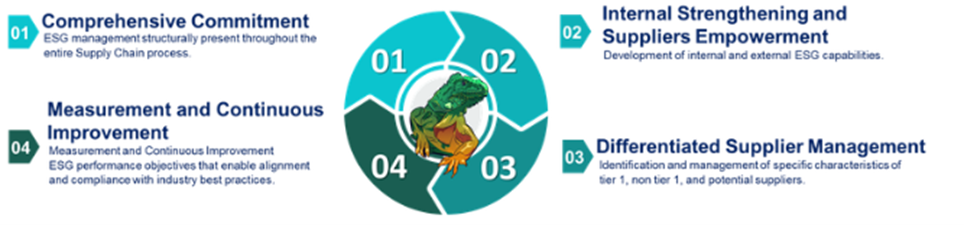
To ensure the proper implementation and achievement of the established goals, Ecopetrol’s Supplier ESG Program is executed through four thematic pillars aimed at fostering comprehensive commitment to sustainable management throughout the entire Procurement Process. These pillars seek to identify the specific characteristics of direct, indirect, and potential suppliers in order to implement differentiated engagement mechanisms focused on value creation, risk identification and management, and the promotion of plurality and local sourcing.
Additionally, the pillars aim to develop capabilities among internal and external stakeholders to address the evolving needs of the market, consolidating cutting-edge competencies supported by international benchmarks and monitoring tools that drive continuous improvement and contribute to achieving the overarching ambition of becoming a reference in the industry.
SUPPLIER ESG PROGRAM STRUCTURE
Governance Model: REVIEW OF PURCHAISING PRACTICES
The Supply Chain management counts with a strong Governance Model for the review, approval, and monitoring of the different procurement strategies, and assure its alignment to the business objectives, the commitment to ethics and transparency, and the sustainable (ASG) management of the Function.
SUPPLY STRATEGIES COMMITTEE
Objective: Review, approve and monitor the procurement strategies for goods and services contracting.
Responsibilities: Approve the procurement strategies, whose defined source has been the strategic Supply.
- Promote the search, analysis, and incorporation of good supply practices.
- Promote demand aggregation as a Business Group; the aggregation or disaggregation of demand that enables local contracting with supply analysis.
- Validate value footprint levers, sustainability strategy leverage and comprehensive benefits.
- Monitor compliance with the goals in the strategies approved by this committee.
SUPPLIER VERIFICATION AND QUALIFICATION
The Supply Chain Management counts with a supplier verification process, through which, Ecopetrol verifies, enables and maintain a plural, updated and qualified Suppliers´ Portfolio for the provision of the goods and services required for the Company´s operation.
This process verifies the suppliers ‘compliance of the 5 criteria defined by Ecopetrol: i) Legal aspects, ii) Technical requirements, iii) Financial statements, iv) HSE obligations and v) Ethical and compliance component. These requirements are typified according to the goods or services offered, the type of supplier or the process of qualification applicable.
It is important to highlight that all natural or legal persons who wish to establish a contractual relationship with Ecopetrol must be registered and qualified in the Supplier Information System through the compliance of all the requirements established by the Company.
As mentioned, through this process, Ecopetrol verifies the compliance of the 5 criteria which looks to assure the following aspects:
- Legal: Verify the legal existence of the supplier and compliance with the minimum applicable legislation, depending on the type of person (Natural, Legal, Consortium or Temporary Union).
- Technical: Verify the compliance of the minimum requirements related to the commercial experience which are established according to the type of good or service offered and its level of risk and impact with Ecopetrol.
- Financial: Have the supplier's financial information available to validate its financial capacity to execute potential contracts with Ecopetrol.
- HSE: Verify the supplier's compliance with Colombian legislation in aspects related to HSE management.
- Ethics and compliance: This criterion is intended to ensure the ethical and compliance profile of the supplier to mitigate risks associated with this critical issue. All suppliers must complete the integrated ethics and compliance questionnaire providing critical details of its management such as the information of counterparties related to the supplier, alarms associated with issues of corruption, bribery, fraud, money laundering, terrorist financing, conflict minerals, among others.
As a comprehensive assurance measure, Ecopetrol also checks its current and potential suppliers in restrictive and control lists to validate the risk profile of the supplier and its counterparties related; In case of a finding in any supplier in any of these lists, it must be managed in accordance with the provisions of current regulations.
Conforming to the results obtained during the verification process, the supplier is classified in accordance with its level of compliance with the requirements. This classification is made in the Supplier Information System, counting with the following qualification states:
- Initial: It is granted when the supplier complies with the following criteria: legal, technical, financial and HSE and the basic due diligence by verifying restrictive and control lists; this qualification enables suppliers to participate in Selection Methods but NOT to be contracted by Ecopetrol.
- Comprehensive: It is granted when the supplier complies with all the criteria requested in the verification process, including the verification in restrictive and control lists of all counterparties related; this qualification enables suppliers to participate in Selection Methods and be contracted by Ecopetrol.
- Conditional: It is granted when, during the verifying process, gaps are identified in one or more criteria, but the supplier qualification is endorsed by an Ecopetrol government area with sufficient supports to continue with the process. This qualification enables suppliers to participate in Selection Methods and be contracted by Ecopetrol.
- Rejected: It is granted when the supplier does not fully comply with all the required criteria. With this qualification, suppliers cannot be invited to participate in selection methods or to be contracted by Ecopetrol.
Accordingly, if the supplier cannot comply with the Legal, Technical, Financial, HSE and Ethics and compliance requirements established by Ecopetrol, the supplier cannot be invited to participate in selection methods or be contracted by Ecopetrol, the supplier cannot be invited to participate in selection methods or be contracted by Ecopetrol.
For suppliers who do not meet the requirements for their qualification in Ecopetrol’s information system, four follow‑up attempts will be conducted (via telephone and email) to request the completion of the pending documentation. If, after these four contact attempts, the corresponding information is not provided, the supplier will be assigned the qualification “Rejected due to lack of commercial interest,” with this qualification the supplier cannot participate in selection processes or be contracted.
Furthermore, as part of the ongoing maintenance of Ecopetrol’s supplier information system, suppliers who have not demonstrated any activity within the platform for a period of five years will have their profiles deactivated. If these suppliers wish to be reconsidered for participation in selection processes or for contract awards, they must undergo the registration and qualification process anew, complying with all requirements established by Ecopetrol.
Finally, as a comprehensive assurance measure, Ecopetrol also checks its current and potential suppliers in restrictive and control lists to validate the risk profile of the supplier and its counterparties related; In case of a finding in any supplier in any of these lists, it must be managed in accordance with the provisions of current regulations.
SUPPLIER FINANCIAL CAPACITY ANALYSIS
Evaluates the financial capacity and risk of potential suppliers to prevent possible breaches of their contractual obligations, through a comprehensive historical analysis of the suppliers’ financial information (3 years).
This analysis provides a supplier financial profile, which contemplates the ability to finance working capital requirements, with internal sources derived from the contracts in progress and/or potential new contracts, as well as its financial profitability, debt and liquidity.
The assessment is made up of the following aspects:
The companies that are identified as "Very High" and "High" risk, must be managed through the identification, design and implementation of controls and mitigants so that suppliers remain at residual risk levels that do not compromise the agreed contractual obligations.
ANALYSIS OF SUPPLIER PERFORMANCE ASSESSMENT RESULTS
As part of the due diligence that Ecopetrol carries out to identify the potential suppliers to be invited to participate in the selection methods, as well as for contract signing, the supply chain official must carry out a comprehensive analysis of the supplier´s favorable and unfavorable information, the results of the performance assessment trends, service lines, among other aspects considered as relevant information for the respective analysis.
The information considered as unfavorable is when the supplier has an assessment performance score less than 80 points in the criteria of Operational Efficiency, Contract Terms, Labor and Commercial Aspects and Environment Management and less than 85 points in the HSE Aspects criteria.
As part of the supplier improvement plan, when a supplier displays unfavorable information and if it is considered necessary, a Corrective Action Plan must be developed in accordance with the process defined by the Company. If one of the potential suppliers has a Corrective Action Plan in force, the supply chain official must request the contract monitoring official the advance, execution, or closure results of the plan, to carry out the respective analysis for decision making about the supplier participation into the selection method.
ANALYSIS OF OFFERS
During the selection methods, Ecopetrol carries out the analysis of offers presented by the suppliers, in accordance with the type of good or service required, market conditions, legal requirements and the defined criteria, which must consider the technical, economic, financial, logistical, legal, social, environmental and compliance aspects to evaluate and identify the offer that represents the best business for Ecopetrol.
Ecopetrol also counts with internal polices, guidelines and normative which seeks to strengthen the supplier´s commitment with this crucial thematic:
|
DOCUMENT |
SUMMARY |
PUBLIC LINK |
|
Contracting Manual |
The Contracting Manual is the regulatory framework that guides the activities and legal transactions conducted by Ecopetrol S.A. for the supply of goods and services. The process of supplying goods and services regulated by this Manual includes the following activities: (i) supply planning; (ii) supplier management; (iii) provisioning; (iv) contract management; and (v) logistics and inventory management. |
|
|
Contractor Performance Procedure |
The supplier performance assessment contemplates the comprehensive management of sustainability in the execution of contracts; therefore, it has evaluation criteria for Environmental, Social and Governance (ESG) management. The contractor performance procedure establishes the methodology and criteria to assess the suppliers´ performance to ensure the contracting objective are complied. |
ESG CRITERIA INTO SUPPLIER SELECTION
During the Supplier´s registration, selection, and assessment performance processes, Ecopetrol considers the following ESG factors:
-
MANAGEMENT SYSTEMS, HSE AND TECHNICAL CERTIFICATIONS:
Suppliers must be registered at Ecopetrol´s Supplier System Information, meeting different requirements such as: management systems certifications, HSE and technical certifications, among others according to their procurement category (economic activity).
Weight: 100%
-
PROMOTION OF THE NATIONAL INDUSTRY:
National Government Legislation (Law 816 of 2003) aims to support the national industry through public procurement. During the selection process this is a mandatory evaluation factor.
Weight: about 10% - 20% (if applicable)
-
HSE (HEALTH, SAFETY Y ENVIRONMENT) CRITERIA:
Evaluates if the supplier has the ISO-14001/2004 certification, or a HSE plan for the management of health and safety risks at work and environment protection; training programs; emergency response capacity or effectuate an analysis supplier real performance (positive or negative) in terms of disabling or fatal events.
Average weight: determined according to the procurement strategy.
-
LOCAL OFFER - GOODS AND SERVICES:
Ecopetrol has in place a "Local contracting of goods and services for the supply chain policy” that promotes local contracting in the procurement strategies. This factor is optional and in accordance with each procurement strategy.
Average weight: determined according to the procurement strategy.
-
ACTIVITIES FOR VALUE GENERATION
Promotes the deployment of activities to strengthen regional prosperity and well-being of municipalities of operation through business strengthening, innovation and development programs, and transfer of knowledge or technology.
Average weight: determined according to the procurement strategy.
-
PROMOTION OF PUBLIC FOOD PROCUREMENT POLICY
Compliance with National Law 2046 of 2020, which seeks to promote the participation of small local and agricultural producers whose production systems belong to peasant, familial and community agriculture, or their legally constituted organizations.
Weight: minimum 10% (if applicable)
-
LOCAL EMPLOYMENT PRIORITIZATION
Commitment to prioritize the employment of skilled and unskilled local labor. The supplier must present at least a commitment to contract 100% of the local unskilled labor and
more than 30% of skilled local labor.
Average weight: determined according to the procurement strategy.
-
DIVERSITY AND INCLUSION - WORKFORCE:
Promotes local hiring of people classified into one or more of the following groups: women, people with disabilities, first job, ethnic groups, and victims of armed conflict. This factor is optional and in accordance with each procurement strategy.
Average weight: determined according to the procurement strategy.
-
ENVIRONMENTAL CRITERIA:
- Decarbonization: Reduction of Greenhouse Gas emissions (carbon intensity indicator or tons of CO2e reduced)
- Zero water discharges: Water footprint calculation generated for the selection process or during the execution of the contract.
- Natural Capital (Biodiversity): Actions that enhance the Net Zero Deforestation Goal through the commitment to the “Intersectoral Pact for Legal Timber in Colombia; count with the Colombian Environmental Seal (SAC) or National Certification Initiative Forest Stewardship Council (FSC), also known as the Voluntary Forest Certification Working Group (CFV).
- Materials and waste: Percentage of recycled raw materials and/or reused and/or remanufactured products used in the manufacture of the good or in the provision of the service or alternatives for the resale of materials or buy back, indicating the value and/or the resale fee.
Average weight: determined according to the procurement strategy.
PERFORMANCE ASSESSMENT:
Ecopetrol assesses the comprehensive ESG management of its suppliers, through 5 criteria distributed as follows:
-
Environmental: HSE aspects
-
Social: Labor and Commercial Aspect, and Milieu Management
-
Governance: Operational Efficiency, and Contract Terms
Average weight: each factor has an individual weight of 100%.
WORLD-CLASS TALENT
INTERNAL TRAINING PROGRAM FOR SUPPLY OFFICIALS
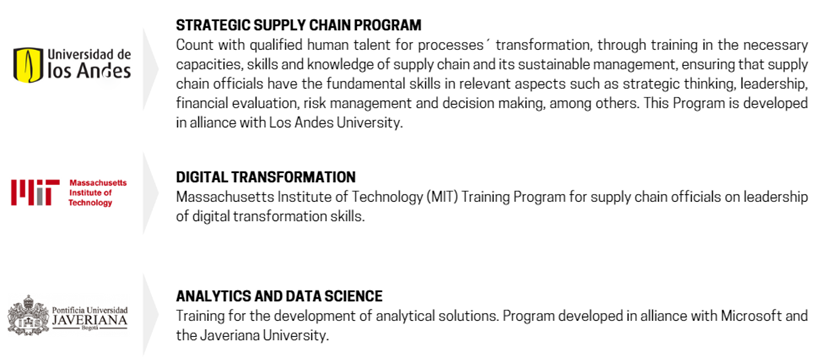
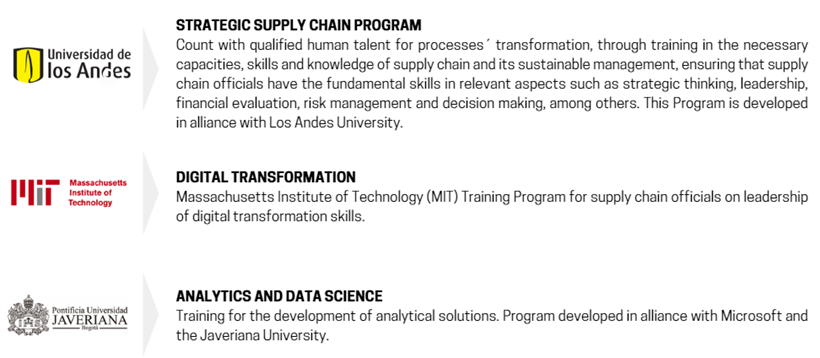
Supply Management recognizes the training, reskilling and installation of new capacities and abilities of the human talent to reach and maintain the competence level to face the challenges imposed by new T-ESG® trends, climate change and energy transition for which it has designed a training system for officials.
The internal training program have had the following courses:
CONTRACT MONITORING OFFICIALS’ ACADEMY
Contract monitoring officers are key interlocutors for the correct performance of the agreed contractual obligations; therefore, the supply chain process recognizes the importance of updating and strengthening their knowledge by designing training programs on high relevance topics for its function, 21workshops and forums were held with the attendance of 200 people average per session, covering critical topics such as payment management, information leak, third parties risk mitigation, SECOP, petition rights, blockage management, claims, particular economic activities, decarbonization, cybersecurity (archer the new technological tool in contractual cybersecurity diagnostics), disclosure of the practice work control, Opex estimates, performance assessment in SAP ARIBA (process and tool), prioritization of skilled local labor, Fieldglass digital platform, management and prevention of conflicts of interest and ethical conflicts and tax management.
As well, contract monitoring officers received the International Association for Commercial and Contract Management (IACCM) Certificate.
ENVIRONMENTAL MANAGEMENT TRAINING
Committed to sustainable Environmental Management, the supply chain has a training program on relevant topics for the different actors in the process: Supply Chain Officials, Suppliers and Contract Monitoring Officials.
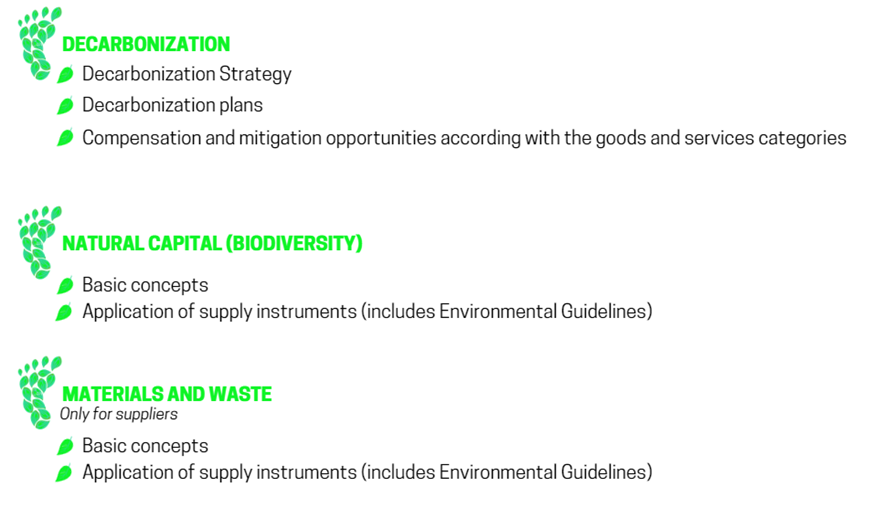
The Environmental Training Plan contemplated the following topics: