

Web Content Viewer
Actions
buscador
Actions
User Services
Actions
User Services
Sep 17, 2026
Ecopetrol Contact Center
Bogotá direct line: +57 310 315 8600.
National toll-free line: 018000918418
Telephone Switch: Monday to Friday from 6:00 a.m. at 5:00 p.m. - +57 310 315 8600.
Shareholder attention
National shareholders toll-free line - 018000113434
Shareholders hotline: 3077075
Ethics Line
International toll free: 018009121013
Direct line in Bogotá: 2343900
Health care lines:
National Toll Free / medical guidance line: 018000915556. Open 24 hours a day, 7 days a week.
New Covid-19 Hotline: 018000 423894, Open seven days a week, from 6:00 a.m. at 10:00 p.m.
Friend line: 018000918418, from cell phone 031 2345000 option 4-5
- If you wish to present a complaint, reclamation, contratulation, information request or petition right, click here
- Click here for consulting the state of your complaint, reclamation, congratulation, information request or petition right
- If you wish to file a complaint to publicize a situation in which it is presumed that a behavior or action goes against our Code of Ethics or is considered as a possible event of fraud, corruption, money laundering or terrorist financing, click here
- If you wish to make a judicial notification use the mailbox: notificacionesjudicialesecopetrol@ecopetrol.com.co
- Procuraduría General de la Nación - Solicitud de Información con Identificación Reservada.
- If you wish to send or request information related to a disciplinary process, contact directly the mailbox:controldisciplinario@ecopetrol.com.co
-
In order to strengthen our culture of customer service, any doubt, suggestion or claim that is related to the provision of the complementary activity of commercialization of Combustible Gas or sale of electricity to its economic associates as Marginal Producer, can be directed to the following address: Kr 7 No. 37-69 Ed Teusacá, Floor 1. Telephone: (57 + 1) 2344444 participacion.ciudadana@ecopetrol.com.co
Transparence Law - Enquiries Report
Transparence Law - Enquiries Report - First Semester of 2020
Transparence Law - Enquiries Report - Second Semester of 2019
Transparence Law - Enquiries Report - First Semester of 2019
Transparence Law - Enquiries Report 2018
General Chat
Shareholders Chat
For line 2345000 Select the option in the menu according to your need and dial:
- 1 if you are a Client or wish to be an Ecopetrol client.
- 2 if you are a Shareholder or Investor of Ecopetrol.
- 3 if you are a Supplier or wish to be an Ecopetrol supplier.
- 4 if you are an Ecopetrol official.
- 5 if you are a pensioner or beneficiary of Ecopetrol.
- 6 if you are an Ecopetrol contractor worker.
- 7 to report a complaint or suggestion.
- 8 if you are part of the larger community.
- 9 to communicate with the switch and other dependencies.
https://sedeelectronica.ecopetrol.com.co
Frequently Asked Questions - Electronic Correspondence Office
Can any natural person register a company?
To register a company, any of its employees must select during registration the type of legal person, so that they can indicate the Nit and trade name of the company; however it will be identified with your corporate email.
What can I file in the electronic correspondence office?
Signed communications addressed to Ecopetrol of any documentary type (with the exception of the matters not allowed, described in the following question) or rights of petition.
Are there any restrictions for filing communications in electronic headquarters?
Yes, no communications related to purchasing and contracting processes, invoices, legal notifications or directed to the Directorate of Physical Security and Hydrocarbon Loss Control are received. To file this type of document, we invite you to make use of the channels that the Company has arranged for it.
Should I attach the signed communication?
Yes, it is required that at least one document be attached, which corresponds to the main communication you wish to file, this communication must be signed, although it does not necessarily have to be electronic or digital.
What if I don't know my recipient's email?
The communication can be directed in a general way to the company or to a specific area, in this case, the recipient's email field can be left blank.
If I can send a communication addressed to the Company, what is the use of writing the recipient's email?
Knowing the recipient email will speed up the delivery of the communication.
Will I receive any notification of the communication that I filed?
In a maximum of 5 minutes after filing, you will receive the assigned filing number in your email, it is important that you previously validate the correct operation of your mailbox.
Does this replace the physical mail windows?
No, the physical windows are maintained for the reception of communications that by their nature require to be delivered through this medium, CD, USB, Boxes, etc.
| Correspondence Attention | |
|---|---|
| City | Correspondence Address |
| Bogotá |
Calle 35 # 7-59 Ed. Caxdac Piso 1 |
Regional presence
In addition to Ecopetrol's relationship strategies in the territory, the Civil Participation Headquarters (JPC) defines, through a diagnostic model, the relevance of its regional presence and the design of its operating model, based on each municipality's relevance to the Company's business plan.
Currently, Ecopetrol provides permanent face-to-face service in 15 municipalities through physical offices and in another 34 municipalities through mobile points and service brigades, all distributed across five regions where the Company operates.
| Region | Office |
|---|---|
| Caribbean | Cartagena |
| Riohacha | |
| Central | Barrancabermeja |
| Bogotá D.C. | |
| Corregimiento de El Centro | |
| Tibú | |
| Puerto Wilches | |
| Andean-Eastern | Neiva |
| Orito | |
| Puerto Gaitán | |
| Orinoquía | Acacías |
| Castilla La Nueva | |
| Guamal | |
| Villavicencio | |
| Piedemonte | Yopal |
Figure 10
Face-to-face Service – Physical Offices
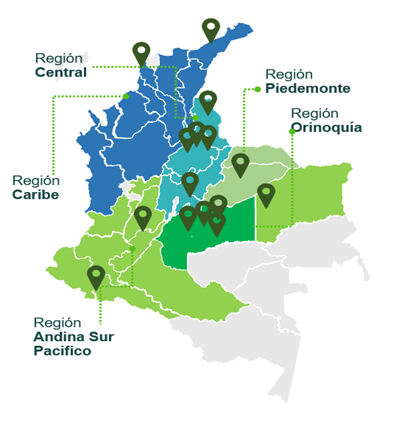
This regional deployment requires the provision of infrastructure, human talent, and locational, technological, and logistical resources that ensure permanent, transparent, and inclusive citizen services. This work constitutes the first step toward guaranteeing the right to access information and civil participation.
Citizen Services for the Management of the Right to Petition (PQRS)
The management of the right to petition (PQRS) entails ensuring timely and substantive responses to all Requests, Complaints, Claims, and Suggestions submitted to Ecopetrol. To this end, there is a formal procedure for managing the right to petition that establishes the conditions, competencies, and the substantive and instrumental aspects for its adequate attention and control. This management is measured by the timely citizen service indicator.
To ensure timely service, Ecopetrol has a robust process and a network of approximately 194 Citizen Service solvers distributed across all areas of the Company. The procedure outlines the stages of the process, the responsibilities, and the mechanisms that guarantee a comprehensive and transparent response.
In the past 5 years, about 275,122 citizen requirements have been met, with a timely citizen service indicator of 99.91% in 2025.
Figure 11
Timely Citizen Service Indicator (2021 – 2025)
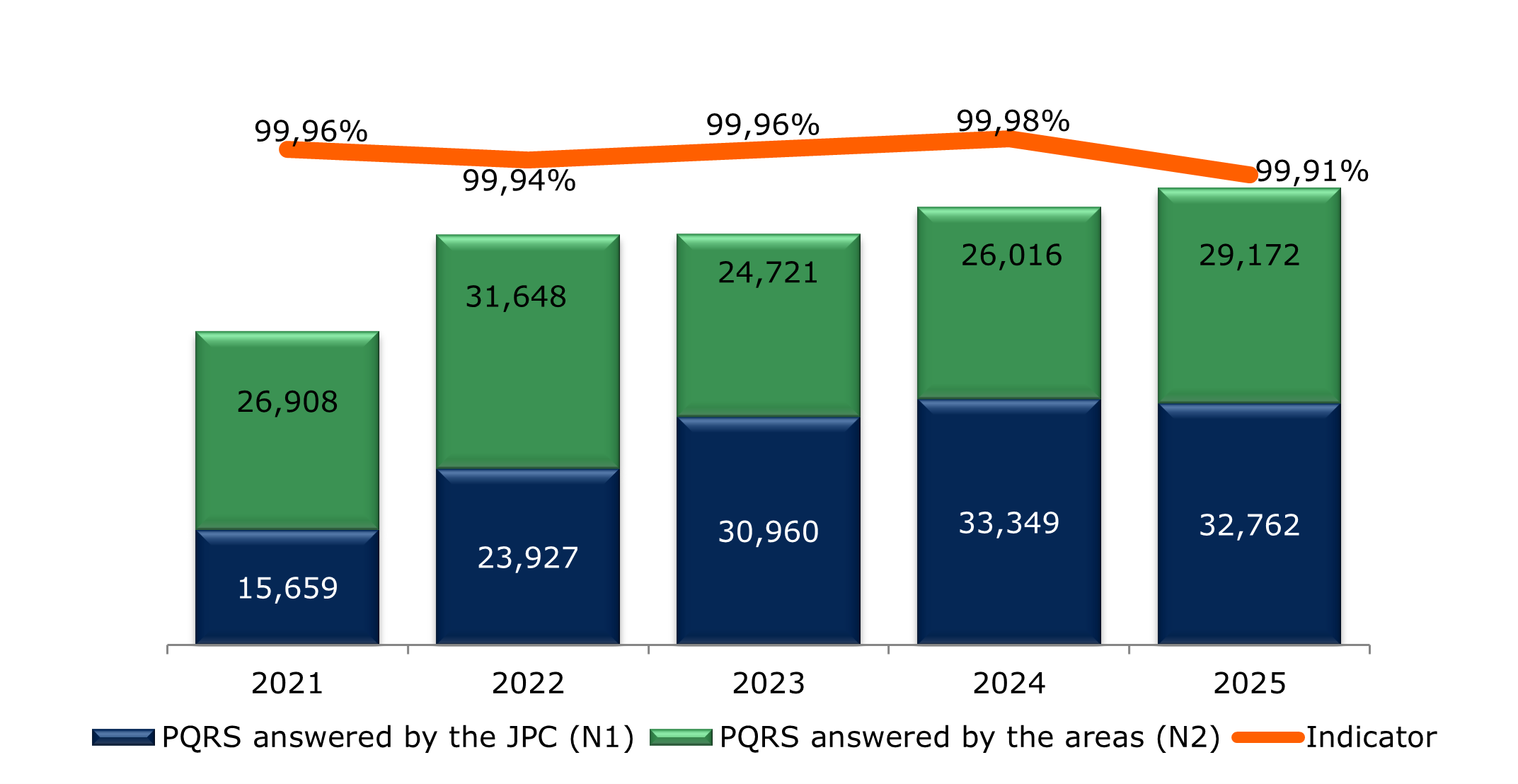
Table 8
Timely Citizen Service Indicator by Stakeholder (2025)
| Stakeholder | General indicator |
|---|---|
| Shareholders and investors | 100% |
| Customers | 100% |
| Civil Society and Cooperation Organizations | 100% |
| Controlled companies | 100% |
| Partners | 100% |
| State | 99,95% |
| Communities | 99,94% |
| Suppliers and their employees | 99,93% |
| Scientific and Academic Community | 99,86% |
| Employees | 99,84% |
| Media and opinion leaders | 98,25% |
| Total | 99,91% |
Ecopetrol has mechanisms and channels to receive and properly manage the Requests, Complaints, Claims, Suggestions (PQRS), and congratulations submitted by its stakeholders, ensuring timely and substantive responses.
Likewise, opportunities for participation are promoted that allow reporting on the Company's activities and provide insight into stakeholders' perceptions, strengthening a close and transparent relationship.
From the management and monitoring of PQRS and the requirements derived from these interactions, data is generated, structured, analyzed, and transformed into valuable information for decision-making. This analysis allows us to identify opportunities to improve internal processes and design solutions to situations of dissatisfaction.
The operational deployment model of the Civil Participation Headquarters (JPC) includes six service models through face-to-face and non-face-to-face channels, as follows:
Table 9
Service Models
Physical spaces for face-to-face and permanent citizen services, where the management of the right of petition and access to information related to the Company's operations and management are facilitated. These can be found in the municipalities that are part of the regional presence.
| ECO Zone | An experience center where the Company can interact with its stakeholders based on a knowledge and participatory science model (Encounter - Knowledge – Opportunities (ECO for its acronym in Spanish)). Currently, there are ECO Zones in the municipalities of Puerto Wilches, Acacías, Neiva, and Riohacha. |
| Service Office | Physical spaces for face-to-face and permanent citizen services, where the management of the right of petition and access to information related to the Company's operations and management are facilitated. These can be found in the municipalities that are part of the regional presence. |
| Mail centers | The mail centers are located in the city of Bogotá, and operate in the Caxdac building Calle 35 No. 7-29 floor 1. |
| Mobile Point | Mobile citizen service points implemented outside Ecopetrol's facilities in different parts of a territory. (Biweekly) |
| Brigade | JPC citizen service days in specific places and groups, typically in conjunction with other areas of the Company. (By demand). |
| Non-face-to-face channels | Virtual, electronic or telephone service mechanisms that do not involve a physical space, nor meeting face-to-face. |
The following are the non-face-to-face communication channels available through the Civil Participation Headquarters (JPC):
Figure 12
Communication Channels
 |
Email. The following mailboxes are available: participacion.ciudadana@ecopetrol.com.co quejasysoluciones@ecopetrol.com.co |
 |
Website: Online form published on the corporate website to submit petitions, complaints, claims, suggestions or reports (www.ecopetrol.com.co > Home > Our Company > Citizen Information Services > Contact Us) |
 |
Corporate Call Center. National toll-free telephone line: 01 8000 918418 Telephone Line: (+057) 310 315 8600 |
The Civil Participation Headquarters (JPC) offers the following platforms for participation, including pedagogical and methodological actions aimed at:
- Building confidence and certainty among stakeholders regarding Ecopetrol's management and operations, within the framework of the Company's legal, regulatory, and strategic requirements.
- Promoting skills, habits, and competencies among stakeholders that facilitate assertive relationships with the Company and contribute to strengthening the social fabric, through the development of interactive and pedagogical tools.
This offer aligns with the Integral Management Strategy for the Territory, which aims to develop organizational capacities, promote genuine social dialogue, ensure transparency in access to information, and implement initiatives for dialogue, participation, and reconciliation.
In this final aspect, the Dialogue and Relationship Department has developed the "CaPAZcidad" approach, which integrates mechanisms to consolidate trust-based relationships grounded in respect for life, the construction of a shared vision of the territory, and the search for comprehensive solutions to the factors contributing to conflict.
The platforms for participation are configured as key spaces to strengthen the Company's relationship with its stakeholders and to ensure regional deployment and continued operations. These scenarios are:
Figure 13
Platforms for Participation
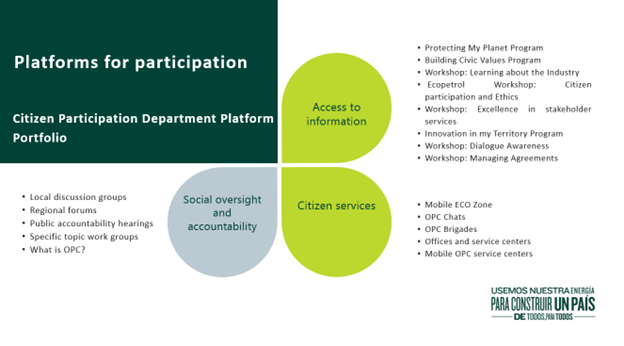
The platforms for participation are configured as key spaces to strengthen the Company's relationship with its stakeholders and to guarantee the Company's regional deployment and continuous operation. These opportunities contemplate a pedagogical and methodological development that seeks:
- To provoke reflection among stakeholders about their actions, feelings, and perceptions of the management and operation of the Company.
- To provide spaces for listening and dialogue, where groups can learn about different positions and develop discussions grounded in arguments, data and truthful information.
Based on this portfolio and considering the needs, particularities, and dynamics of each region, a strategic plan for participation opportunities is developed each year and must be aligned with Ecopetrol's relationship plan in the territories.
Figure 14
Some of the most relevant platforms included in the portfolio
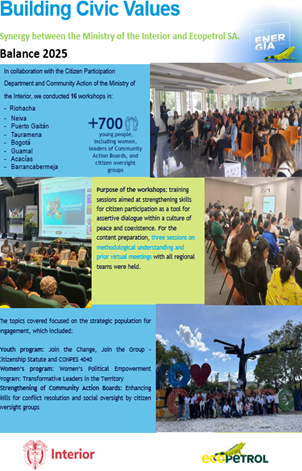
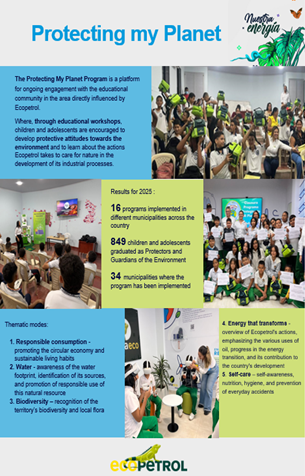
In 2025, within the framework of the portfolio of platforms for participation, 544 platforms for participation were created, involving 18,613 people, with the community as the primary focus. The programs developed in 2025 are detailed below, including their locations of execution and participants:
Table 10
2025 Platforms –Programs Developed from the Portfolio
| Department / Number of participants per program | OPC Brigades | OPC Chats | Building Civic Values | Workshop: Citizen participation and Ethics | Protecting my Planet | Mobile OPC service centers | Workshop: Learning about the Industry | Workshop: Excellence in stakeholder services | Total participants by Department |
|---|---|---|---|---|---|---|---|---|---|
| ANTIOQUIA | 1 | 5 | 6 | ||||||
| BOGOTÁ D.C. | 1 | 1 | 1 | 5 | 8 | ||||
| BOLIVAR | 5 | 2 | 1 | 2 | 1 | 11 | |||
| BOYACÁ | 1 | 1 | 2 | ||||||
| CASANARE | 2 | 3 | 3 | 2 | 9 | 19 | |||
| CUNDINAMARCA | 1 | 1 | |||||||
| HUILA | 1 | 1 | 2 | ||||||
| LA GUAJIRA | 4 | 2 | 2 | 2 | 1 | 107 | 118 | ||
| META | 1 | 1 | 1 | 69 | 72 | ||||
| NORTE DE SANTANDER | 55 | 36 | 4 | 5 | 53 | 2 | 5 | 49 | 209 |
| PUTUMAYO | 3 | 3 | |||||||
| SANTANDER | 6 | 1 | 2 | 12 | 2 | 23 | |||
| Total participants by program | 62 | 53 | 13 | 15 | 65 | 5 | 13 | 248 | 474 |
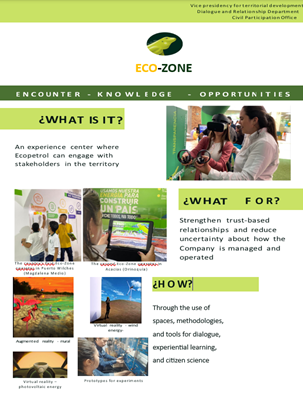
ECO-Zone: Ecopetrol's Experience Center for dialogue, knowledge, and transparency in action, serving citizens.
Background and context. In 2020, the strategic and operational model of the ECO Zone was designed and, to date, has been adopted as an initiative for dialogue, participation, and reconciliation. The model's ideation and appropriation were based on a basic diagnosis of the territory, mapping Ecopetrol's presence in the areas of influence, identifying its own and the sector's good practices, and analyzing civil participation processes. The model is aligned with national regulations, the Company's strategic needs, and stakeholder expectations.
The foregoing, within the framework of the "Integral Management Strategy for the Territory" and the constitutional principle of participation and transparency in access to information, serves as a mechanism for territorial transformation and for Ecopetrol's relationship with its stakeholders.
Scope and objective. The ECO-Zone (Encounter, Knowledge, and Opportunities) is an experience center for learning, dialogue, and access to information of public interest, featuring innovative and creative environments that enable, through pedagogy, citizens residing in the Company's areas of influence to improve their impact on the platforms for participation and, in turn, contribute to the strengthening of relations of trust between Ecopetrol and its stakeholders. This is done in accordance with the principles of quality, inclusion, and transparency in action.
We have developed content within experience routes that promote the social appropriation of knowledge on topics such as energy, energy transition and renewable energy, biodiversity, industry, science, and participation, among others of common interest, developed with a shared vision of the territory.
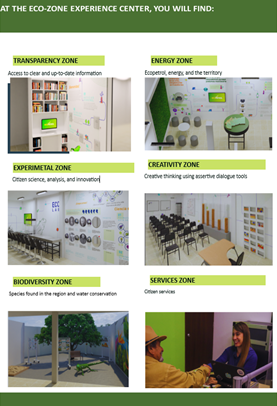
The experiences are arranged in a space designed for people with reduced mobility and include pedagogical tools (analog and digital) that motivate learning, creativity, participation, and the projection of ideas, such as virtual and augmented reality, models of the territory, soundscapes, social cartography, technological equipment, scientific elements, interactive screens, figures with texture and relief, large-scale games, as well as content with audio guides, methodologies for project formulation and ideation processes, among others, some designed for people with visual and hearing disabilities.
Figure 15
Eco-Zone
Balance sheet
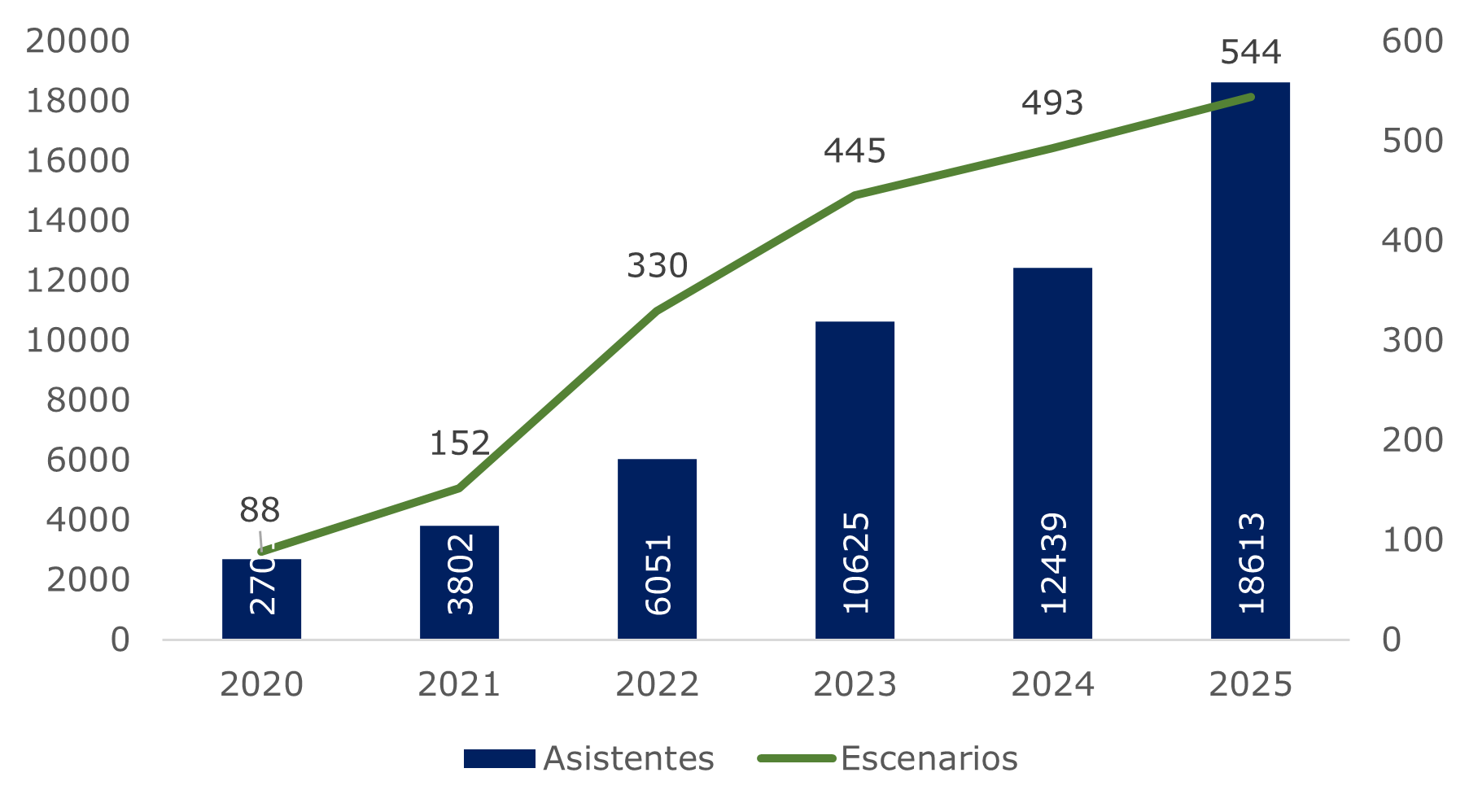
Over the past 6 years, 1,830 activities were carried out across all the regions where the Company operates, with the participation of 45,987 people, as illustrated in the following table:
Table 11
Regional Platforms for Participation (2020 – 2025)
| Regional OPC | 2020 | 2020 | 2021 | 2021 | 2022 | 2022 | 2023 | 2023 | 2024 | 2024 | 2025 | 2025 |
|---|---|---|---|---|---|---|---|---|---|---|---|---|
| Regional OPC | Attendees | Events | Attendees | Events | Attendees | Attendees | Events | Attendees | Events | Attendees | Attendees | Events |
| Pacific Caribbean | 266 | 7 | 485 | 14 | 353 | 15 | 661 | 26 | 437 | 14 | 2701 | 81 |
| Central | 1158 | 27 | 1351 | 73 | 1949 | 128 | 3104 | 103 | 1773 | 93 | 2512 | 87 |
| Eastern | 231 | 4 | 234 | 8 | 922 | 30 | 1761 | 65 | 1198 | 76 | 4196 | 76 |
| Orinoquía | 462 | 31 | 1182 | 25 | 919 | 78 | 101 | 76 | 1022 | 87 | 5144 | 140 |
| Piedemonte | 209 | 8 | 285 | 13 | 485 | 27 | 666 | 44 | 964 | 25 | 685 | 19 |
| South | 375 | 11 | 265 | 19 | 1423 | 52 | 1196 | 61 | 1028 | 46 | 3375 | 141 |
| Total | 2.701 | 88 | 3.802 | 152 | 6.051 | 330 | 7.489 | 375 | 6.422 | 341 | 18.613 | 544 |
Figure 16
Platforms for Participation (2020 – 2025)
Stakeholder Management Oversight
The Civil Participation Headquarters (JPC), committed to excellence and continuous improvement, permanently monitors its relationship with stakeholders to identify opportunities to improve processes. To this end, it uses the Requests, Complaints, Claims, and Suggestions (PQRS) received by the Company as its main source of information.
Under these guidelines, different types of reports are issued. The most representative are those shown in the following table:
Table 12
Types of Reports
| # | Type of Report | Level | Frequency |
|---|---|---|---|
| 1 | Monitoring by TOP topic | National | Monthly |
| 2 | Environment alarms | National | Weekly |
| 3 | PQR Trend Analysis (KRI) | National | Quarterly |
| 4 | PQR monitoring by regional | Regional | Bimonthly |
| 5 | PQR monitoring by process | National | Monthly |
| 6 | Stakeholder monitoring | National | Quarterly |
| 7 | PQR analysis by segment or project | Regional | According to instrument |
| 8 | Socio-environmental compliance of Environmental Management Plans (PMA) for all assets and projects | National and Regional | Monthly |
| 9 | PQR for Contract Evaluation | Regional | Monthly |
| 10 | PQRS for Audits | Regional | On demand |
| 11 | PQRS for disciplinary and ethical investigations | National | On demand |
These reports make it possible to identify environmental alerts, deviations in processes and expectations, and stakeholder disagreements, and, in general, situations that may affect the relationship in the territory.
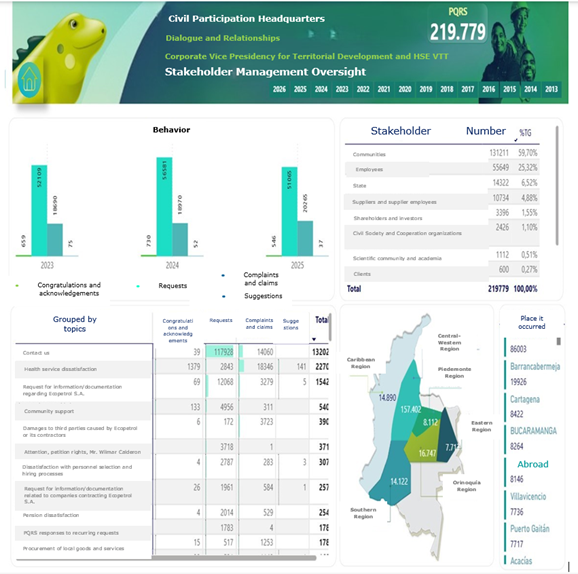
All information is obtained from the PQRS management tool (Salesforce) and processed and analyzed using Excel and Power BI. Visualizations are delivered through PowerPoint presentations, maps in ArcGIS, and real-time interactive dashboards in Power BI. The following is an example:
Figure 17
Stakeholder Management Oversight (2023 – 2025)
To ensure the necessary level of detail in managing improvements and addressing relationship situations, Ecopetrol has a classification structure composed of 1,002 sub-topics grouped into 134 topics.
Since 2015, the PQR Trend Analysis has been conducted to alert the Company to the behavior of issues that pose risks, with the goal of reducing dissatisfaction to zero by identifying root causes and implementing improvement or mitigation plans.
These measurements are based on a methodology that combines historical analysis with a forward-looking approach, using Recurrent Neural Networks (RNNs) to predict the monthly frequency of complaints by topic. The model captures patterns such as trends and seasonality, projecting next month's value from the last 24 months.
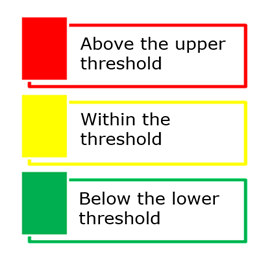
To determine the alert levels (low, moderate, high), upper and lower thresholds are established by calculating the moving average and standard deviation, which allows the current period's complaints to be compared with historical complaints for each grouping.
Alerts are reported by following the guidance below:
Figure 18
Guide to Reporting Alerts
By monitoring 17 grouped topics, the behavior of 80% of the complaints received by Ecopetrol is analyzed. This monitoring allows us to identify trends in increases or decreases in dissatisfaction, serving as the starting point for analyzing the causes of deviations.
This exercise has enabled the identification of opportunities for improvement in the Company's processes, products, and services, which are translated into action plans defined and executed by the areas responsible for the relationship, with the aim of addressing the causes of the identified problems.
In 2025, 12 improvement plans were defined, including 167 actions that address the most relevant issues for stakeholders: Community; State; Employees; Suppliers and Contractors, across all regions of the country.
Figure 19
Oversight
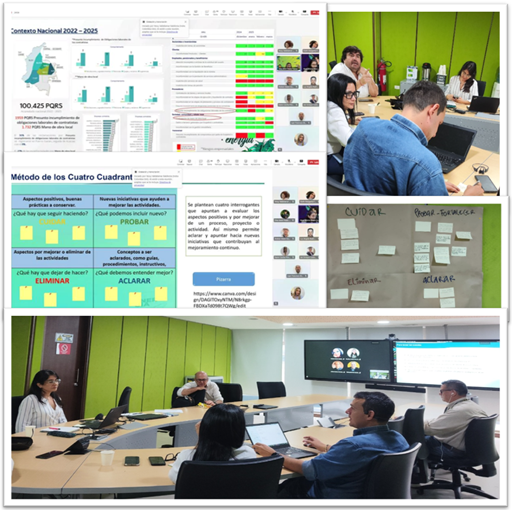
The entire process described is governed by the procedure for overseeing and improving stakeholder management.
Accountability
Ecopetrol is one of the leading companies in Colombia that practices constitutional accountability with its stakeholders, since, in addition to the traditional mechanisms required by law, it has numerous channels, specialized events, and written reports that reaffirm its commitment to transparency in information.
Any citizen who seeks to communicate with the Company from anywhere in the world, or to request information about its management, can do so in a fluid and permanent manner through mechanisms established to guarantee transparency and access to information. Among them are the following:
- General Shareholders' Meeting: The GSA is held annually, during which the results are reported in detail to the shareholders and decisions of that corporate body are made.
- Platforms for participation: events focused on specific topics and locations, methodologically guided by the portfolio of the Civil Participation Headquarters (JPC).
- Website Information: contains updated information on the Company's operations and results, as well as relevant information for each stakeholder.
- Integrated Management Report: this annual publication includes general information on the Company, its value chain and operational processes, financial results, stock behavior, risk management, and, in general, the Company's management across its economic, social, and environmental aspects.
- Requests for information: all citizens can access information from the Company by meeting certain requirements set out in the law governing the right to petition.
Environmental Claims
In 2025, 472 claims were addressed (including cases classified as complaints and claims) regarding alleged environmental impacts caused by Ecopetrol or its contractors in the course of their industrial and commercial activities. Details can be consulted through the Civil Participation Headquarters (JPC).
Table 13
Environmental Claims (2025)
| Topic | Number of cases |
|---|---|
| Affectations to bodies of water | 173 |
| Crops and vegetation | 113 |
| Substance and waste management | 78 |
| Damage to property | 35 |
| Noise | 34 |
| Odors | 25 |
| Air emissions | 14 |
| Total | 472 |
Regarding the validity of these claims, 52% of valid cases are reported, meaning they correspond to events for which the company should have taken mitigation actions:
Table 14
Validity of Environmental Claims (2024)
| Validity of the claim | Number of cases |
|---|---|
| Valid | 247 |
| Invalid | 144 |
| Notified | 46 |
| In process | 30 |
| Withdrawn | 5 |
| Total | 472 |
Employment Practices and Discrimination Complaints
In 2025, 26 complaints were filed regarding alleged harassment and working conditions. No cases of discrimination by Ecopetrol employees were reported during the year.
On the other hand, 54 complaints were received from contractor employees and were transferred by Ecopetrol to the respective companies, which are responsible for guaranteeing adequate working conditions for their employees. These claims relate to "labor practices" associated with working conditions and workplace harassment, as well as five cases of alleged discrimination.
The JPC's operational deployment model considers six care modalities through face-to-face and non-face-to-face channels, as follows:
| ECO Zone | An experience center where the Company can interact with its stakeholders based on a knowledge and participatory science model (Encounter - Knowledge – Opportunities (ECO for its acronym in Spanish)). Currently, there are ECO Zones in the municipalities of Puerto Wilches, Acacías, Neiva, and Riohacha. |
| Service Office | Physical spaces for face-to-face and permanent citizen services, where the management of the right of petition and access to information related to the Company's operations and management are facilitated. These can be found in the municipalities that are part of the regional presence. |
| Mail centers | The mail centers are located in the city of Bogotá, and operate in the Caxdac building Calle 35 No. 7-29 floor 1. |
| Mobile Point | Mobile citizen service points implemented outside Ecopetrol's facilities in different parts of a territory. (Biweekly) |
| Brigade | JPC citizen service days in specific places and groups, typically in conjunction with other areas of the Company. (By demand). |
| Non-face-to-face channels | Virtual, electronic or telephone service mechanisms that do not involve a physical space, nor meeting face-to-face. |
The following are non-presential communication channels available to the Citizen Participation Office - JPC (for its initials in Spanish):
Communication Channels
 |
Email. The following mailboxes are available: participacion.ciudadana@ecopetrol.com.co quejasysoluciones@ecopetrol.com.co |
 |
Website: Online form published on the corporate website to submit petitions, complaints, claims, suggestions or reports (www.ecopetrol.com.co > Home > Our Company > Citizen Information Services > Contact Us) |
 |
Corporate Call Center. National toll-free telephone line: 01 8000 918418 Telephone Line: (+057) 310 315 8600 |
| Schedule from Monday to Friday | ||
|---|---|---|
| City | Schedule | Address and telephone number of the Citizen Participation Offices |
| Bogotá | 7:30 a.m. to 4:30 p.m. | Kr 7 No. 37-69 Ed Teusacá Piso 1 Teléfono: (57+1) 2344444 |
| Cartagena | 7:30 a.m. to 4:00 p.m. | Kilómetro 10 Vía Mamonal Teléfono +57 310 315 8600. Ext. 50845 |
| Barrancabermeja | 6:00 a.m. to 10:30 a.m. and 12:00 m a 4:30 p.m. | Bloque tres Oficinas del 25 de Agosto de la Gerencia Complejo Barrancabermeja Teléfono: (57+7) 6208994- 6208484 Fax: (57+7) 6209734 |
| Puerto Wilches | Monday to Friday from 7:30 a.m. - 12 m. and 2 p.m. - 5 p.m. |
Dirección: Carrera 7a # 6 – 42 |
| Bucaramanga | 7:30 a.m. to 4:30 p.m. | Instituto Colombiano de Petróleo (ICP) Dirección Km 7 autopista a Piedecuesta Santander Teléfono (57+7) 684 7000 Ext. 47413 (Recepción) Fax: (57+7) 684 7444 |
| Neiva | 7:00 a.m. to 4:30 p.m. | Campo Dina km 17 vía Neiva - Bogotá Teléfono: (57+8) 8671111 Ext. 1114 Fax: (57+8) 8671196 |
| Orito | 7:00 a.m. to 12 m and 1:00 p.m. to 5:00 p.m. | Comisariato de Ecopetrol - Barrio Colombia Teléfono: (57+8) 4292933 Atención al público la última semana de cada mes |
Cúcuta |
8:30 a.m. -11:30 a.m. and 1:30p.m. a 4:00 p.m. | Calle 19 No. 1 - 44 Barrio Blanco |
|
Dosquebradas |
9:00 a.m. to 12:00 p.m. and2:00 p.m. to 4:30 p.m. |
Avenida del Ferrocarril No. 17-12 Edificio Ópalo |
| Villavicencio |
Monday, Tuesday, Wednesday and Friday from 8:00 am to 11:30 am and 1:30 to 4:00 pm. Thursday from 9:30 am to 11:30 am and 1:30 pm to 4:00 pm. |
Calle 15 # 40 - 01, Centro Comercial Primavera Urbana. Piso 1, Local 153. |
| Acacías | 8:00 am to 1:00 pm and 2:00 to 4:00 pm. | Calle 14 # 12 - 51, barrio Juan Mellao. |
| Guamal | 7:30 am to 1:00 pm and 1:30 to 4:00 pm. |
Carrera 7 # 16-19, barrio Los Fundadores Av. Las Palmas. |
| Castilla la Nueva |
8:00 am to 12:00 m and 1:00 to 4:00 pm. |
Avenida Nuevo Milenio Calle 9 No. 12-06 |
| Puerto Gaitán |
7:30 am to 12:00 m and 1:00 to 4:30 pm. |
Calle 14 # 9-87, local 1, hotel Las Iguanas. |
| Yopal |
8:00 am to 12:00 m and 1:00 to 4:00 pm. |
Carrera 21 con calle 37 esquina. |
- To communicate with any Ecopetrol office via email, please write to us at participacion.ciudadana@ecopetrol.com.co
- If you wish to make a judicial notification use the mailbox: notificacionesjudicialesecopetrol@ecopetrol.com.co
The portfolio of participation scenarios includes pedagogical and methodological actions promoted by the Citizen Participation Office - JPC, which aim to: 1. Generate trust and certainty among stakeholders regarding Ecopetrol's management and operations within the framework of corporate legal, regulatory, and strategic requirements, and 2. Promote among the stakeholders skills, habits, and competencies that enable assertive relationships with the company, and strengthen the social fabric through implementation of interactive, pedagogical tools.
The foregoing is aligned with the Comprehensive Territorial Management Strategy, which is intended to develop organizational capacities, promote genuine social dialogue, ensure transparency in access to information, and implement initiatives for dialogue, participation, and reconciliation. Regarding the latter point, the Management for dialogue and engagement has developed the approach called “CaPAZcidad”, which incorporated mechanisms to consolidate relationships of trust based on respect for life, building of joint visions of the territories, and search for comprehensive solutions to conflict factors.
Participation scenarios are designed as key spaces for improving the company's relationship with its stakeholders and thus ensuring the company's regional expansion and continued operation. These are:
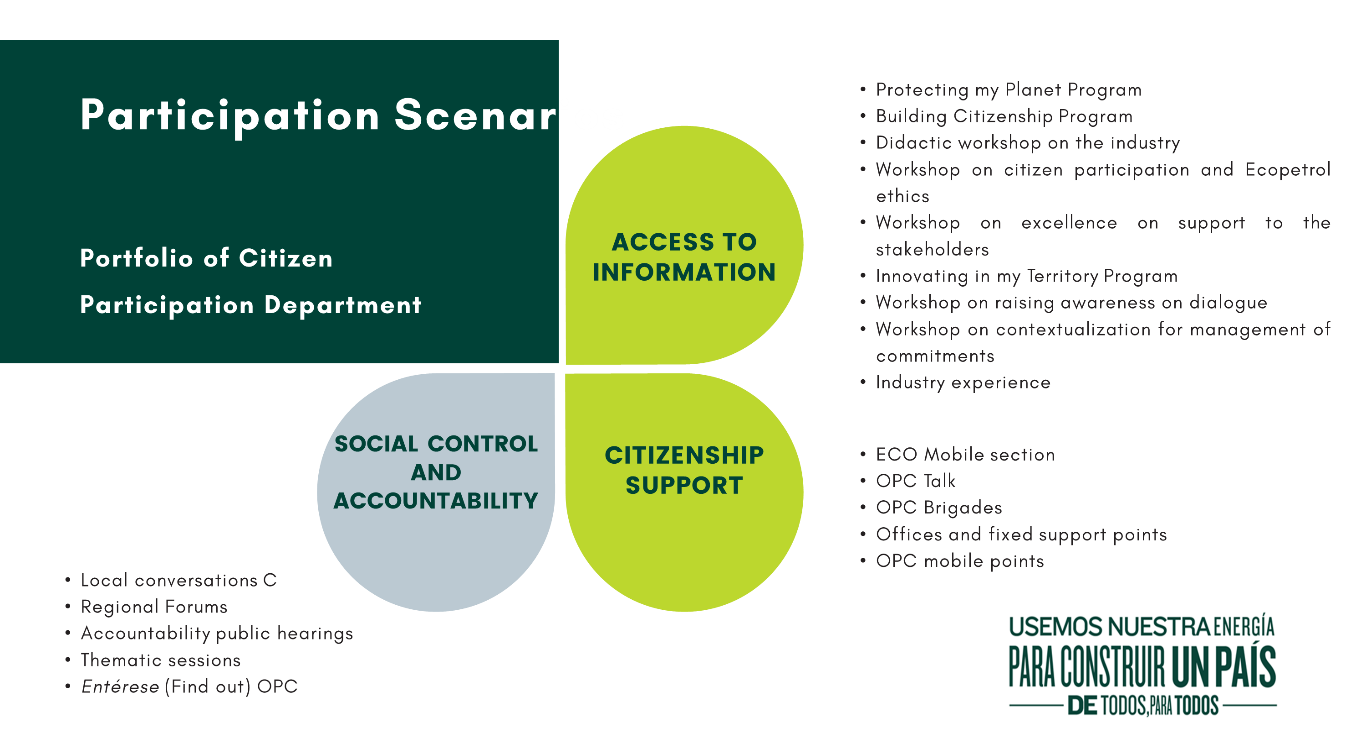
These are aimed at a pedagogical and methodological development seeking to provoke reflections among stakeholders regarding their actions, feelings and perceptions of the company's management and operation. They are also conceived as places where groups can listen to different positions to hold discussions based on arguments, data, and truthful information.
Based on the portfolio and, considering the needs, particularities, and dynamics of each region, every year a strategic plan of participation scenarios is built, in line with Ecopetrol's engagement plan in the territories.
Some of the most relevant scenarios of the portfolio are:
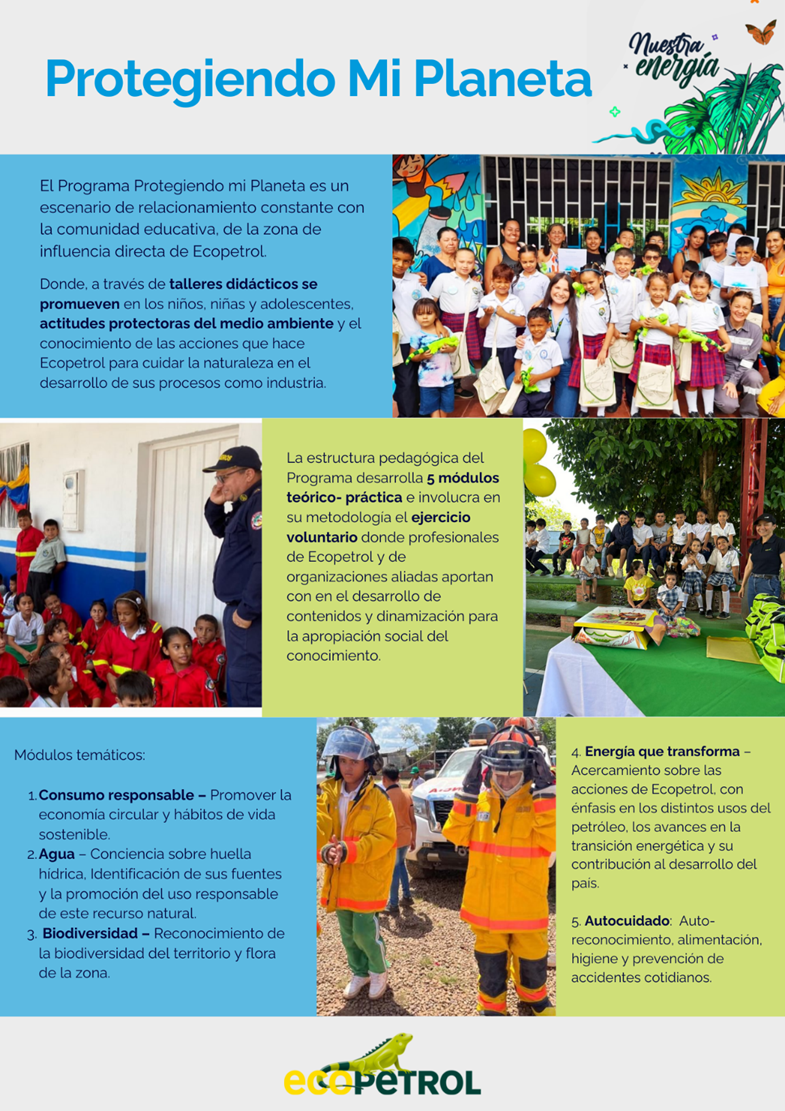
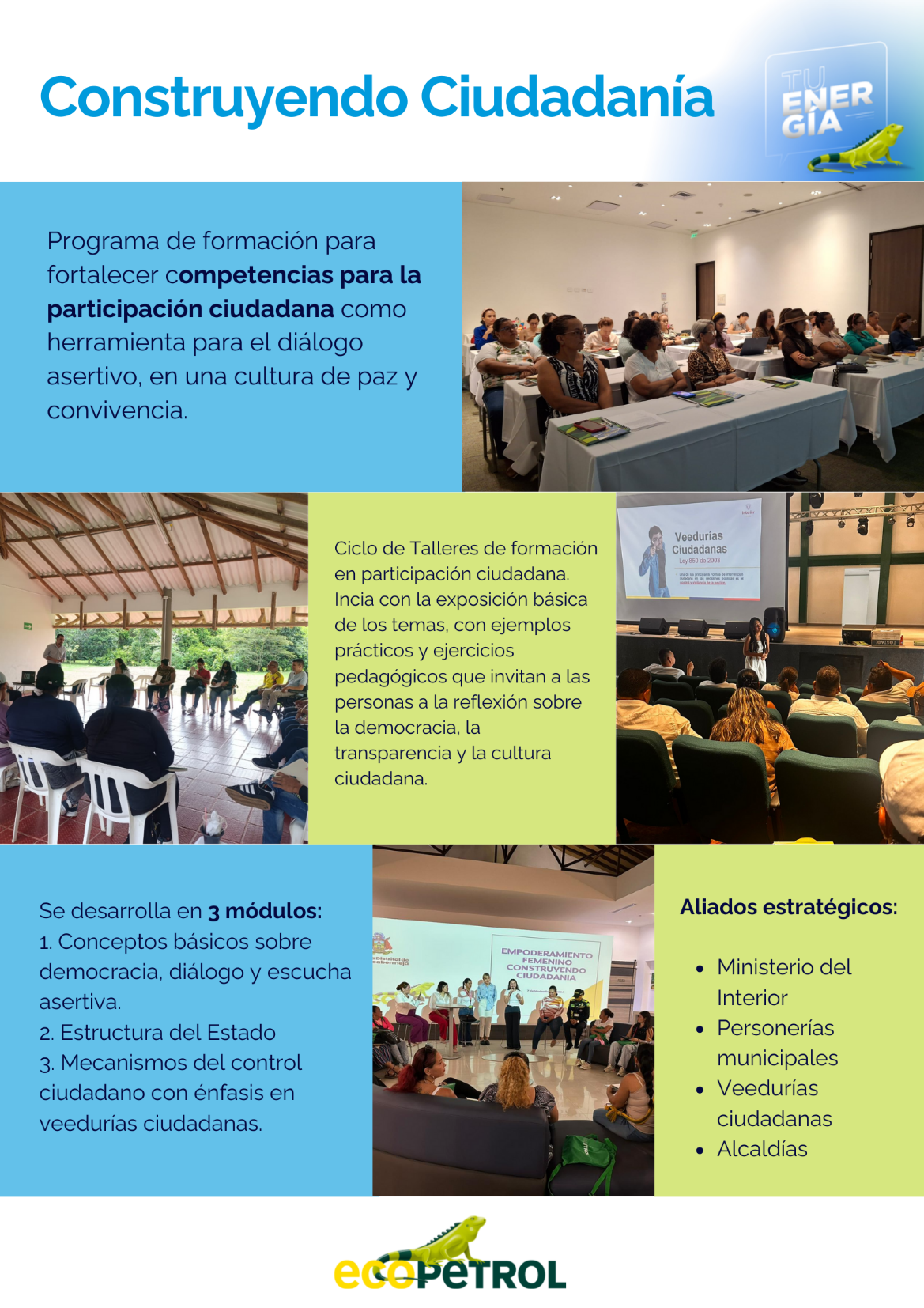
In 2024, within the framework of the participation scenarios portfolio programs, 341 participation spaces were held with 6,422 people, with the community being the main focus of these spaces. Detailed below are the programs conducted in 2024, showing the place of execution and the participants:
Table. 2024 Scenarios - Portfolio programs executed
|
Department / Number of participants by program |
OPC Brigades |
OPC Talks |
Building Citizenship |
Citizen participation and ethics at Ecopetrol |
Protecting my planet |
JPC mobile points |
Didactic workshops on the industry |
Workshop on excellence of attention to stakeholders |
Total participants by Department. |
|
ANTIOQUIA |
44 |
44 |
|||||||
|
BOGOTÁ D.C. |
11 |
11 |
|||||||
|
BOLÍVAR |
59 |
65 |
75 |
142 |
76 |
42 |
17 |
476 |
|
|
BOYACÁ |
20 |
18 |
42 |
80 |
|||||
|
CASANARE |
106 |
103 |
92 |
530 |
92 |
41 |
964 |
||
|
CUNDINAMARCA |
33 |
4 |
32 |
62 |
131 |
||||
|
HUILA |
17 |
10 |
22 |
51 |
100 |
||||
|
LA GUAJIRA |
96 |
33 |
274 |
46 |
19 |
468 |
|||
|
META |
854 |
371 |
89 |
143 |
655 |
36 |
72 |
2220 |
|
|
NORTE DE SANTANDER |
48 |
48 |
|||||||
|
PUTUMAYO |
49 |
412 |
25 |
35 |
39 |
560 |
|||
|
SANTANDER |
374 |
624 |
45 |
8 |
79 |
54 |
98 |
38 |
1320 |
|
Total participants by program |
1463 |
1388 |
388 |
8 |
1631 |
964 |
343 |
237 |
6.422 |
Source: Corporate Vicepresidency of Transformation of the Territory and HSE, Dialogue and Relationships Management
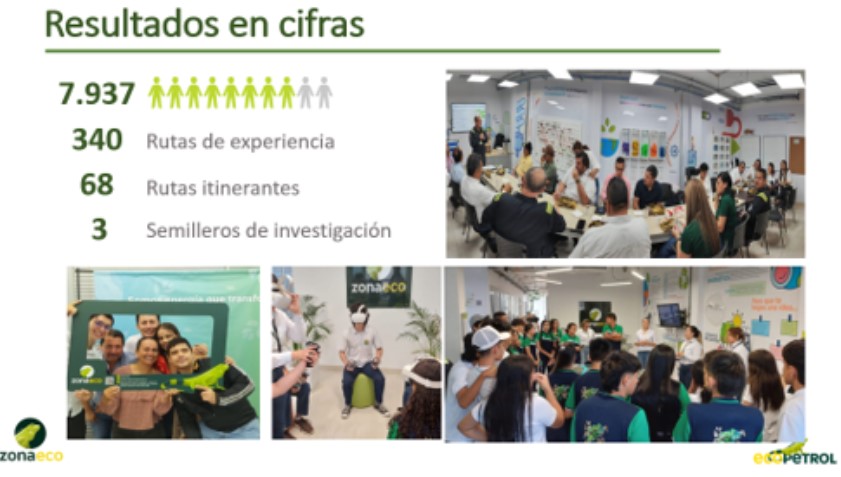
ECO Zone: Ecopetrol's Experience Center for dialogue, knowledge, and active transparency at the service of citizens.
Background and context. In 2020, the strategic and operational model for the ECO Zone was designed and, to date, adopted as an initiative for dialogue, participation, and reconciliation. The conception and adoption of the model were derived from a basic assessment of the territory, mapping Ecopetrol's presence in the areas of influence, identifying its own and industry-wide best practices, and analyzing citizen participation processes. The model is aligned with national regulations, the strategic needs of the company, and the expectations of the stakeholders.
The foregoing, within the framework of the "Comprehensive Territorial Management Strategy" and the constitutional principle of participation and transparency in access to information, as mechanisms for territorial transformation and Ecopetrol's relationship with its stakeholders.
Objectives and Scope. The ECO Zone (Knowledge, Experiences, and Opportunities) is a center of experience for learning, dialogue, and access to information of public interest. It provides innovative, creative environments so that, through pedagogy, citizens residing in the company's areas of influence can improve their impact in participatory spaces, thereby contributing to strengthening the relationships of trust between Ecopetrol and its stakeholders. All of this pursuant to principles of quality, inclusion and active participation.
We have developed content within experience routes that promote the social appropriation of knowledge on themes such as energy, energy transition and renewable energy, biodiversity, industry, science, participation, and other areas of common interest, developed with a shared vision of the territory.
The experiences, arranged in a space adapted for people with reduced mobility, feature pedagogical tools (analog and digital) that motivate learning, creativity, participation, and projection of ideas, such as virtual and augmented reality, territorial models, soundscapes, social cartography, technological equipment, scientific elements, interactive screens, figures with texture and relief, large-scale games- Further, their contents are sown through audio guides, methodologies for project formulation and ideation processes, among others, with some of them designed for people with visual and hearing disabilities.
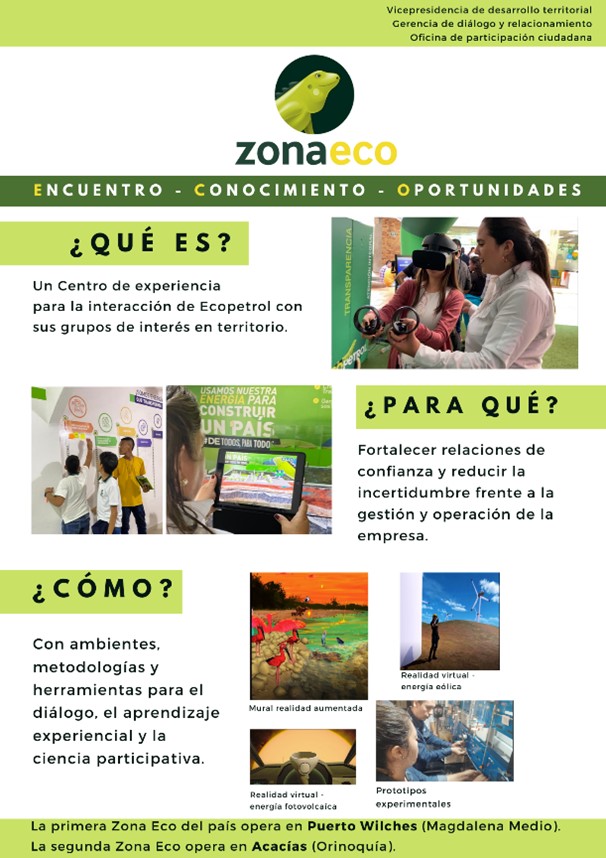
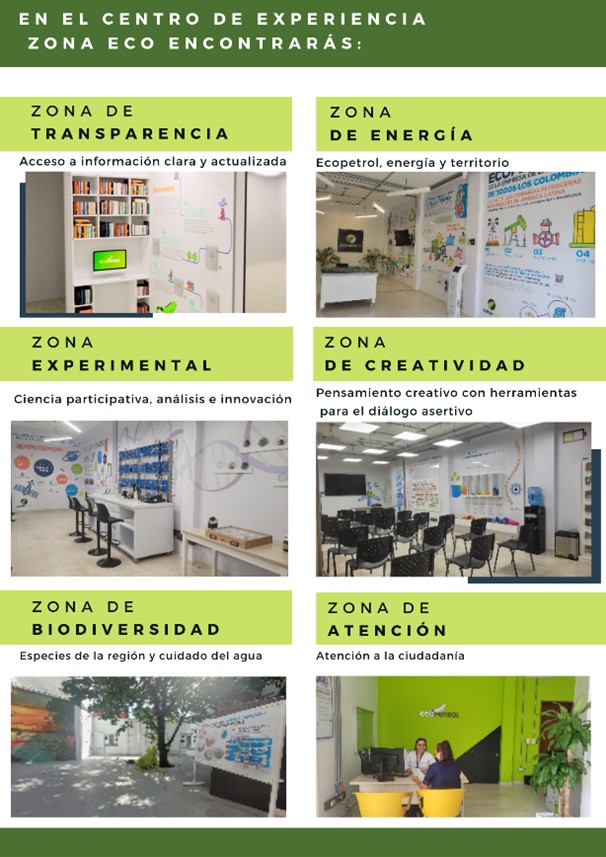
Balance
In the past 6 years, 1,617 activities have been conducted in all the Company's regional offices, with the participation of 35,878 people, as shown in the following table:
Table. Participation scenarios by region 2019 to 2024
|
OPC Regional |
2019 |
2020 |
2021 |
2022 |
2023 |
2024 |
||||||
|
Participants |
Events |
Participants |
Events |
Participants |
Events |
Participants |
Events |
Participants |
Events |
Participants |
Events |
|
|
Caribbean and Pacific |
1,374 |
22 |
266 |
7 |
485 |
14 |
353 |
15 |
661 |
26 |
437 |
14 |
|
Central |
1,592 |
106 |
1,158 |
27 |
1,351 |
73 |
1,949 |
128 |
3,104 |
103 |
1773 |
93 |
|
East |
788 |
21 |
231 |
4 |
234 |
8 |
922 |
30 |
1,761 |
65 |
1198 |
76 |
|
Orinoquía |
3,692 |
133 |
462 |
31 |
1,182 |
25 |
919 |
78 |
1,01 |
76 |
1022 |
87 |
|
Piedemonte |
447 |
22 |
209 |
8 |
285 |
13 |
485 |
27 |
666 |
44 |
964 |
25 |
|
South |
611 |
27 |
375 |
11 |
265 |
19 |
1,423 |
52 |
1,196 |
61 |
1028 |
46 |
|
Total |
8,504 |
331 |
2,701 |
88 |
3,802 |
152 |
6,051 |
330 |
8,398 |
375 |
6,422 |
341 |
Source: Corporate Vicepresidency of Transformation of the Territory and HSE, Dialogue and Relationships Management
Graph. Participation scenarios 2019 to 2024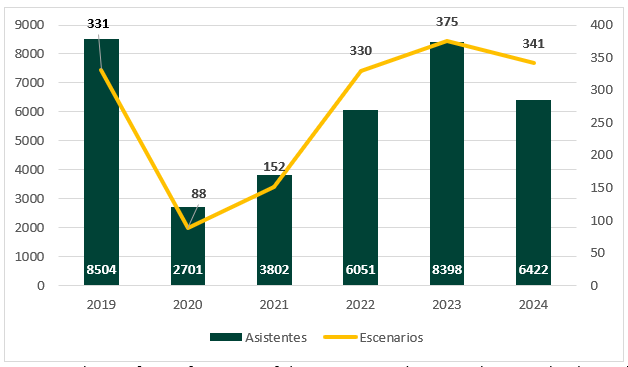
Source: Corporate Vicepresidency of Transformation of the Territory and HSE, Dialogue and Relationships Management

